Should I sell my RSUs for a house down payment?

Yes, and the tax cost depends on which lots you sell, not on how much you raise. In 2026 a married couple pays 15% federal on long-term gains until taxable income reaches $613,700, plus 3.8% NIIT above $250,000 of MAGI, while gains on shares held one year or less are taxed as ordinary income, up to 37%.
Summary
Who: Michael, 33, a senior software engineer at Google in Atlanta, four years in, married to Grace, 31, a physical therapist. First baby due in April, a house under contract in Decatur. An illustrative composite; names and figures are hypothetical.
The problem: $430,000 of Google stock across 46 monthly lots, a $225,000 down payment and closing bill to raise, and a brokerage account set to sell the oldest, lowest-basis lots first.
What Alphanso did: mapped every lot by basis and vest date, sold the newest, highest-basis lots by specific identification, timed the sale for the lower-income year, and set future vests to sell on the day they land.
The result: about $6,100 of federal tax on the sale instead of about $18,300, a down payment that cleared underwriting without touching the emergency fund, and a written rule for every vest after it.
What did Michael and Grace need the money for?
A house, a nursery, and a cushion, all inside six months. Michael joined Google's Atlanta office in 2022 as a software engineer and was promoted last year. He had done the sensible things: a maxed 401(k), $60,000 in an index fund, $45,000 in a savings account, and not one share of his GSUs sold, because every time he thought about it the next vest had already landed. Grace runs a physical therapy clinic's outpatient team. In October they went under contract on a $900,000 house in Decatur with a March closing, five weeks before the baby's due date.
The Google position was $430,000. Google stock units vest monthly, with no cliff, on a front-loaded schedule, so four years of employment plus a promotion grant had left him with 46 separate lots, each with its own vest date and its own cost basis equal to the share price on that day. The 2022 and 2023 lots had a basis near 53 cents on the dollar. The 2024 lots were near 73 cents. The 2025 lots were near 93 cents, and the 2026 lots were within a few percent of their current value either way. The couple's 2026 household income was about $460,000, nearly all wages and vests. They needed $180,000 for 20% down, about $25,000 for closing, and they wanted $20,000 of slack: $225,000, with the savings account left alone for the baby.
What does selling RSUs for a down payment actually cost in tax?
Only the gain since vest is taxed, and the rate depends on the lot. RSU shares are taxed as wages on the day they vest, and that vest-day value becomes the cost basis, so a sale only creates a capital gain or loss on the movement since then. A lot held more than one year is long-term; one year or less is short-term and taxed as ordinary income (IRS Topic 409). For a joint return in 2026, long-term gains are taxed at 15% up to $613,700 of taxable income and the 3.8% net investment income tax applies once MAGI passes $250,000 (Rev. Proc. 2025-32; IRC Section 1411). For Michael and Grace that meant 18.8% on long-term gain and, in their 32% bracket, 35.8% on short-term gain. Georgia taxes gains as ordinary income at its flat rate; every figure below is federal.

The same $1,000 of down payment costs about $89 of federal tax from the oldest lots and about $7 from the newest. That is the whole decision, and it is invisible if the account sells in the order it arrived. This is how Alphanso frames a sell-or-hold decision: not whether the stock is good, but what each lot costs to turn into cash, and when.
What was the gap?
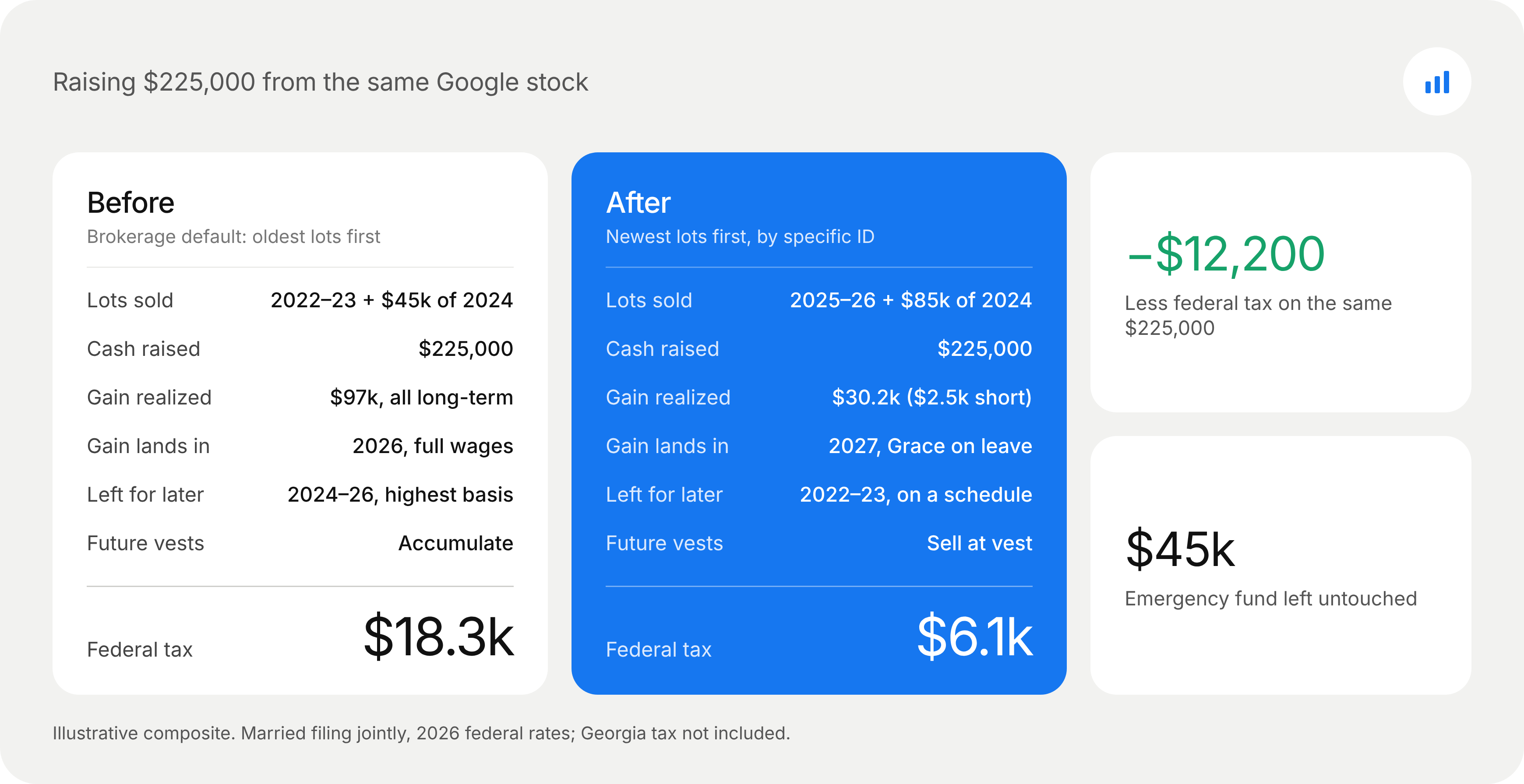
Nobody was choosing the lots, so the default was choosing them. Michael's brokerage account had never had its cost-basis method changed from first in, first out. His CPA, who files cleanly every April, would have seen the sale eleven months later as a line on a 1099-B. The mortgage broker wanted a number in the bank by a date. Each of them was right inside their lane. Left alone, the $225,000 would have come out of the 2022 and 2023 lots and a slice of 2024, realizing about $97,000 of long-term gain and about $18,300 of federal tax, paid on the lots with the biggest gains at the worst possible moment: a year with full wages, a new mortgage and a baby. The gap was not a bad advisor. It was that the lot ledger, the closing date and the bracket table had never been on one page.
What did Alphanso change?
We split the question into two: how much Google to hold after the house, and which lots to turn into the down payment. The first was Michael's call. He is bullish on the company he works for, and the plan does not argue with that; it sets a written rule for how much of the household's net worth can sit in one stock once the house is bought, and sells only what the rule requires. The second question is where the tax is.
- Change the cost-basis method to specific identification before any sale, so each trade names the lot it comes from. This is a setting, not a strategy, and it is the one most people never touch.
- Rank the 46 lots by gain per dollar, not by age. The order was 2026, then 2025, then 2024, with the 2022 and 2023 lots untouched.
- Sell $225,000 from the top of that list. All of the 2026 lots, all of the 2025 lots and $85,000 of the 2024 lots: about $27,700 of long-term gain and $2,500 of short-term gain, roughly $6,100 of federal tax. The chart shows the two paths.
- Time the sale for January, the lower-income year, since Grace's unpaid leave after the birth would pull 2027 household income down and the proceeds needed to sit in the account before underwriting anyway. With this little gain the year mattered less than the lots, but it cost nothing to get both right.
- Set every future vest to sell on the day it lands. A share sold at vest has a basis equal to its value, so there is no gain and no tax friction, and the concentration stops rebuilding while the couple is busy with a newborn.

Three of the 2026 lots were slightly under water, about $400 in total. They were sold anyway, because the cash was the point, but the loss was disallowed: a new vest lands every month, and the monthly-vesting wash sale trap means any loss sale within 30 days of a vest is a wash sale, with the loss added to the basis of the new shares instead of deducted. The plan never counted on harvesting a loss from a monthly-vesting stock, and it told the couple so up front rather than in April. Alphanso's AI agents track each lot's basis and holding period, and they sized the January estimated payment for the gain and the under-withheld vests so the sale did not become a surprise a year later.
Did the lender count his RSUs?
Partly, under a published rule, and the plan did not lean on it. Fannie Mae's Selling Guide (section B3-3.3-07, dated 10/07/2026) lets a lender count restricted stock and RSU income when the shares have vested and been distributed without restriction, with a 12-month history from the current employer for time-based awards; the qualifying income is the 200-day average share price times the pre-tax shares vested over the last 24 months, divided by 24, and a one-time time-based award must be expected to keep vesting for at least three years from the application date. Michael's vest history qualified, which raised the loan the couple could get. We sized the mortgage on the two salaries instead, so a weak year for the stock could not become a weak year for the house. The lender side of RSU wealth looks very different at a private company; at a public one the shares are the easy part, and the order of the sale is the part that costs money.
What did it save them?
- About $12,200 less federal tax on the same $225,000, from roughly $18,300 to roughly $6,100, by choosing lots instead of accepting the default
- The lowest-basis lots, about $85,000 of gain, kept for a year of the couple's choosing rather than spent in a full-wage year
- A down payment that cleared underwriting with the $45,000 emergency fund untouched, five weeks before the baby arrived
- No argument about the stock, because the plan sized how much of the household can rest on one company and left the rest to Michael
Why did this work?
The saving came from a lot ledger, a closing date and a bracket table read together before the first trade, not from a view on the stock. The brokerage, the CPA and the mortgage broker each had a correct piece; Alphanso's job was to put the pieces on one page, show the couple what each lot would cost, and then do the work: the basis election, the specific-ID orders, the estimated payment, the sell-at-vest instruction.
Alphanso Inc is a flat-fee fiduciary wealth advisory for employees with equity compensation (RSUs, ISOs, NSOs and ESPP); advisors are paid a flat annual fee, never a percentage of assets or commissions. The flat annual fee is the same whether a client sells every share or none, which is what makes it possible to lay out the lots and let the client decide. If a house or a baby is inside the next year and one company's stock is most of what you own, book a call and we will map your lots against your closing date.
FAQ
Do I pay capital gains tax if I sell RSUs right after they vest?
Almost none. The vest-day value was already taxed as wages and becomes the cost basis, so a sale on or near the vest date realizes only the price movement since then, often a few dollars. That is why selling at vest is the cheapest way to turn RSUs into cash, and why the newest lots usually cost the least to sell.
Which RSU lots should I sell first for a down payment?
In a high-income year, the lots with a cost basis closest to today's value, usually the most recent vests, realize the least gain per dollar of cash. The oldest, lowest-basis lots realize the most and are worth saving for a lower-income year. Choosing lots requires switching the brokerage account from first in, first out to specific identification before the trade.
Can I sell RSUs at a loss to offset the gains if my RSUs vest monthly?
Usually not. A loss sale within 30 days before or after buying the same stock is a wash sale, and a vest counts as a purchase, so with monthly vesting there is almost never a clear 61-day window. The disallowed loss is added to the basis of the new shares rather than lost, but it does not reduce this year's tax.
Should I sell RSUs in December or January for a down payment?
If the lots you sell carry little gain, the year barely matters and the closing date should decide. If the sale has to come from low-basis lots, splitting it across December and January spreads the gain over two tax years, and putting it in a lower-income year, such as one with unpaid parental leave, lowers the rate. Lenders also want the proceeds documented and in the account before underwriting, which argues for selling earlier rather than later.
Priyanshi Gupta is Head of Product at Alphanso; she was one of the first product managers at Datadog and led its APM team through the company's IPO.
This case study is a composite illustration based on real Alphanso client scenarios. Names and identifying details have been changed for privacy. Results are not guaranteed and will vary based on individual circumstances. All investing involves risk, including the possible loss of principal. Tax information is for educational purposes and does not constitute legal advice. Alphanso Inc is a registered investment adviser; registration does not imply a certain level of skill.
Sources: 2026 capital gains rate amounts and standard deduction: IRS Rev. Proc. 2025-32; 2026 tax brackets: IRS IR-2025-103; 3.8% net investment income tax: IRS, Net Investment Income Tax (reviewed Jul 1, 2026); Long-term vs short-term holding periods: IRS Topic 409, Capital Gains and Losses (reviewed Nov 9, 2026); Wash sales: IRS Publication 550; Lender treatment of RSU income: Fannie Mae Selling Guide B3-3.3-07, Restricted Stock Units and Restricted Stock (10/07/2026); Google monthly, front-loaded vesting: levels.fyi, Front-Loaded Vesting (Sep 9, 2025) and Understanding Google's Compensation (Sep 5, 2022).

Schedule demo with our advisors
What to expect