The Wash Sale Trap: Why Monthly RSU Vesting Quietly Disallows Your Tax Losses
.jpg)
If you're a senior engineer or manager at a large tech company, there's a good chance that 30% to 70% of your net worth is sitting in a single stock — your employer's. You know you should diversify. You've probably read a dozen posts about concentration risk.
So you open your brokerage account, find some shares that are underwater — trading below the price they were at when they vested — and sell them. You take the capital loss. You reduce your concentrated position. You plan to use that loss to offset gains elsewhere in your portfolio. Clean, responsible, textbook.
Except the IRS just disallowed your loss. And you might not find out until you file your return next spring.
The reason is the wash sale rule — and if your RSUs vest on a monthly schedule, it creates a trap that even financially savvy tech workers walk right into.

What the wash sale rule actually says
IRS wash sale rules (Section 1091) are straightforward in concept: if you sell a security at a loss and acquire a "substantially identical" security within a 61-day window — 30 days before and 30 days after the sale — the loss is disallowed for tax purposes.
The rule exists to prevent people from selling a stock just to book a tax loss and immediately buying it back. But it doesn't require intent. Any acquisition of substantially identical shares within that window triggers it — including shares you didn't choose to buy.
RSU vesting counts as an acquisition. When your employer delivers shares on a vest date, the IRS treats that as a purchase at fair market value. It doesn't matter that the timing was set by your grant agreement two years ago. It doesn't matter that you had no choice in the matter. A new lot of employer stock entered your account, and the wash sale clock is running.
Why monthly vesting creates a near-permanent wash sale zone
Here's where the math gets uncomfortable.
At most large tech companies — Google, Meta, Amazon (after Year 1), Salesforce, Nvidia, and many others — RSUs vest on a monthly or near-monthly cadence. That means a new batch of employer shares hits your account roughly every 30 days.
The wash sale window extends 30 days in both directions from your sale date. So if you sell employer shares at a loss on any given day:
- Any vest that occurred in the prior 30 days is a wash sale trigger (you already "bought" substantially identical shares).
- Any vest that occurs in the next 30 days is also a wash sale trigger (you're about to "buy" substantially identical shares).
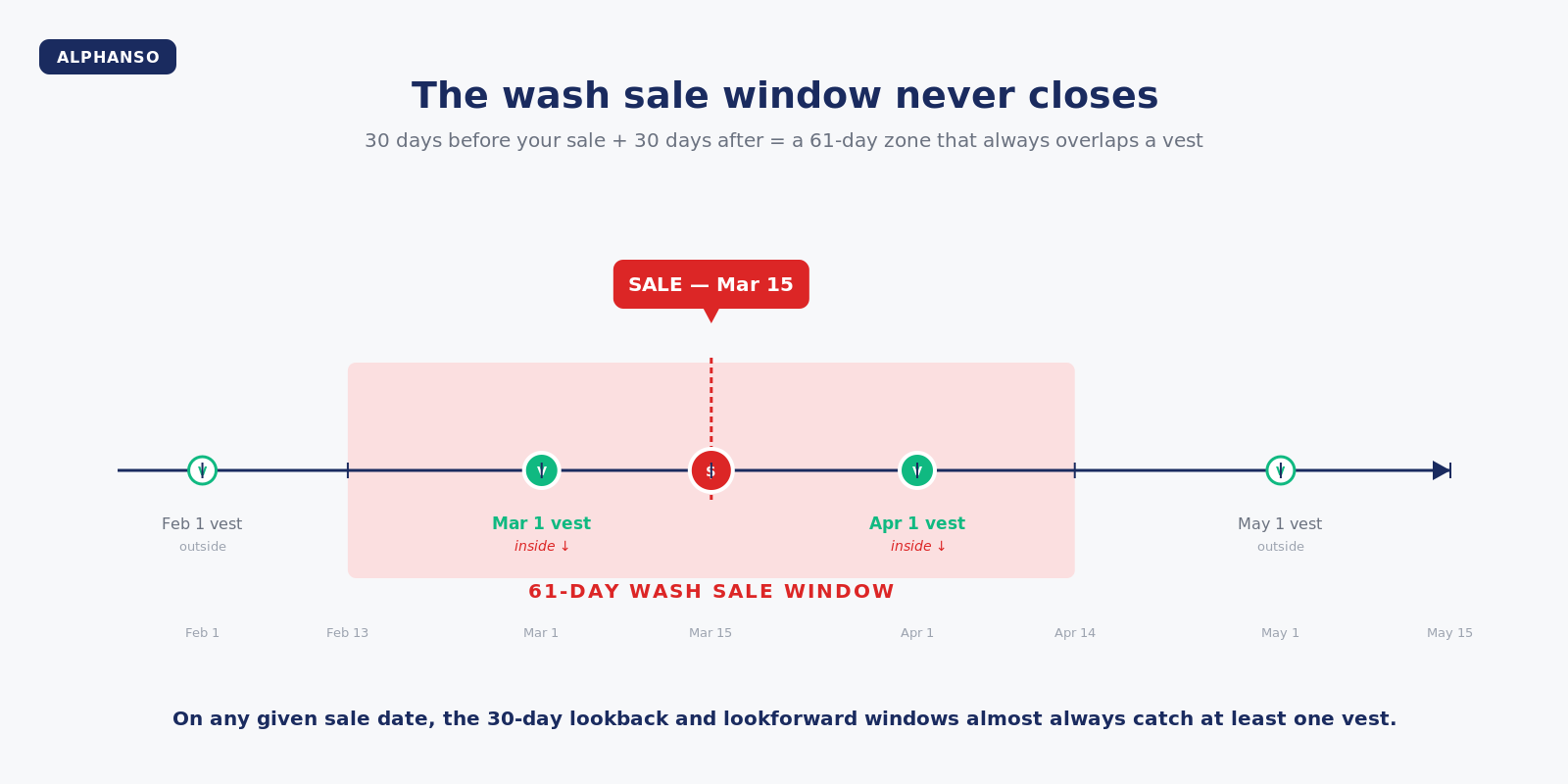
With monthly vesting, there is almost always a vest date within 30 days on one side or the other. In many cases, both.
Let's walk through a concrete example.
Scenario: A Google engineer with monthly vesting on the 1st of each month.
You hold 50 shares of $GOOG from a vest last year with a cost basis of $185/share. The stock is trading at $165. You want to sell those 50 shares, realize the $1,000 loss ($20/share × 50 shares), and use it to offset gains from selling some of your other positions.
You sell on March 15th.
Your March 1st vest delivered new Google shares 14 days ago. That's within the 30-day lookback window. Wash sale triggered.
Even if you had sold on March 3rd — just two days after the vest — the March 1st acquisition is within 30 days. Wash sale.
And if you sold on March 28th to get further from the March vest? Your April 1st vest is only 4 days away. Wash sale.
With vesting on the 1st of every month, there is literally no calendar day where a sale of employer stock at a loss avoids both the backward-looking and forward-looking wash sale windows.
What happens to the disallowed loss
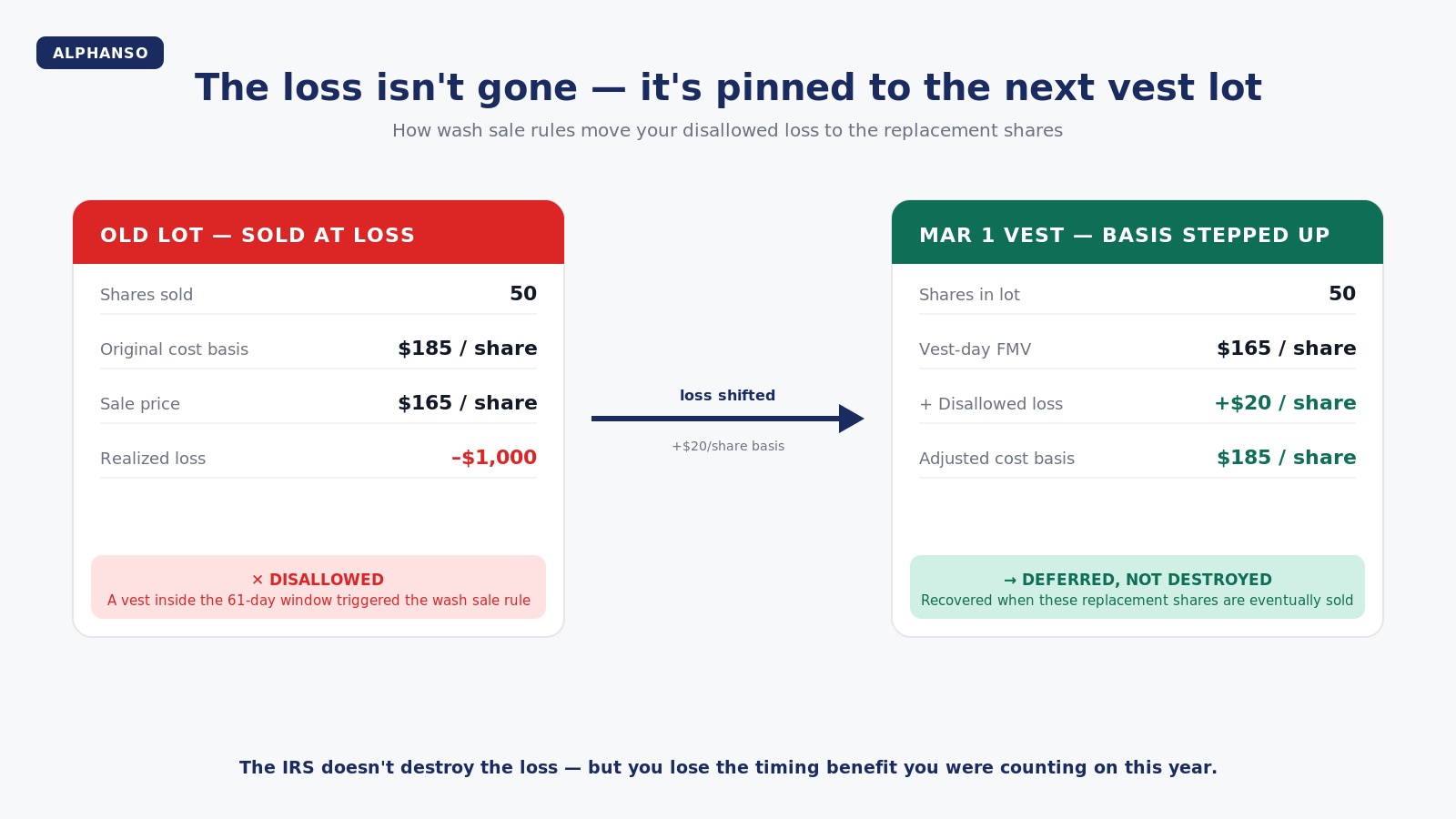
The loss isn't permanently destroyed — it's deferred. Under wash sale rules, the disallowed loss gets added to the cost basis of the "replacement" shares. In the RSU context, that means the newly vested shares absorb the loss.
Using the example above: your $1,000 loss from selling the old shares gets added to the cost basis of the shares that triggered the wash sale (the March 1st vest lot). When you eventually sell those replacement shares, your cost basis will be $20/share higher than it otherwise would have been.
So in theory, you get the benefit eventually — when you sell the replacement shares at a gain, you'll owe less because the basis is higher. But "eventually" can be a long time, especially if:
- You hold the replacement shares and they also decline, creating a chain of deferred wash sales.
- You leave the company and stop vesting, but by then you've accumulated a stack of adjusted-basis lots that are confusing to track.
- You were counting on the loss this tax year to offset a specific capital gain — a concentrated stock sale, an RSU gain, or investment income. The deferral means you lose the timing benefit entirely.
Tax lot selection: the hidden layer
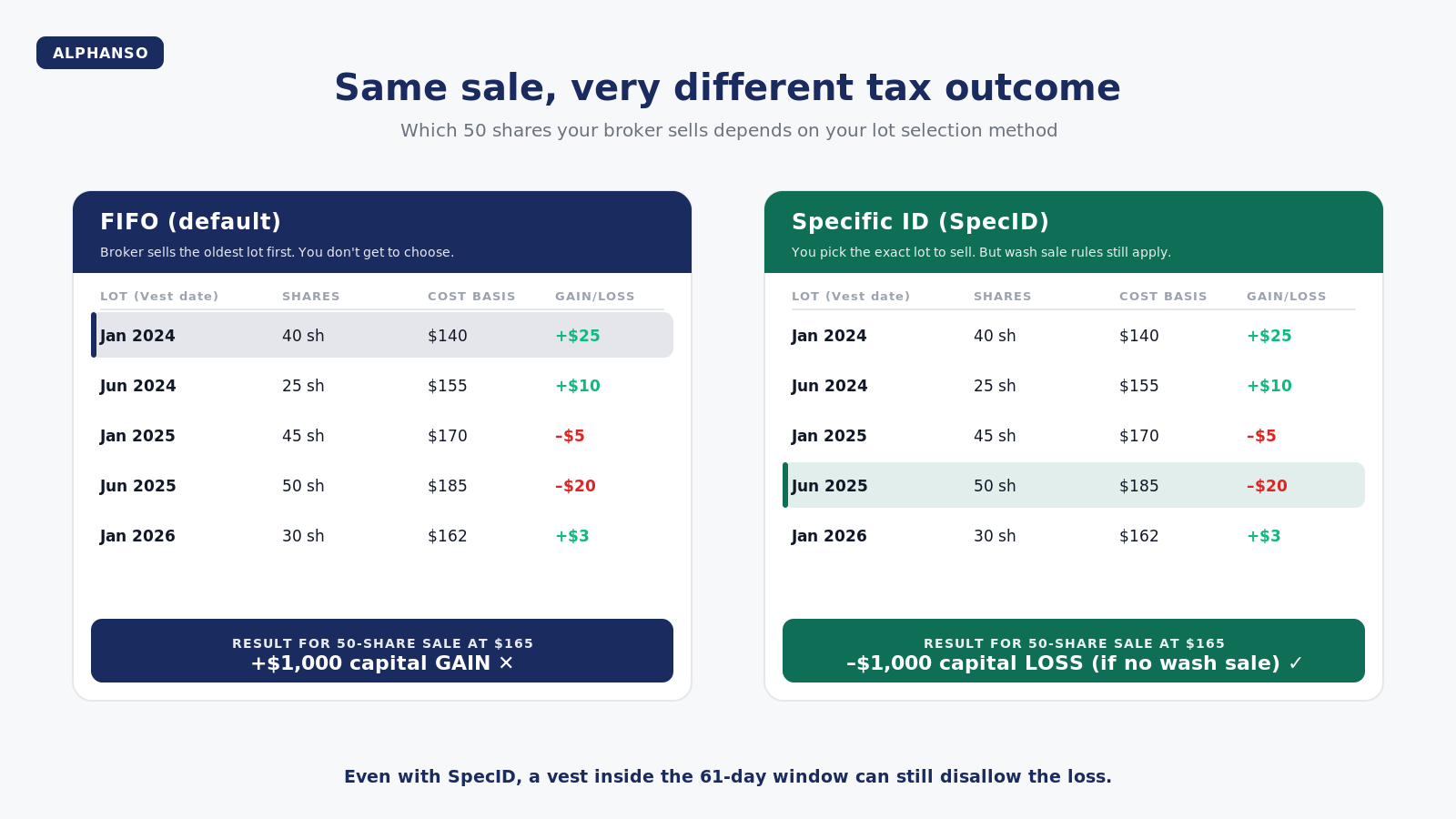
Most brokerages default to FIFO — first in, first out — when you sell shares. That means they sell your oldest lots first. Depending on your stock's price history, the oldest lots might be your highest-gain shares, not your loss shares.
If you're trying to harvest losses from specific lots, you need to switch to specific identification (SpecID) lot selection. This lets you choose exactly which shares to sell — which cost basis, which acquisition date, which gain or loss.
But even with SpecID, the wash sale rule still applies. You can pick the perfect loss lot, sell it, and still have the loss disallowed because a vest happened within the window.
The lot selection method matters for a different reason too: it determines the holding period. Shares held longer than one year qualify for long-term capital gains rates (0%, 15%, or 20% + 3.8% NIIT). Shares held less than one year are taxed as short-term gains at your ordinary income rate — which for most of Alphanso's clients is 35% to 37% federal, plus state.
Selling the wrong lot doesn't just affect the gain/loss calculation. It can change the tax rate on the entire transaction.
Why this isn't the same as tax-loss harvesting an index fund
Tax-loss harvesting in a diversified portfolio works because you can sell one fund and immediately buy a similar — but not substantially identical — replacement. Sell the Vanguard S&P 500 ETF (VOO) at a loss and buy the iShares S&P 500 ETF (IVV) the same day. The loss sticks because IVV is not "substantially identical" to VOO under current IRS guidance.
You can't do this with employer stock. There is no "similar but not identical" replacement for Google shares. Google is Google. Every vest delivers the same security you just sold. Every vest within the 61-day window is a wash sale trigger.
This is the fundamental difference that trips people up. The muscle memory from managing a diversified portfolio — "sell the loser, harvest the loss, swap into something similar" — does not work for concentrated employer stock positions with ongoing vesting.
So what can you actually do?
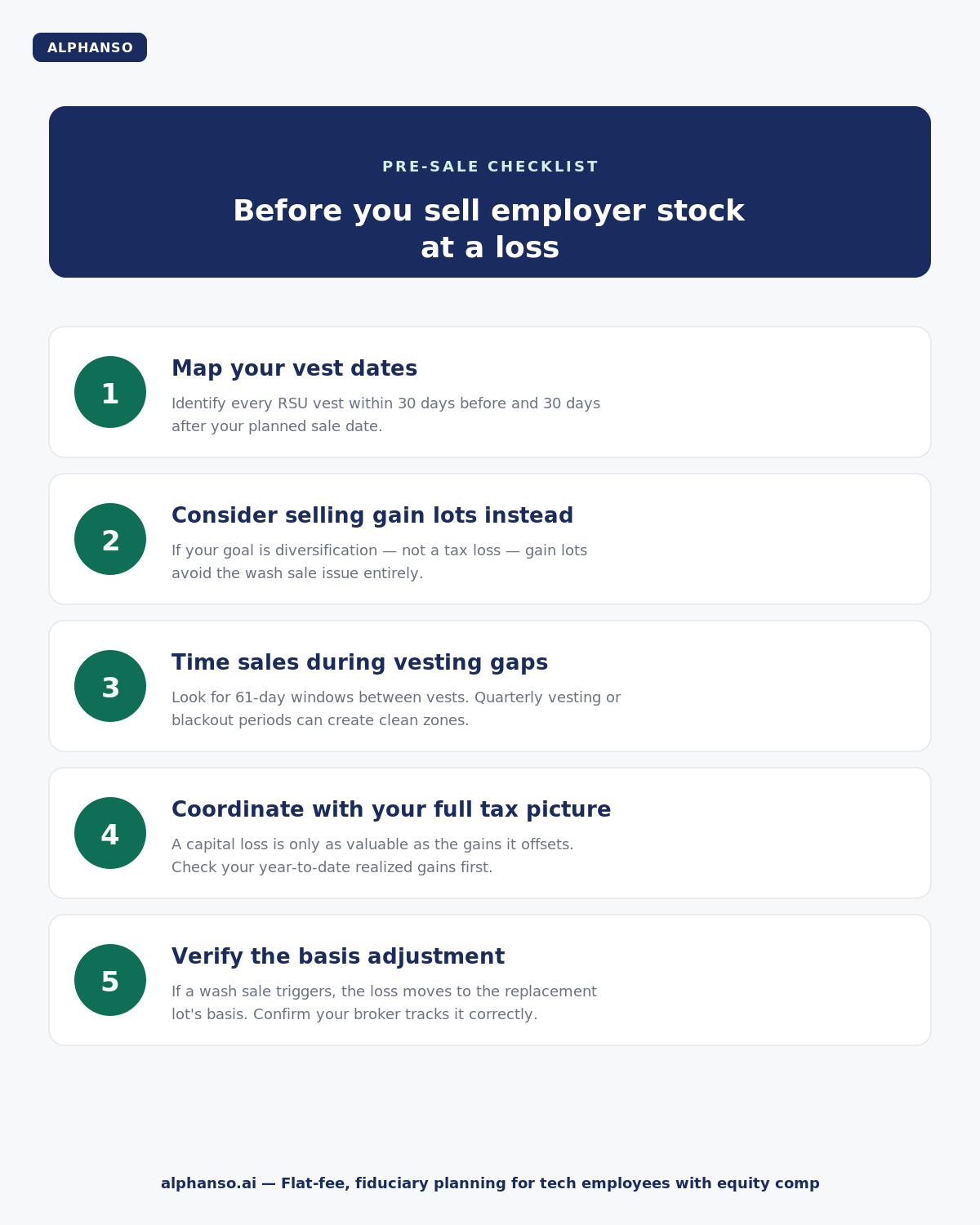
This isn't a dead end. It just requires planning around your vest schedule rather than ignoring it.
- Map your vest dates against your tax lot inventory. Before selling any employer stock at a loss, identify every vest date within 30 days before and after your planned sale date. If a vest falls in the window, the loss will be disallowed (and deferred to the new lot's basis).
- Consider selling gain lots instead. If your goal is to reduce concentration — not to harvest a loss — selling shares with gains avoids the wash sale issue entirely. You'll owe capital gains tax, but you'll achieve the diversification you were after. For long-term lots, the rate is 15% or 20% plus the 3.8% net investment income tax — meaningfully lower than ordinary income rates.
- Time sales during vesting gaps. Some companies have quarterly vesting instead of monthly. Others have specific blackout periods where no vesting occurs. If your schedule has a gap of more than 61 days between vests, that window is wash-sale-free for loss harvesting. These gaps are rare with monthly vesting but worth checking.
- Coordinate with your broader tax picture. The value of a capital loss depends on what you're offsetting. If you have large realized gains elsewhere — from selling investments, real estate, or other equity — the wash sale deferral hurts more. If your gains are modest, the deferral may be less consequential. Either way, you need to see the full picture before deciding.
- Understand the basis adjustment. If the loss is disallowed, it's not gone. Track the adjusted basis on the replacement shares carefully. Your brokerage should handle this automatically, but it's worth verifying — especially across multiple accounts or brokers. Some platforms handle wash sale basis adjustments inconsistently.
The bottom line
Monthly RSU vesting is designed to give you steady income throughout the year. But it also creates a rolling 61-day acquisition window that makes it nearly impossible to harvest capital losses on your employer stock without triggering a wash sale.
This doesn't mean you shouldn't sell. It means the decision to sell — which lots, at what price, and on which date — needs to account for your vesting schedule, your tax lot inventory, your gain/loss position across accounts, and your broader tax year plan.
The wash sale rule isn't obscure. But the way it interacts with monthly RSU vesting is something most tech workers never think about until it shows up on their return as a disallowed loss and a tax bill they didn't expect.
If you have concentrated employer stock and a monthly vesting schedule, we'd love to walk through your specific situation and map out the math before you sell. Schedule a call with Alphanso →
This article is for educational purposes only and does not constitute personalized tax or investment advice. Tax rules are subject to change and individual circumstances vary. Consult a qualified tax professional for advice specific to your situation. Alphanso AI Wealth Advisors, LLC is a registered investment adviser.

Plan with an expert
What to expect


.png)
.jpg)
.png)
.png)