Should I exercise my vested ISOs in the 90-day window after I leave?

After you leave, an incentive stock option keeps its tax status only if you exercise it within 3 months of your last day (IRC Section 422), and most startup plans cut that to 90 days. Exercising adds nothing to regular taxable income, but the spread counts for the alternative minimum tax, where the 2026 exemption is $140,200 for joint filers.
Summary
Who: Tomás, 38, a staff engineer at a late-stage private company in Miami, married to Lucía, a physical therapist, leaving for a public-company role with 40,000 vested ISOs at a $2.00 strike against a $14.00 409A value. An illustrative composite; names and figures are hypothetical.
The problem: his plan gave him 90 days to exercise or forfeit, the spread was $480,000 of AMT income, and nobody had told him the AMT bill on an all-at-once exercise would be about $125,000 on top of the $80,000 strike.
What Alphanso did: modeled the AMT under every exercise count, found that his notice date let the 90-day window straddle December 31, split the exercise across two tax years, ran the safe-harbor check on the resulting bill, and set up the minimum tax credit to recover it.
The result: cash due by April 2027 of about $138,000 instead of about $205,000, total AMT across the two years about $7,600 lower, and roughly $117,000 of AMT recorded as a credit to claim against future regular tax.
What did Tomás hold when he gave notice?
Most of his net worth was an option grant he could not sell, and a departure date turned it into a decision with a deadline. Tomás had spent five years at the company, the last two as a staff engineer, and he was leaving for a public company that offered RSUs and a $260,000 base. He had done the sensible things: a maxed 401(k), a 529 for their daughter, an emergency fund, and a CPA in Coral Gables who files on time. What he did not have was anyone who had modeled what leaving would do to his options. I went through Datadog's IPO as one of its first PMs, and the question of what to do with options you believe in but cannot yet sell is one I have lived with.
Tomás held 40,000 vested ISOs with a $2.00 strike. The company's latest 409A valuation put the common stock at $14.00, so the spread was $12.00 a share, or $480,000 across the grant. He and Lucía earned about $300,000 together and would file jointly for 2026, and Florida has no state income tax.
What happens to ISOs 90 days after you leave?
Under IRC Section 422(a)(2), an option is an incentive stock option only if the holder was an employee at all times from the grant date until 3 months before the exercise date. Exercise later than that and the option is no longer an ISO for tax purposes, whatever the plan calls it. Most startup plans go further and simply cancel vested options that are not exercised within 90 days of termination; a minority let the options live longer, in which case they are generally treated as nonqualified stock options (NSOs) once the 3 months pass. The plan document and the grant notice decide which case applies, and both are worth reading before the last day.
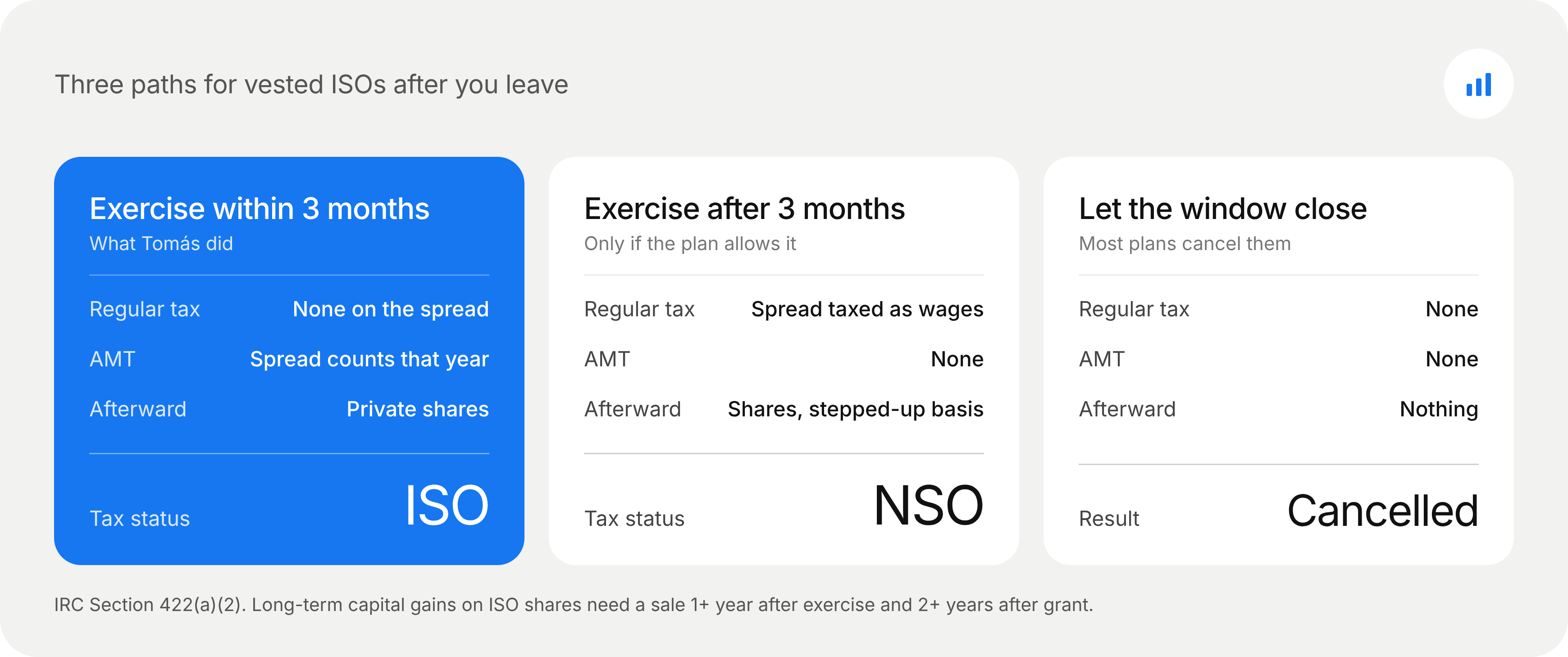
For ISOs the IRS treats the spread at exercise as an adjustment on Form 6251, taxed at 26% on the first $244,500 of the AMT base in 2026 and 28% above that, after the $140,200 joint exemption (Rev. Proc. 2025-32). Alphanso's guide to pre-IPO options explains the AMT crossover point, the number of options you can exercise in a year before AMT exceeds regular tax; for a $300,000 household that crossover is only about $30,000 of spread, so a $480,000 exercise was always going to be mostly AMT.
How much AMT would exercising all 40,000 ISOs cost?
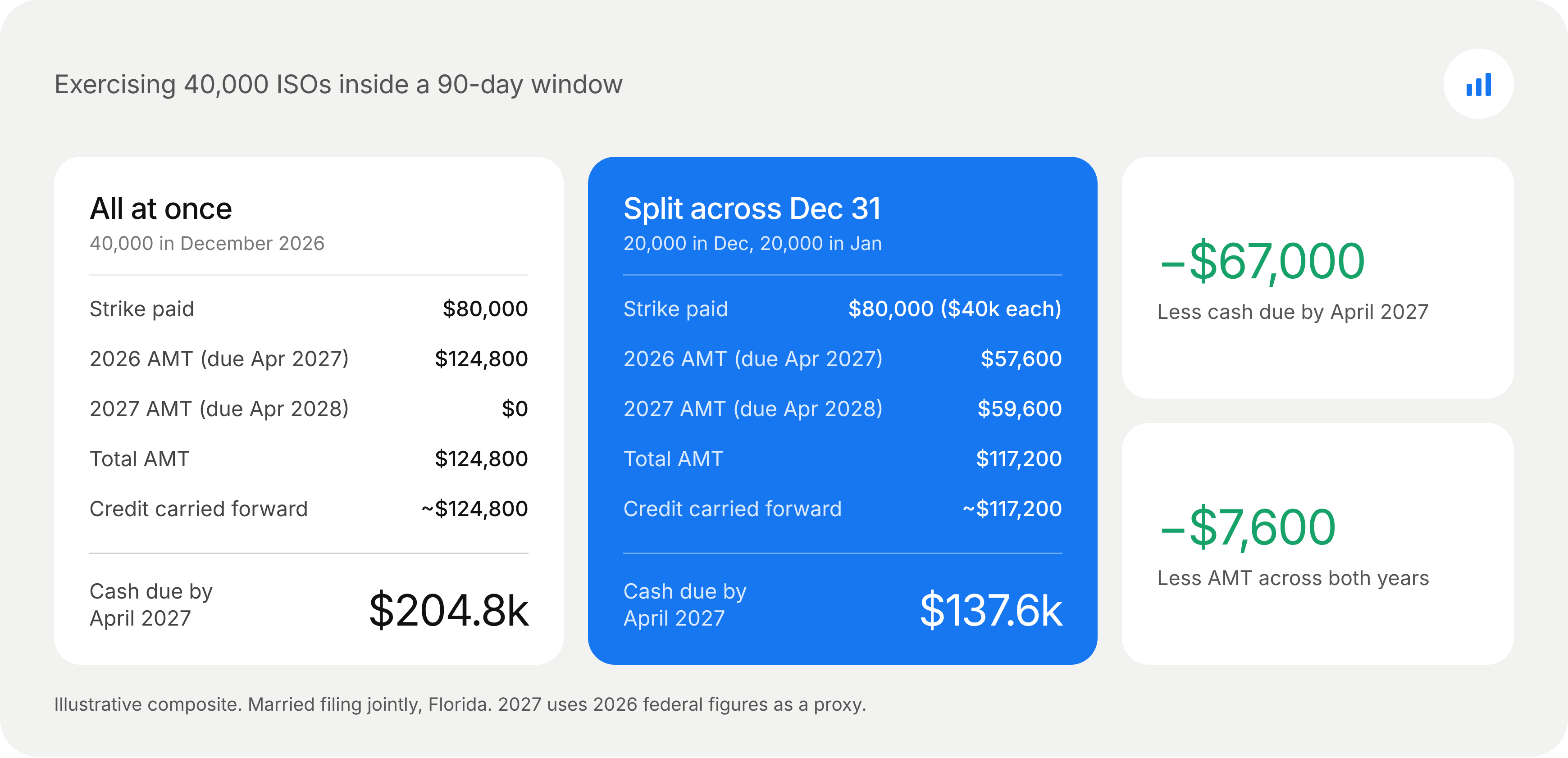
About $125,000, on top of the $80,000 strike price, with all of it due by April 2027. Here is the math his CPA had not been asked to run. On $300,000 of joint income and the $32,200 standard deduction, the household's 2026 regular tax is about $49,500. Exercising all 40,000 ISOs in December adds $480,000 to alternative minimum taxable income, which lands at $780,000 (the standard deduction is added back for AMT). After the $140,200 exemption, the AMT base is $639,800: 26% on the first $244,500 is $63,570, and 28% on the remaining $395,300 is $110,684, for a tentative minimum tax of $174,254. The AMT owed is the excess over regular tax, about $124,800.
Add the $80,000 strike and the household needed about $205,000 of cash for shares it could not sell, within five months of a job change. Nobody had done a bad job. His CPA sees the return after the year ends; his option portal shows the window and nothing about tax; his new employer's benefits team has never heard of the old grant. Nobody was looking at the calendar, the AMT and the bank balance on one page.
What did Alphanso change?
The first change was the calendar. Tomás gave notice on November 20, so a 90-day plan window ran to February 18, 2027, and the statutory 3-month limit ran to February 20; the earlier date governs. That window straddled December 31, which meant the exercise did not have to happen in one tax year. Splitting it is the same staged exercise idea a pre-IPO employee uses over several years, compressed into the one straddle the departure date allowed.
Tomás chose to exercise all 40,000 options; whether to exercise, and how many, was his call, and we made the cost of each count visible rather than picking for him. What we designed was the sequence: 20,000 in December 2026 and 20,000 in January 2027. The December exercise added $240,000 to 2026 AMT income, for AMT of about $57,600. The January exercise landed in 2027, a year with his higher public-company salary, and using 2026 figures as a proxy produced AMT of about $59,600, due in April 2028. Two years, two 26% bands, two chances for regular tax to absorb part of the AMT.
Then the execution. AMT is part of the tax the estimated-payment rules look at, so a December exercise can create an underpayment penalty for 2026 even though the return is not due until April; the penalty switches off if withholding and estimates reach the 110% safe harbor for a household with prior-year AGI above $150,000. Alphanso's AI agents read both payroll feeds, found his 2026 withholding short of 110% of 2025 tax, and sized a January 15 estimate to close it. The same check was scheduled for 2027 against the new employer's withholding.
Most of the AMT paid on an ISO exercise is a prepayment rather than a permanent cost: it becomes a minimum tax credit, claimed on Form 8801 in later years to the extent regular tax exceeds tentative minimum tax. We opened a tracking schedule for the roughly $117,000 of credit, so the carryforward follows him across future returns and future CPAs. We also recorded the holding clocks on each exercised lot, because a sale within 1 year of exercise, including into a company tender, would be a disqualifying disposition and would reverse the AMT treatment. And we rebuilt the cash plan so the strike and the April 2027 bill came from the emergency fund and the new company's sign-on bonus, not from a loan against private shares.
What did it save him?
- About $67,000 less cash due by April 2027, from roughly $205,000 to roughly $138,000, by moving half the exercise across December 31 inside the same 90-day window
- About $7,600 less AMT in total, because two tax years each contribute a 26% band and their own regular-tax headroom
- Roughly $117,000 of minimum tax credit on a tracked schedule, with a plan to claim it on Form 8801 as his regular tax rises at the new company
- No underpayment penalty on either year's AMT, because the safe harbor was checked before the exercise rather than after the return
Why did this work?
The win was not a clever strategy. It was a departure date, a plan document and an AMT worksheet read together by one team before the window started. The CPA, the option portal and the new employer each had a correct piece. Alphanso's job was to put the pieces on one page, show Tomás what each exercise count would cost in cash and in AMT, and then do the work: the estimate, the credit schedule, the holding-period record.
Alphanso Inc is a flat-fee fiduciary wealth advisory for employees with equity compensation (RSUs, ISOs, NSOs and ESPP); advisors are paid a flat annual fee, never a percentage of assets or commissions. The flat annual fee is the same whether a client exercises every option or none, which is what makes it possible to lay out the trade-offs and let the client decide. If you are inside a 90-day window, or expect to be, book a call and we will run the AMT math on your actual grant and dates, and explain how the 2026 AMT changes work for your household.
FAQ
Do I have to pay AMT when I exercise ISOs after leaving a company?
Not always, but usually on a large exercise. The spread between the strike and the fair market value at exercise is added to alternative minimum taxable income, and AMT is owed only when the resulting tentative minimum tax exceeds your regular tax. For 2026 the joint exemption is $140,200 ($90,100 unmarried), so a small exercise can fit under the crossover, while a six-figure spread generally cannot.
What happens if I miss the 90-day exercise window after leaving?
Under most startup plans the vested options are cancelled and you receive nothing for them. Where the plan allows a longer post-termination period, options exercised more than 3 months after leaving lose ISO status under IRC Section 422 and are taxed like nonqualified options, with the spread treated as ordinary income at exercise. The plan document and your grant agreement control, so read both before your last day.
Can I get the AMT back after exercising ISOs?
Often, over time. AMT paid because of an ISO exercise generates a minimum tax credit, claimed on Form 8801, that reduces regular tax in later years when regular tax exceeds tentative minimum tax. If the shares are later sold in a disqualifying disposition, the AMT treatment reverses in the year of sale. How quickly the credit comes back depends on your income in those later years, which is why it needs a tracked schedule.
Can I split my ISO exercise across two tax years inside a 90-day window?
Yes, if the window straddles December 31. A departure in roughly October through December gives a 90-day window that runs into the next calendar year, so part of the exercise can fall in each tax year, with each year's AMT exemption, 26% band and regular-tax headroom applying separately. A departure earlier in the year does not create the straddle, and the exercise then lands in a single year.
Priyanshi Gupta is Head of Product at Alphanso; she was one of the first product managers at Datadog and led its APM team through the company's IPO.
This case study is a composite illustration based on real Alphanso client scenarios. Names and identifying details have been changed for privacy. Results are not guaranteed and will vary based on individual circumstances. All investing involves risk, including the possible loss of principal. Tax services are for educational purposes and do not constitute legal advice. Alphanso Inc is a registered investment adviser; registration does not imply a certain level of skill.
Sources: ISO 3-month rule and $100,000 limit: IRC Section 422, Cornell LII; 2026 AMT exemption, phase-out, 28% breakpoint, brackets and standard deduction: IRS, Rev. Proc. 2025-32; ISO tax at exercise and holding periods: IRS Topic 427, reviewed Sep 24, 2026; Minimum tax credit: IRS, About Form 8801, reviewed Mar 31, 2026; AMT rates: IRS, Instructions for Form 6251; Supplemental withholding: IRS Publication 15 (2026); ISO exercise statement: IRS, About Form 3921.

Schedule demo with our advisors
What to expect