An Nvidia engineer cut his 2026 tax bill by $144,000.

The Situation
Mateo is 39, a staff engineer at Nvidia in Santa Clara, and 2026 was the biggest income year of his life. A large tranche of RSUs vested in the spring, the stock cooperated, and by midyear his projected federal tax bill for the year had crossed $210,000. His wife, Elena, had stepped back from her consulting work when their second child arrived, so the household ran on his income and his equity.
He was doing most things right. He maxed his 401(k), sold RSUs at vest so he was not sitting on an oversized Nvidia position, and had a good CPA who filed clean returns every April. He had even built up a comfortable cash cushion after the vest, which was sitting in a high-yield savings account while he figured out what to do with it.
The Gap We Found
Nothing was wrong with Mateo's setup. The gap was timing. His CPA sees Mateo's year in February, when the only thing left to do is report it accurately. His brokerage sees his shares, not his tax bill. Nobody was looking at a $210,000 federal liability in September, when there was still time to change it. Alphanso's agents had been tracking his payroll and vest data all year, so the projected liability was already on his advisor's screen, along with the cash he had set aside and the fact that a joint return gave the household more flexibility than Mateo realized.

What We Did
Mateo's advisor walked him through a strategy that very few W-2 employees know exists: owning a small, US-built commercial solar facility outright, and claiming the federal clean energy credit and first-year depreciation that come with it. With $100,000 of his cash cushion, he bought a facility worth roughly $200,000. The facility is leased to an operator whose rent covers the loan, so the asset pays for its own financing and sends a modest distribution back to Mateo each year.
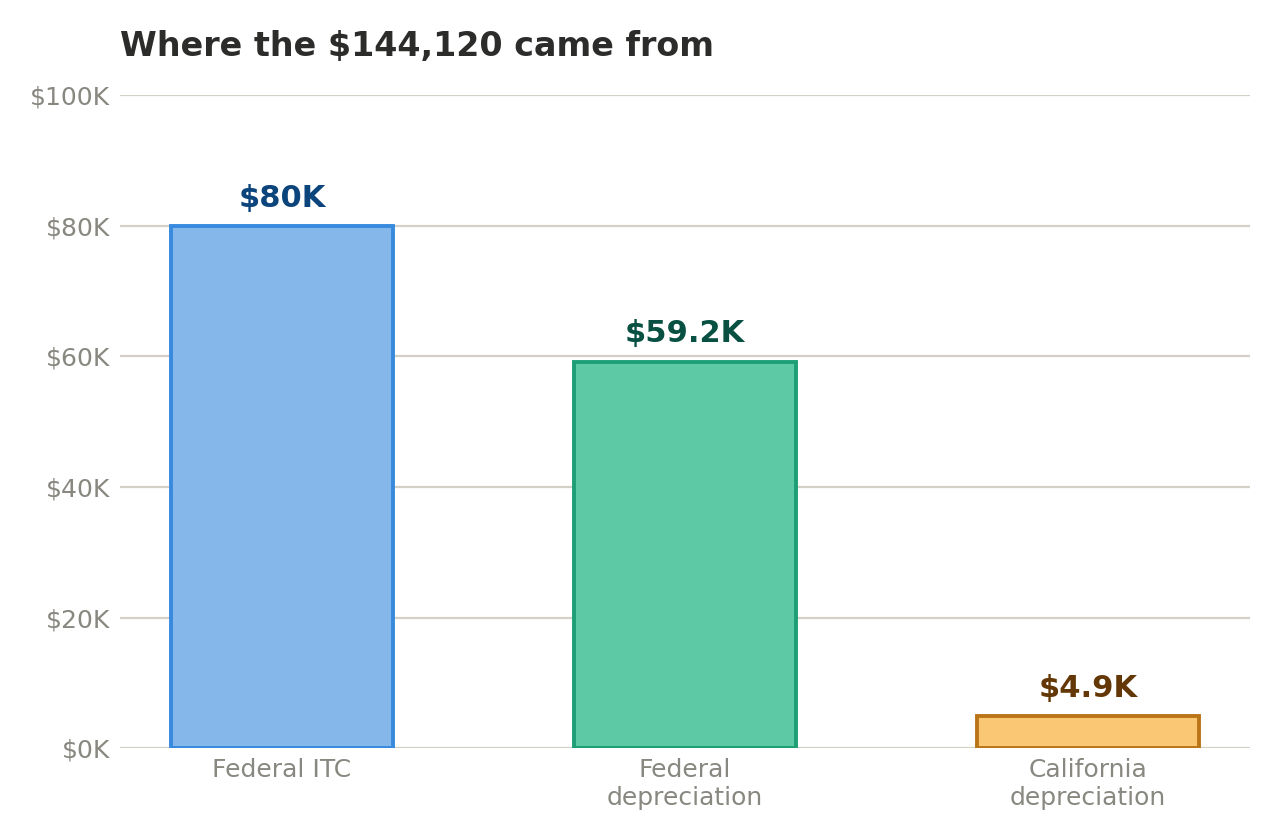
The tax benefit lands in the year the facility goes into service. On the calculator Mateo and his advisor ran together, the federal investment tax credit came to $80,000, first-year depreciation reduced his federal tax by another $59,200, and California's partial treatment of that depreciation added $4,920. That is $144,120 of 2026 tax reduction, against a federal bill of $210,000, from a single decision made in September.
His advisor was equally clear about what the strategy asks in return. The cash has to stay in the asset for at least five years. There is a real time commitment in the first year, which Elena was positioned to take on alongside Mateo. And it only makes sense for someone whose tax bill is large enough to absorb it, which is why the advisor ran Mateo's actual projection before raising it, rather than pitching it to every client. Alphanso charges nothing extra for the strategy and receives nothing from the project sponsor, so the recommendation had no fee attached to it.
The Result
- $144,120 less tax in 2026 on a $100,000 cash investment: $80,000 in federal credits, $59,200 in federal depreciation savings, and $4,920 in California savings
- A hard asset Mateo owns outright that pays about $10,000 a year in distributions after its own loan payments
- Three estimated-tax reminders, not one surprise: Alphanso's agents recalculated his quarterly payments once the strategy was confirmed, so he stopped overpaying in Q4
- No change to his lifestyle or his portfolio. The money came from cash that was already idle, not from selling anything
Why This Worked
The strategy itself is not a secret; what made it work was that one team could see Mateo's tax projection, his cash, his household structure, and his five-year plans at the same time, in September instead of February. Because Alphanso charges a flat fee, the advisor's only incentive was whether the numbers worked for Mateo, and as a fiduciary he had to show the trade-offs, not just the headline. If your 2026 tax bill is heading somewhere uncomfortable and you would rather own something than write a check, we would be glad to run your numbers: request a callback.
This case study is a composite illustration based on real Alphanso client scenarios. Names and identifying details have been changed for privacy. Results are not guaranteed and will vary based on individual circumstances, including tax bracket, state of residence, and whether participation requirements are met. Tax credits and depreciation benefits depend on current federal and state law. All investing involves risk, including the possible loss of principal. Alphanso LLC is a registered investment adviser.

Schedule demo with our advisors
What to expect