On paper he was a millionaire. Two lenders said no anyway.

The Situation
Nikhil is 34, a machine learning engineer who joined Anthropic in 2023. His wife Sana is a UX researcher at a smaller company. They have a two-year-old, they have been renting the same Oakland apartment since 2021, and this spring they started looking at houses.
Between them the household earns about $505,000 in salary. Nikhil's equity grant is worth a number he does not say out loud at dinner parties. By any reasonable measure they are doing extremely well.
Two lenders declined to count a dollar of the equity toward qualifying income. The second one was polite about it, which somehow made it worse. Nikhil called us that week, and the question he asked was whether he was doing something wrong.
The Gap We Found
He was not. The lenders were right, and the deeper problem was one nobody had put in front of him.
Anthropic grants double-trigger RSUs. Time vesting alone does nothing. The units settle only when a qualifying liquidity event occurs, and if that does not happen inside roughly a seven-year window, they can be forfeited entirely. Until the second trigger fires there is no share, no income, and nothing an underwriter can price.
His mortgage broker saw a W-2 and a thin down payment. His 401(k) advisor saw a modest balance. His CPA saw an accurate return. Every one of them was doing their job correctly inside their own lane, and not one of them had reason to say the thing that actually mattered: the household had organized its entire financial life around an asset with no settlement date, and had under-funded everything liquid in order to do it.
They had $184,000 sitting in a savings account paying 0.4%, which is what happens when the money feels temporary.
What We Did
We built the liquidity map first, because every other decision depended on it. Which tranches vest on which dates. What the second trigger actually requires under his plan documents, not under internet summaries. What the forfeiture window means in practice. And plainly, in writing, what happens to the household if the liquidity event never comes. Nikhil had been carrying that question privately for two years and had never seen it answered on paper.
Then we fixed the cash, which was the fastest money in the engagement. The $184,000 moved into a Treasury bill ladder structured around a realistic purchase window. At roughly 4.1% against the 0.4% it had been earning, that is about $6,800 a year of income the household was simply declining. The emergency reserve was sized separately, deliberately, against a scenario where the liquidity event slips two years and Sana's company has a bad quarter.
The mortgage approach changed shape entirely. Instead of trying to get an underwriter to believe in the grant, we built the application around documented W-2 income and an asset-depletion structure that counts the liquid portfolio rather than the illiquid equity. We also modeled what changes the day a tender or a listing settles, so they know which version of the plan they are in.
Sana asked the question that reframed the whole engagement: what would we be doing differently if the equity turned out to be worth nothing. We spent most of the second meeting on that, and it is the reason the plan holds.
The Result
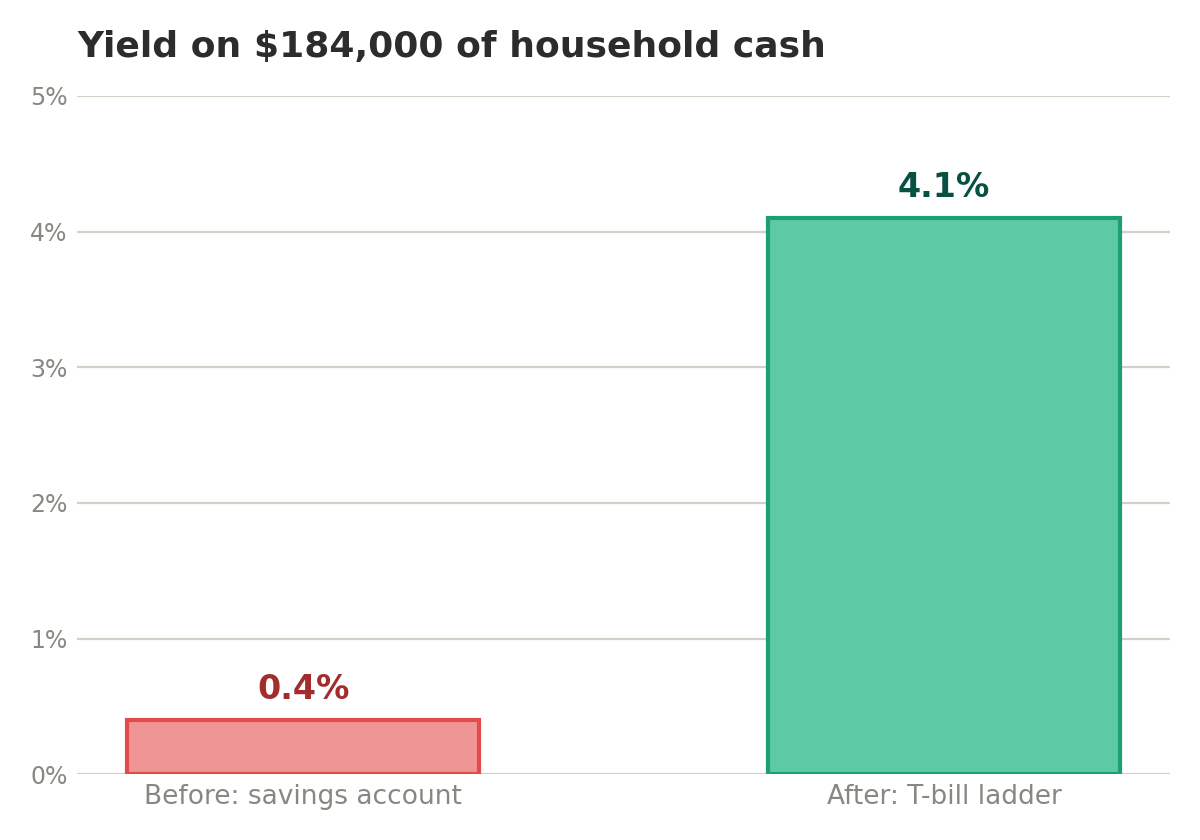
- About $6,800 a year recovered from cash that had been sitting at 0.4% for two years
- A purchase plan with an actual date on it, built on income and assets an underwriter will count rather than on equity they will not
- An emergency reserve sized against a two-year delay, not against the assumption that liquidity arrives on schedule
- A written answer to the forfeiture question, which is the one Nikhil had been carrying alone
- They stopped treating the grant as a plan. It is now one line in a plan that works without it.
Why This Worked
Nobody in Nikhil's financial life was failing him. The broker priced what he could see, the advisor managed what he was given, and the CPA filed what happened. But the household's actual problem lived in the space between a grant agreement, a bank statement and a loan application, and nobody was holding all three. Because Alphanso charges a flat annual fee and requires no asset transfer, telling them to move $184,000 into Treasury bills at a different institution costs us nothing, which is why the advice is worth what it says. If most of your net worth is in equity that has not settled, the plan around it matters more than the number. Talk to an advisor.
This case study is a composite illustration based on real Alphanso client scenarios. Names and identifying details have been changed for privacy. Results are not guaranteed and will vary based on individual circumstances. All investing involves risk, including the possible loss of principal. Alphanso LLC is a registered investment adviser.
.png)
Schedule demo with our advisors
What to expect