Her divorce split the RSUs 50/50. It never said who paid the tax.

Vested shares moved to a former spouse under a divorce decree are not a taxable sale: IRC Section 1041 recognizes no gain or loss, and the cost basis carries over. Unvested RSUs are different. The IRS’s divorce rulings stop at rights unvested when transferred, so each vest lands on the employee’s W-2, and the decree decides who really pays.
Summary
- Who: Rachel, 47, a senior manager at Amazon in Denver with two kids, finalizing a divorce with roughly $900,000 of unvested RSUs on Amazon’s back-loaded schedule and $600,000 of vested shares. An illustrative composite; names and figures are hypothetical.
- The problem: her draft settlement split “all RSUs” 50/50 by share count, with no word on who paid the tax when the unvested ones vested, and no word on which lots of vested stock went to her ex-husband.
- What Alphanso did: built the grant-by-grant vest schedule the attorneys’ formula needed, modeled the tax on each future vest under three decree wordings, and produced a lot-by-lot basis table for the vested shares, then handed all of it to both attorneys.
- The result: on a single $200,000 vest, the wording changed what Rachel keeps from $16,500 to $58,250; across the marital share of her unvested grants, about $100,000 more of her own after-tax vest value, and a beneficiary and titling list that finally matched her new life.
What did Rachel’s Amazon grants look like when the divorce started?
Most of her equity was still unvested, and the back-loaded shape of Amazon’s schedule is what made the divorce math layered. Rachel joined Amazon’s Denver office four years ago after a decade at a Colorado telecom, and she has done the responsible things since: a maxed 401(k), a 529 for each kid, a CPA who files on time, and a habit of leaving her vested shares alone because she believes in the company. Her ex-husband, Tom, teaches high school. The divorce was not bitter, but it was slow, and the RSUs were the reason.
Amazon’s new-hire grants vest 5% in year one, 15% in year two, and 40% in each of years three and four, the shape explained in Alphanso’s guide to Amazon’s 5-15-40-40 vesting schedule. A 1,000-unit grant made two years before the separation had vested only 200 units by the day they separated; 800 were still waiting on years three and four. Add a promotion grant and two refreshers and Rachel had about 4,500 unvested units against 3,000 vested ones. At a round $200 a unit, that is roughly $900,000 of paper and $600,000 of stock.
Which of her unvested RSUs counted as marital property?
That question belongs to the attorneys and to Colorado law, and we did not answer it; we made sure the formula they chose ran on correct inputs. Unvested grants can be marital property if they were earned during the marriage, and attorneys commonly use a time-based fraction to decide how much of each grant was earned before the separation date. Rachel’s attorneys agreed on one.
The trouble was the input. The draft agreement said “all RSUs” and attached a brokerage screenshot that showed only vested shares. Nobody had a table of every grant’s date, unit count and vest dates, so we built one from her stock plan account. Run the attorneys’ fraction on that 1,000-unit grant: 24 of 48 months during the marriage makes 500 units marital, and because only 200 had vested, 300 marital units were still unvested. Across all four grants the formula put about 2,400 unvested units, roughly $480,000 at $200, on the marital side. That is where the split actually lives, and it was invisible in the screenshot.
Who pays the tax when RSUs split in a divorce finally vest?
In practice the employee does, because the shares cannot leave her name until they vest, and the vest is wages. Rev. Rul. 2002-22 lets a former spouse report the income on vested options and deferred pay transferred in a divorce, but it says plainly that it does not apply to rights that are unvested at the time of transfer or subject to substantial contingencies. Most plans, including every one we have seen, do not let an employee transfer unvested units to a former spouse anyway. So Rachel keeps the units, and when they vest she delivers Tom’s share. The vest shows up on her W-2 at her marginal rate.
For 2026 the 35% federal bracket for a single filer runs from $256,200 to $640,600 of taxable income, and Medicare tax is 1.45% plus an additional 0.9% on wages above $200,000. Colorado’s flat income tax rate was 4.4% for tax year 2025. Rachel’s post-divorce filing status has its own thresholds, but her salary plus vests put each vest in the 35% bracket, so her all-in marginal rate on a vest is about 41.75%. The draft decree split the shares 50/50 by count. It never said whose 41.75% that was.
What did Alphanso change in the settlement math?
We modeled one $200,000 vest under three decree wordings and put the table in front of both attorneys. The decree could split gross shares, net out tax at the 22% federal supplemental withholding rate (the number on every vest statement, which is why it gets copied into settlements), or net out tax at the employee’s actual marginal rate.
One $200,000 vest, three decree wordings
- Gross shares split 50/50: Tom receives $100,000; Rachel pays $83,500 of tax; Rachel keeps $16,500
- Net of tax at the 22% withholding rate: Tom receives $78,000; Rachel pays $83,500 of tax; Rachel keeps $38,500
- Net of tax at Rachel’s actual 41.75% rate: Tom receives $58,250; Rachel pays $83,500 of tax; Rachel keeps $58,250
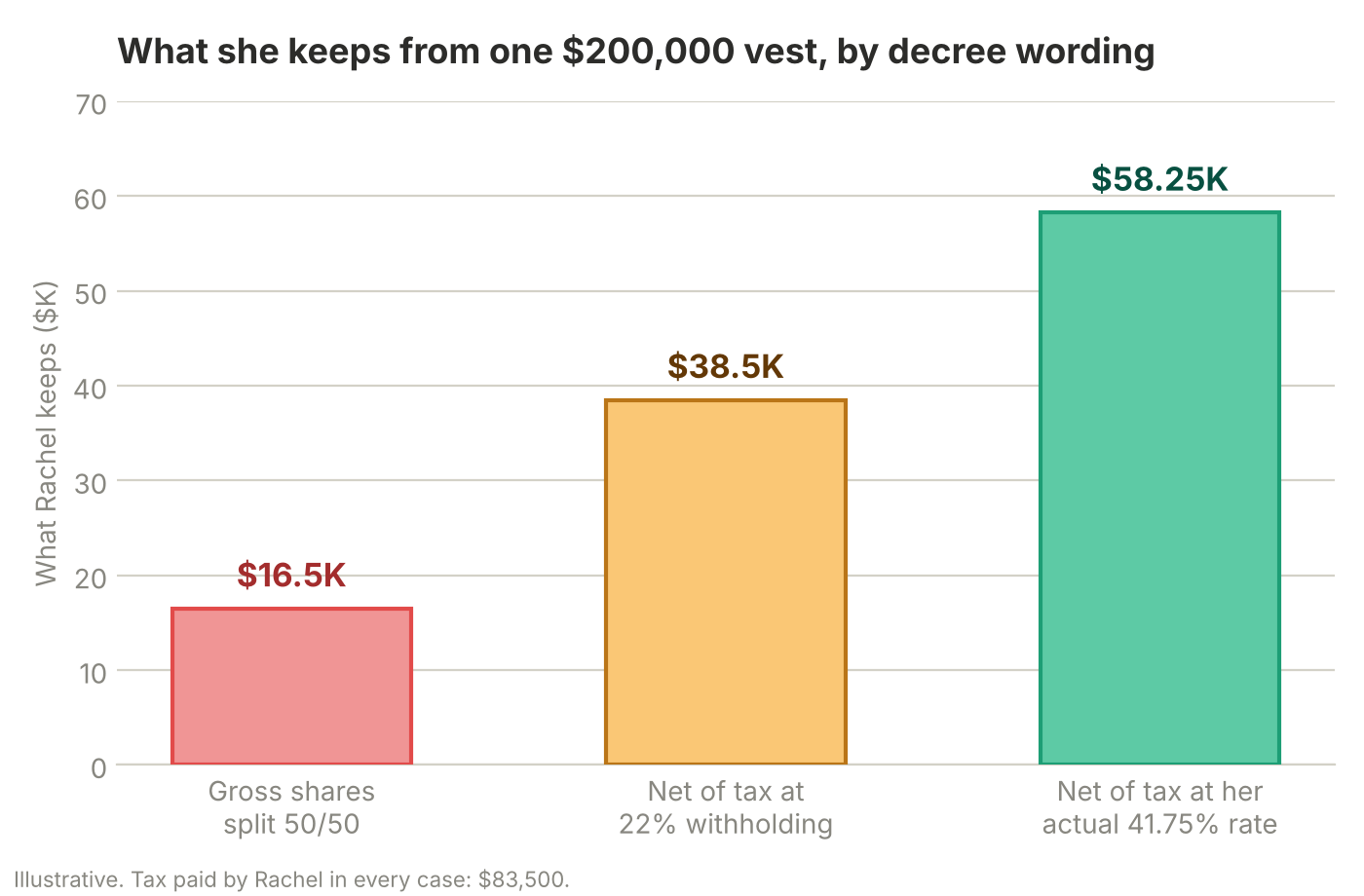
The first row is not a typo. Under a gross split Rachel delivers half the shares and pays all of the tax, which leaves her about eight cents of every vest dollar. The attorneys settled on the third wording, with the rate recomputed each year from her actual return. It was Tom’s attorney’s choice as much as hers, because it is the only row where the two of them are treated the same.
Then the vested shares. A transfer of vested stock to a former spouse incident to the divorce is not a sale under Section 1041, and Tom takes Rachel’s basis in whatever lots he receives. Which lots is the whole question. Her 3,000 shares sat in two groups: 1,200 with a $90 basis and 1,800 with a $180 basis. Moving $300,000 of stock as the low-basis lots would carry about $138,000 of embedded gain to Tom; the high-basis lots would carry about $30,000. We produced the lot table, both attorneys negotiated with it in front of them, and the decree now names lots instead of a share count. Tom’s side has the table too, because the cost basis your broker reports on a 1099-B after a divorce transfer is often wrong.
The last layer is the one divorcing clients skip because it is paperwork. Rachel’s 401(k), her life insurance and her brokerage transfer-on-death form all still named Tom; a workplace retirement plan pays whoever is on its beneficiary form, and courts have enforced that even when the person named is a former spouse. We ran a beneficiary and titling review after a big life change, redrafted the designations with the kids and a guardian in mind, and set up a revocable trust so the shares she keeps avoid probate. Alphanso’s AI agents already read her payroll, so each future vest now arrives with the tax estimated, the quarterly payment sized to the safe harbor, and Tom’s net share computed from the decree formula rather than from memory.
What did it save her?
- $58,250 instead of $16,500 kept from each $200,000 vest, by changing one sentence in the decree.
- About $100,000 more of her own after-tax value across the marital share of her unvested grants, spread over the remaining vest dates.
- About $108,000 of embedded gain allocated deliberately, not by accident, because the decree names lots.
- Beneficiaries, titling and a trust that match her new life, done in the same month as the decree instead of discovered years later.
Why did this work?
Nobody on either side did a bad job: the attorneys are good at family law, the CPA files a clean return, payroll withholds what the law says. The gap was that a divorce decree is a tax document pretending to be a legal one, and no one had modeled what each sentence would cost at vest time. Alphanso Inc is a flat-fee fiduciary wealth advisory for employees with equity compensation (RSUs, ISOs, NSOs and ESPP); advisors are paid a flat annual fee, never a percentage of assets or commissions. That means the advice was the same whether Rachel kept more shares or fewer, and the implementation (the vest schedule, the tax model, the lot table, the beneficiary forms, the quarterly estimates) was done for her, not handed back as a to-do list. If you are splitting RSUs in a divorce, or you are the spouse on the other side of one, we would love to walk you through it. See the flat annual fee and book a call.
FAQ
Are unvested RSUs marital property in a divorce?
They can be. Most states treat grants earned during the marriage as marital property even if they vest after the divorce, and attorneys commonly apply a time-based fraction to each grant to decide how much was earned before the separation. The answer depends on your state and your decree, so it is a question for your attorney; the inputs (grant dates, unit counts, vest dates) are what a planner can supply.
Can my employer transfer unvested RSUs directly to my ex-spouse?
Usually not. Most stock plans do not allow unvested units to be assigned, so the employee keeps the units and delivers the former spouse’s share after each vest. Because the vest is taxed as the employee’s wages, the decree needs to say how the tax is shared, or the employee can end up paying all of it on shares they hand over.
Is transferring vested stock to my ex-spouse in a divorce taxable?
No. Under IRC Section 1041, a transfer of property to a former spouse within one year of the divorce, or later under the divorce instrument, is not a taxable sale, and the recipient takes the transferor’s cost basis. That carryover basis means which lots are transferred decides who eventually pays the capital gains tax, so a lot-by-lot table belongs in the settlement.
What happens to the RSUs split in my divorce if I leave the company before they vest?
Unvested units are generally forfeited when employment ends, and whether the former spouse is owed anything in that case depends entirely on how the decree was written. Some decrees allocate only what actually vests; others require a make-whole payment. It is worth asking your attorney to address departure explicitly before the decree is signed.
Do I need a QDRO to split RSUs?
No. A qualified domestic relations order is the tool for dividing qualified retirement plans such as a 401(k). RSUs and stock options are divided through the property settlement and the divorce decree itself, which is why the wording of that document carries the whole tax outcome.
This case study is a composite illustration based on real Alphanso client scenarios. Names and identifying details have been changed for privacy. Results are not guaranteed and will vary based on individual circumstances. All investing involves risk, including the possible loss of principal. Tax services are for educational purposes and do not constitute legal advice; nothing here is legal advice about your divorce. Alphanso Inc is a registered investment adviser; registration does not imply a certain level of skill.
Sources: no gain or loss on transfers incident to divorce, carryover basis: IRC Section 1041, Cornell LII; former spouse reports income on vested options; ruling excludes unvested rights: Rev. Rul. 2002-22, IRS; FICA and withholding on divorce transfers: Rev. Rul. 2004-60, IRS; 2026 single-filer 35% bracket: Rev. Proc. 2025-32, IRS; net investment income tax thresholds: IRS Topic 559, reviewed Sep 24, 2026; Colorado 4.4% rate for tax year 2025: Colorado Individual Income Tax Guide, January 2026; property settlements: IRS Publication 504 (2025); Amazon 5-15-40-40 vest shape: Alphanso, Financial Planning for Amazon Employees.

Schedule demo with our advisors
What to expect