The 110% Rule: How One Payment Before September 15 Switches Off Your 2026 Underpayment Penalty
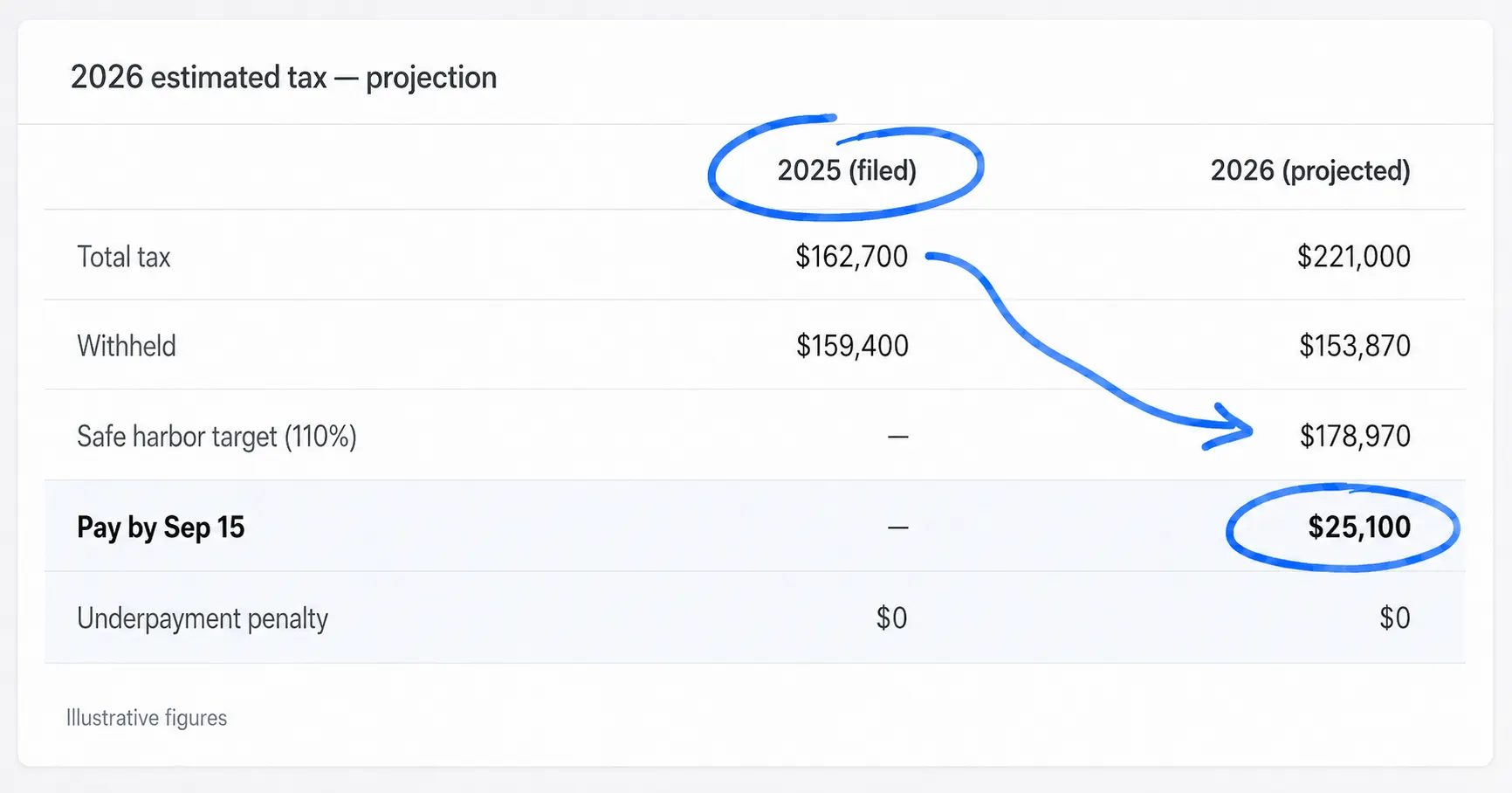
If you have RSUs vesting this year, your employer withheld 22% on them. Your actual marginal rate is probably 32% or 35%. Most people know that math ends in a bill next April, and most people plan to settle up then.
Here is the part almost nobody knows: the IRS started charging interest on that gap in April 2026, not April 2027. And you have until September 15 to switch most of it off.
Safe harbor is not one rule. It is three.
"Safe harbor" gets talked about like a single number. It is actually a choice, and the arithmetic is different for each option.
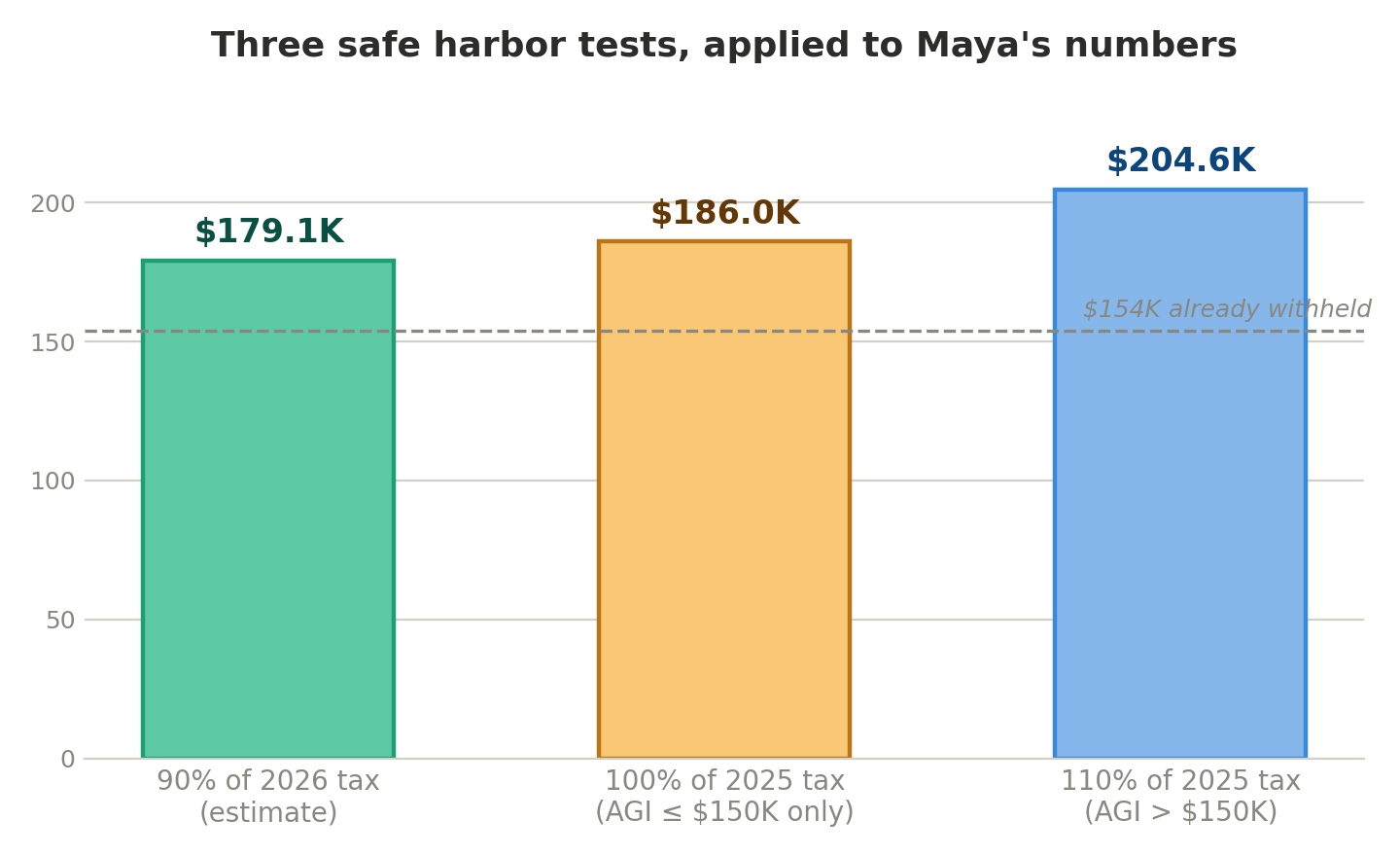
The IRS will not charge you an underpayment penalty for 2026 if your total payments (withholding plus any estimated payments) come to at least:
- 90% of your 2026 tax. Accurate, but it requires you to forecast vests that have not happened yet, at a stock price you do not know.
- 100% of your 2025 tax. A fixed, knowable number. Available only if your 2025 AGI was $150,000 or less ($75,000 if married filing separately).
- 110% of your 2025 tax. The same fixed number, 10% higher. This is the version that applies if your 2025 AGI was above $150,000.
That third line is why this post exists. If you had a full year of vests at an equity-heavy employer in 2025, your AGI cleared $150,000. Option 2 is not on your menu. Your two real choices are 90% of a number you have to guess, or 110% of a number you can read off last year's Form 1040, line 24.
And you get the lower of the two, not the one you prefer. Which is exactly why you should calculate both.
What this looks like on $600,000 of vests
Let's use a real shape. Maya is a senior silicon engineer at AMD, married filing jointly, spouse not currently working.
- Base salary: $180,000
- 2026 RSU vests: $600,000 (grants from 2023 through 2025, vesting into a stock that has run hard)
- Total 2026 wages: $780,000
Her 2026 federal income tax, using the 2026 brackets and the $32,200 standard deduction for married filers, comes to roughly $199,000. Her marginal rate is 35%.
Here is what payroll actually sent to the IRS:
- Withholding on her $180,000 salary, which payroll calculates as though that salary is her only income: about $22,000
- Withholding on $600,000 of vests at the 22% flat supplemental rate: $132,000
- Total withheld: $154,000
So her April 2027 balance is roughly $45,000. That is the withholding gap, and it is not news to most people reading this.
Now the safe harbor math. Her 2025 federal tax was $186,000 and her 2025 AGI was $770,000.
- 90% of 2026 tax: $199,000 × 0.90 = $179,100
- 110% of 2025 tax: $186,000 × 1.10 = $204,600
She needs the lower of the two: $179,100. She has paid in $154,000. Her shortfall against safe harbor is $25,100.
Read that again, because it is the whole point of this article. She will owe $45,000 in April. She only has to send $25,100 to switch off the penalty. The remaining $19,900 can sit in her savings account until April 15, 2027, and the IRS will charge her nothing for holding it.
The penalty is quarterly, which is why September 15 matters
The underpayment penalty is not calculated on your year-end balance. It is calculated at four separate checkpoints, and it runs like interest from each missed checkpoint until you pay it.
The 2026 checkpoints are April 15, June 15, September 15, and January 15, 2027. The rate for the quarter beginning July 1, 2026 is 7% annualized. The IRS resets it every quarter at the federal short-term rate plus three percentage points.
Maya's required installment is $179,100 ÷ 4 = $44,775 per checkpoint. Her withholding covers $38,500 per checkpoint. So she is short $6,275 at every single one.
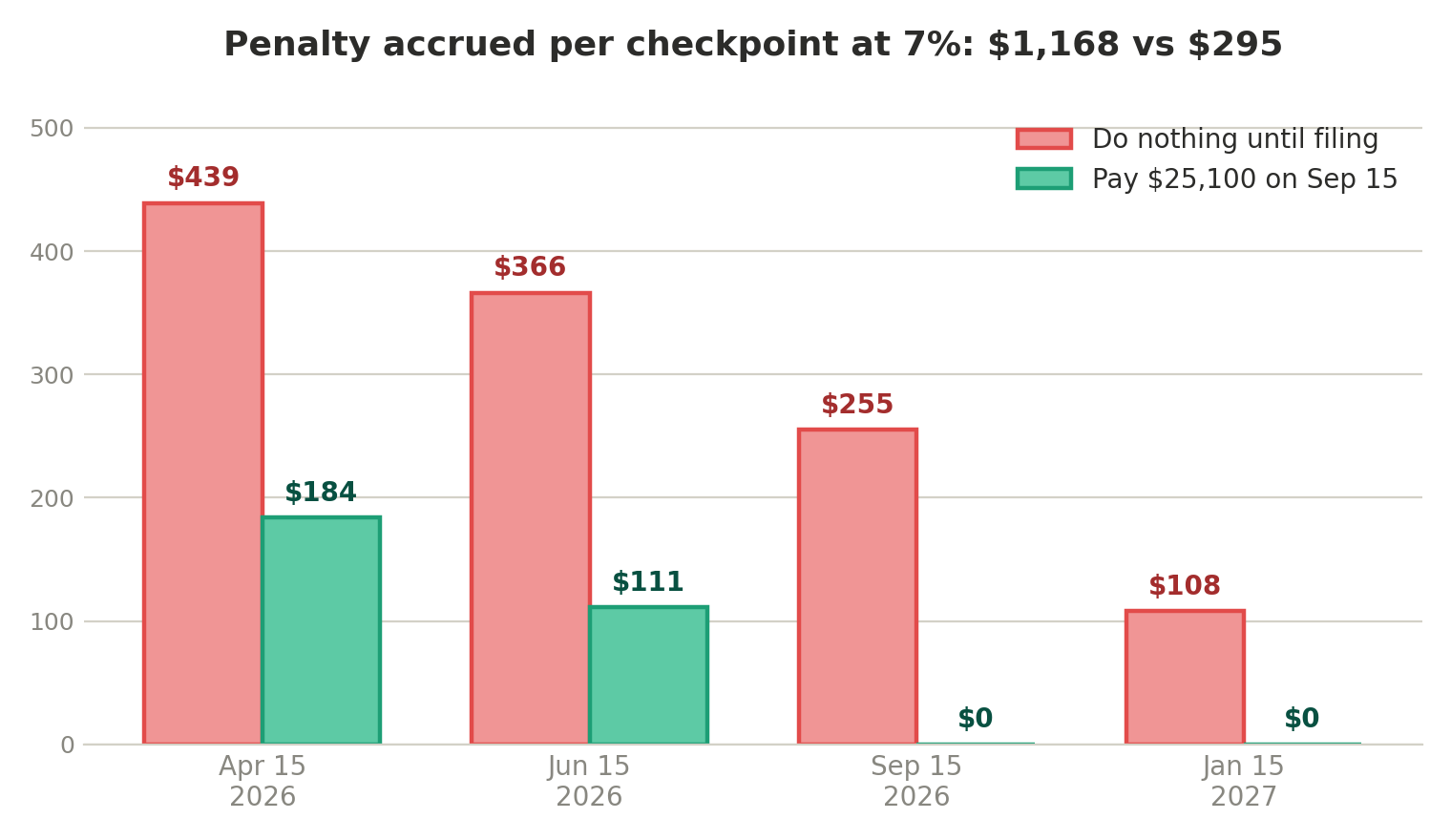
If she does nothing until she files, the penalty accrues at every checkpoint:
- April 15, 2026 — 365 days accruing at 7%: $439
- June 15, 2026 — 304 days accruing at 7%: $366
- September 15, 2026 — 212 days accruing at 7%: $255
- January 15, 2027 — 90 days accruing at 7%: $108
- Total: $1,168
If instead she sends $25,100 on September 15, the IRS applies it to the oldest unpaid installment first. April gets covered, then June, then September, and the January installment ends up prepaid:
- April 15, 2026 — 153 days accruing at 7%: $184
- June 15, 2026 — 92 days accruing at 7%: $111
- September 15, 2026 — 0 days accruing: $0
- January 15, 2027 — 0 days accruing: $0
- Total: $295
About $870 saved for one transfer. And notice the honest limit here: the September payment does not erase April and June. It stops the meter going forward and caps the damage at what already accrued. A large payment in December does neither, and a big check stapled to your return does nothing at all.
Withholding and an estimated payment are not the same instrument
This is the part that surprises even careful people.
Estimated payments are credited on the date you make them. Withholding works differently. By default, the IRS treats your full year of withholding as though it were paid in four equal pieces across the four installment dates, no matter when it actually came out of your paycheck.
Which means this: if Maya raises her withholding in September and October instead of writing a check, that money gets credited 25% to April, 25% to June, 25% to September, and 25% to January. It cures the earlier misses retroactively. Her penalty goes to $0 instead of $295.
Same dollars. Different result. Two ways to do it:
- Elect a higher supplemental rate on your remaining vests. Some payroll systems let you choose a rate above the default 22%, up to 37%. On a $150,000 Q4 vest, moving from 22% to 37% pulls an extra $22,500.
- Add extra withholding on your W-4, line 4(c). A flat dollar amount per paycheck. Eight remaining paychecks at $650 each is another $5,200.
Between the two, Maya covers her $25,100 without ever touching Form 1040-ES.
The catch is arithmetic, not strategy. Withholding only works if you have enough paychecks and vests left in the year to move that much money. By late September, for a lot of people, there simply is not enough runway. That is the point at which the estimated payment becomes the right tool, and $295 of accrued penalty is the price of using it.
Two more wrinkles worth knowing
If your vests are lumpy, the even-quarters math may not apply to you. The default assumption is that you earned your income in four equal chunks. If your entire vest landed in November, that assumption works against you. Form 2210, Schedule AI lets you use the annualized income installment method, which recalculates each required installment based on what you had actually earned by that point in the year. It is more paperwork, and it can eliminate the penalty on the early quarters entirely.
California does not follow the federal schedule. Two differences matter for anyone in the Bay Area, San Diego, or anywhere else in the state:
- California's installments are front-loaded and uneven: 30% due in April, 40% in June, 0% in September, 30% in January. There is no September checkpoint for the FTB at all. Your California deadlines have already passed, and the next one is January 15, 2027.
- California's 110% test looks at your current-year AGI above $150,000, not your prior-year AGI. And if your California AGI reaches $1,000,000, the prior-year safe harbor disappears completely and you are required to hit 90% of current-year tax.
California also withholds a flat 10.23% on bonus and stock option income, which lands roughly in the neighborhood of the state marginal rate most equity-heavy employees actually pay. The state rate gap is usually much smaller than the federal one. It is the timing rule, not the rate, that catches people here.
What to do before September 15
Four steps, in order:
- Pull your 2025 Form 1040 and find line 24, total tax. Multiply it by 1.10 if your 2025 AGI (line 11) was above $150,000.
- Estimate your 2026 tax and multiply by 0.90. Include every vest scheduled through December at a price you actually believe.
- Take the lower of the two numbers. Subtract what payroll will have withheld by December 31. That difference is your number.
- Decide the instrument. If you have enough remaining paychecks and vests to withhold that amount, do that, because withholding cures the earlier quarters. If you do not, send the difference through IRS Direct Pay by September 15 and accept the small April and June accrual.
If the number comes out negative, you are already inside safe harbor and you can stop reading.
The Bottom Line
Safe harbor stops the penalty. It does not settle the bill. Those are two different things, and confusing them costs people money in both directions: some overpay months early for no benefit, and some pay nothing and let 7% run on four separate checkpoints.
Maya owes $45,000 in April. She only has to move $25,100 by September 15. The rest of it is hers to hold, interest-free, for another seven months.
And the date is real. Penalties accrue from each quarterly checkpoint, so a payment on September 15 is worth meaningfully more than the same payment on December 15, and a great deal more than the same payment attached to your return.
If you have vests landing this year and you are not sure whether you are already inside safe harbor, we are happy to run both calculations against your actual numbers before September 15.
This content is for educational purposes and does not constitute personalized financial or tax advice. Tax rules and IRS interest rates change quarterly. Verify current figures, and your own numbers, before acting.

Plan with an expert
What to expect


.png)
.jpg)
.png)
.png)