Why Your RSU 1099-B Shows a $0 Cost Basis
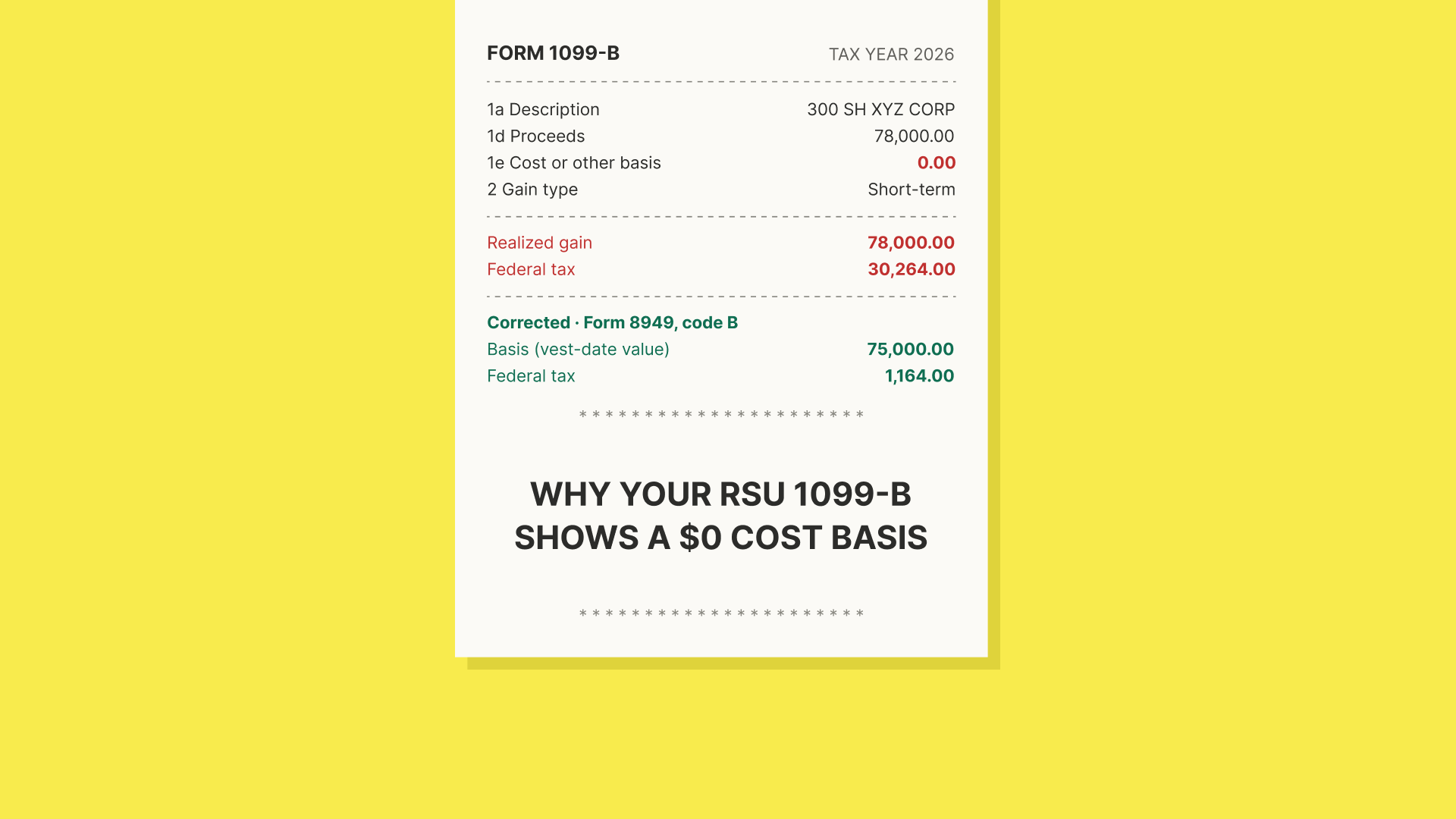
Your 1099-B shows a $0 or missing cost basis because IRS rules bar brokers from adding compensation income to the basis of equity-comp shares acquired after 2013. The real basis of each RSU share is its vest-date value, which was already taxed as wages on your W-2. You restore it on Form 8949, usually with adjustment code B.
Key takeaways
- Under the 2026 Instructions for Form 1099-B, a broker “cannot increase initial basis for income recognized upon the exercise of a compensatory option or the vesting or exercise of other equity-based compensation arrangements granted or acquired after 2013,” so RSU basis arrives on the form understated or blank.
- The correct basis of an RSU share is the vest-date fair market value that your employer included in Box 1 of your W-2; if the 1099-B basis was reported to the IRS and is wrong, you keep it in column (e) of Form 8949 and fix it with code B and an adjustment in column (g).
- A return that used the $0 basis can be amended for a refund within three years of the date it was filed or two years of the date the tax was paid, whichever is later.
Why is the cost basis on my RSU 1099-B $0 or blank?
Because the broker is following the rule, not making an error. Since 2014, Treasury regulations have told brokers to report the basis of shares acquired through equity compensation without the compensation element, which for an RSU is the entire vest-date value.
On a vest date your employer adds the fair market value of the vested shares to your wages, withholds tax on it (at the 22% supplemental rate for most employees, 37% once supplemental wages pass $1 million in the year), and reports it on your W-2. The shares then land in your brokerage account, where, as far as the broker is concerned, you paid nothing for them. The 2026 Instructions for Form 1099-B, Box 1e, tell the broker it “cannot increase initial basis” for that vest-date income, so the form shows $0 or a blank, whether the broker labels the shares covered or noncovered.
The number is not lost. Payroll knows the vest-date value and the brokerage knows the sale. Your tax return is where the two have to meet, and nothing on either form does that for you.
Are RSUs taxed twice if I leave the $0 basis in place?
Yes, on the part that was already wages. If you accept the 1099-B as filed, every dollar of sale proceeds is treated as gain, including the vest-date value you already paid income tax on.
Most tax software imports the 1099-B as delivered, and the prompt that saves you is a yes-or-no question along the lines of “do you need to adjust the cost basis for this sale?”, with no as the default. The result matches the IRS copy of the 1099-B exactly and overpays. Nothing flags it, which is why this mistake tends to surface years later, if at all.
How much does a $0 basis cost?
For an employee in the 35% bracket, a $0 basis on a $78,000 sale can turn roughly $1,200 of real tax into roughly $30,000. The gap scales with the vest-date value of the shares, not with how well the stock did afterward.
Take Mei-Lin, 38, an engineer at Microsoft in Seattle. Her annual stock award vests in portions on scheduled vest dates, subject to her still being employed on each date, which is how Microsoft’s benefits page describes its awards. On one vest date, 400 shares vest at a value of $250 each, so $100,000 goes on her W-2. The broker sells 100 shares to cover withholding and 300 shares land in her account. Eight months later she sells those 300 shares at $260, for $78,000 in proceeds. The 1099-B arrives with the basis blank.
Her correct basis is 300 shares at $250, which is $75,000. Her real gain is $3,000, short-term because she held the shares less than a year. She files as a single taxpayer and her taxable income already sits above the 2026 single-filer threshold for the 35% bracket, $256,200, so the gain is taxed at 35%, plus the 3.8% net investment income tax because her modified adjusted gross income is above the $200,000 single threshold.
Same sale, two returns
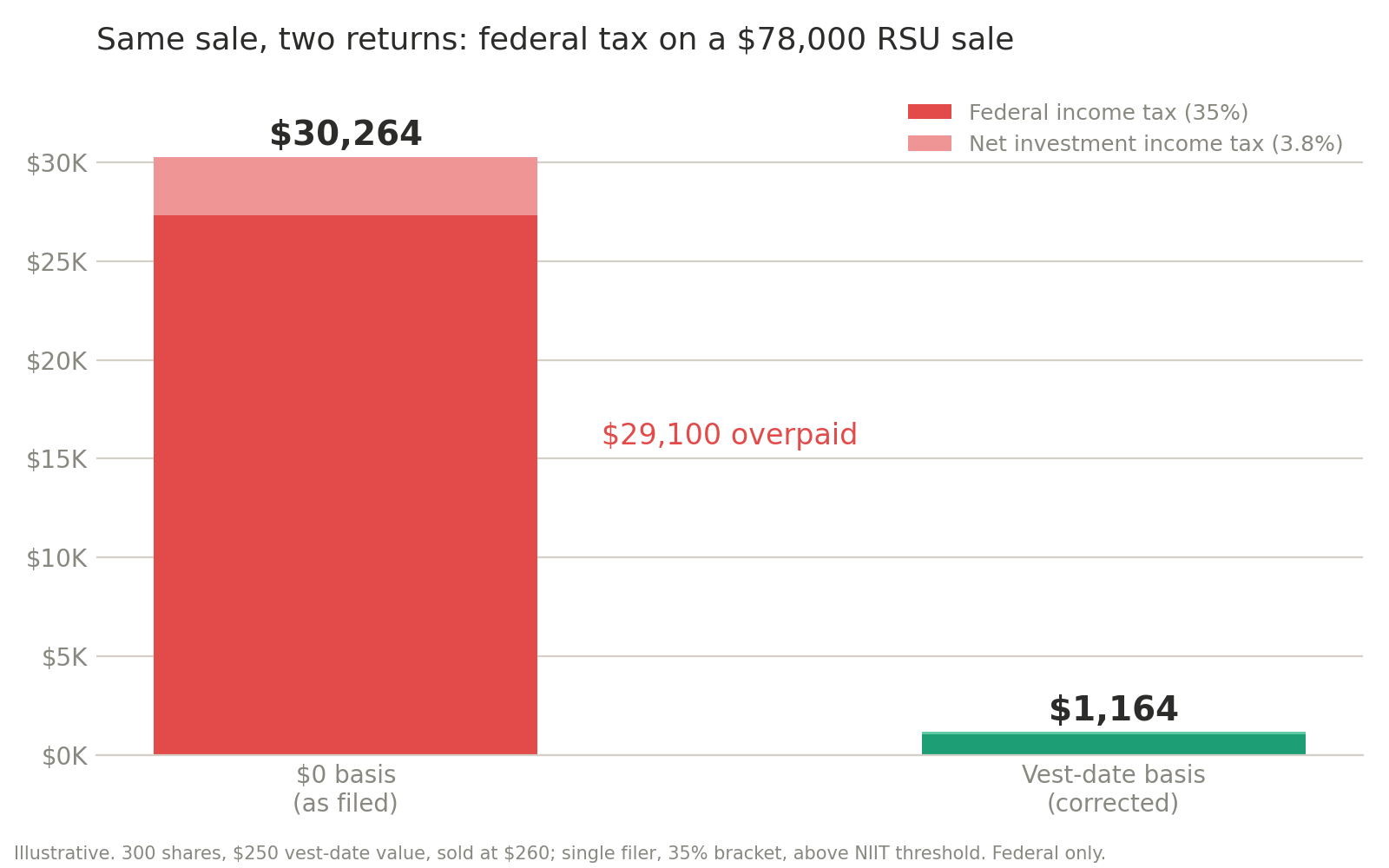
- Proceeds: $78,000 with a $0 basis (as filed); $78,000 with the vest-date basis (corrected)
- Cost basis: $0 as filed; $75,000 corrected
- Short-term gain reported: $78,000 as filed; $3,000 corrected
- Federal income tax at 35%: $27,300 as filed; $1,050 corrected
- Net investment income tax at 3.8%: $2,964 as filed; $114 corrected
- Total federal tax on the sale: $30,264 as filed; $1,164 corrected
- Overpayment from the $0 basis: $29,100
The $75,000 difference is the vest-date value she already paid tax on through her W-2. Reported at $0, it is taxed a second time, and in her bracket the second time costs about 39 cents on the dollar.
How do I correct the RSU cost basis on Form 8949?
You report the sale with the basis the broker sent, then adjust it, or you enter the correct basis directly, depending on whether the broker reported the basis to the IRS. The 2025 Instructions for Form 8949 set out both paths.
- Find the vest-date value of the shares you sold. It is on the vest confirmation from your stock plan administrator, on the supplemental statement most brokers attach to the 1099-B, and, in total, in your W-2 wages for the vest year. Per share, it is the vest-date fair market value your employer used.
- Check which box applies on the 1099-B. If the basis was reported to the IRS (box A for short-term, box D for long-term), enter the reported basis in column (e) even though it is wrong, enter code B in column (f), and enter the correction in column (g) as a negative number equal to the missing basis.
- If the basis was not reported to the IRS (box B or box E, often shown as “noncovered”), enter the correct basis directly in column (e) and enter -0- in column (g).
- Count only the shares you sold. If 100 shares were sold or withheld at vest to cover tax, those shares were already disposed of; the basis of the remaining 300 is 300 times the vest-date value, not 400 times. Applying the whole vest’s basis to a partial sale overstates it and creates a false loss.
- Keep the supplemental statement and the vest confirmation with your return; the IRS copy of the 1099-B still shows $0, so the paper trail is what answers a notice.
Shares that vest monthly or quarterly also raise a second filing question when a sale at a loss lands within 30 days of a vest: the wash sale trap that monthly and quarterly vesting creates walks through that one.
Does the same thing happen with ESPP shares?
Yes, with one more layer. For ESPP shares the broker usually reports what you actually paid, the discounted purchase price, and the discount itself is the compensation element that may belong on your W-2 and on your basis.
Microsoft’s ESPP, for example, lets employees contribute 1% to 15% of eligible pay over three-month offering periods and buy shares at 90% of the closing price on the last US business day of the period. Say an offering period closes at $250 and the purchase price is $225. The 1099-B basis will show $225. Whether the $25 discount is added to your basis depends on whether the sale is a qualifying or disqualifying disposition, and on what your employer reported on the W-2 for that year. Our ESPP planning guide covers the holding-period mechanics; the point here is that the ESPP basis on a 1099-B is a starting number, not a finished one.
Can I get the money back if I already filed with a $0 basis?
Generally yes, if you are inside the refund window. The IRS allows a claim for refund up to the later of three years from the date the return was filed or two years from the date the tax was paid.
In practice that means a return filed in April 2024 can be amended for a refund until April 2027, and so on. The amendment is a Form 1040-X with a corrected Form 8949 and Schedule D attached. Each year with an RSU sale is a separate check, and a sell-to-cover at vest counts as a sale on the 1099-B even if you never placed the trade yourself.
Why does the basis matter beyond the tax return?
Because the lot-level basis is the raw material of every later decision about the shares. Knowing what each lot is worth after tax is how a sell versus hold decision on RSUs is evaluated, and it is what a systematic sell plan is built on: which lots to sell first, which to pair with harvested losses, which to let cross the one-year line.
An employee with several grants vesting quarterly holds a dozen or more lots with different bases, and the broker’s record of those lots is, by rule, wrong for tax purposes. The error on the return is the visible symptom. The underlying problem is that no one is carrying the vest-date number from payroll, to brokerage, to the return, to the decision about what to sell next. That handoff is what a team that sees all three systems is for; a Microsoft engineer’s surprise tax bill shows the same gap from the withholding side.
FAQ
Is a $0 cost basis on my RSU 1099-B a broker mistake?
No. The 2026 Instructions for Form 1099-B tell brokers they cannot add compensation income to the basis of equity-comp shares acquired after 2013, so a $0 or blank basis for RSU shares is the expected result. The correction belongs on your Form 8949, not with the broker.
What is the cost basis of RSU shares after sell-to-cover?
Each share you still hold has a basis equal to its vest-date fair market value, the same per-share figure your employer used to calculate your W-2 wages. The shares sold or withheld to cover tax at vest were disposed of at that same value, so they typically show little or no gain of their own.
Do I report RSU income on my tax return if it is already on my W-2?
You report the W-2 wages once, as wages. You do not report the vest-date value again as a capital gain; you use it as the basis of the shares so that only the change in value between vest and sale is taxed.
Which Form 8949 code fixes an incorrect RSU basis?
Code B, which means the basis shown on Form 1099-B is incorrect. If the basis was reported to the IRS, enter the reported basis in column (e), code B in column (f), and the correction in column (g). If the basis was not reported to the IRS, enter the correct basis in column (e) and -0- in column (g).
How far back can I amend a return that double-taxed my RSUs?
The IRS accepts a refund claim up to the later of three years from the date you filed the return or two years from the date you paid the tax. File a Form 1040-X with a corrected Form 8949 and Schedule D for each affected year.
If you would rather have someone reconcile the W-2, the brokerage statements and the return every year, and build the sell plan on top of the right lot-level numbers, that is the work an Alphanso advisor does for a flat annual fee. Alphanso Inc is a flat-fee fiduciary wealth advisory for employees with equity compensation (RSUs, ISOs, NSOs and ESPP); advisors are paid a flat annual fee, never a percentage of assets or commissions. Book a call and bring last year’s 1099-B; the basis check takes about twenty minutes.
Tracy Weston, CFP, EA, is a Senior Wealth Advisor at Alphanso, where she runs tax strategy and filing for employees with equity compensation.
This article is for educational purposes only and does not constitute tax, legal or investment advice. Tax services are for educational purposes and do not constitute legal advice. Consult a qualified professional about your own situation. Registration does not imply a certain level of skill.
Sources: 2026 Instructions for Form 1099-B, Box 1e (IRS); 2025 Instructions for Form 8949, columns (f) and (g) (IRS); Rev. Proc. 2025-32, 2026 inflation adjustments (IRS); Publication 15 (2026), supplemental wages (IRS); Topic no. 559, Net investment income tax (IRS); Time you can claim a credit or refund (IRS); Stock Awards and ESPP (Microsoft US Benefits).

Plan with an expert
What to expect