How a Snowflake senior PM mapped his exit at 48

The Situation
Andre is a 39-year-old senior product manager at Snowflake, based in Bellevue, Washington. Four years into his time at the company, his total compensation sits around $540,000 a year, more than half of it in RSUs. He is single, disciplined, and organized: he maxes his 401(k) every year, keeps a solid emergency fund, holds index funds in a taxable account, and files clean returns with a CPA he likes. His goal is specific and non-trivial. He wants to stop working full time at 48.
The problem was that his plan lived in a spreadsheet, and the spreadsheet changed every time SNOW moved. Roughly 55% of his $1.9 million net worth sat in Snowflake stock, and a volatile quarter could swing his net worth by $150,000 in either direction. Some months the spreadsheet said he could retire at 45. Other months it said 55. He was not sure which number to believe, so he kept holding, kept vesting, and kept rebuilding the model.
The Gap We Found
Nobody had connected his vesting schedule to his retirement date. His CPA filed accurate returns after the year ended. His index funds were sensible. But no one was looking at the whole picture: a net worth dominated by one volatile stock, RSU income withheld at 22% while his marginal rate was 35%, and almost all of his non-SNOW savings locked inside retirement accounts he cannot touch penalty-free until 59 and a half. For someone who wants to stop earning at 48, that last part is the whole ballgame. He did not have a bridge, and no single advisor in his life was positioned to see that.
What We Did

We started with the target, not the portfolio. Using what-if simulations, his advisor modeled what an exit at 48 actually requires: annual spending, healthcare costs before Medicare, sequence-of-returns risk in the early years, and how many years the plan has to fund before retirement accounts unlock. That turned a bouncing spreadsheet number into a fixed funding goal.
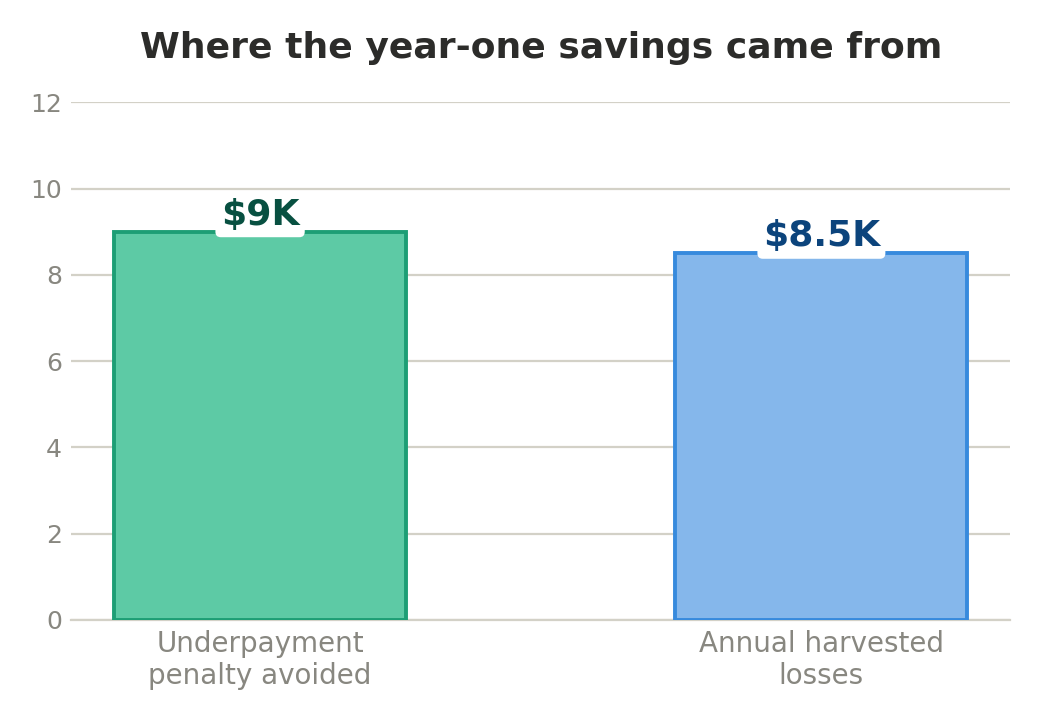
Then we addressed the concentration. New RSUs now sell at vest, which means effectively zero capital gains on those lots since the sale price matches the price he was taxed at. For the existing SNOW position, we used specific lot identification to sell the highest-cost lots first, unwinding toward a 20% cap over about two years. Proceeds moved into a direct indexing portfolio, where tax-loss harvesting generates losses (roughly $8,500 a year in his bracket) that offset the gains created by the unwind. His accounts stayed exactly where they were; nothing transferred.
Finally, we built the bridge. Backdoor Roth contributions and after-tax 401(k) contributions with in-plan conversions now fill tax-advantaged space he was leaving unused, and his plan maps out a Roth conversion ladder for the low-income years after 48 to reach his retirement accounts early without penalties. In the background, Alphanso’s AI agents parse his payroll after every vest, flag the gap between what was withheld and what he will owe, and calculate his quarterly estimated payments so his advisor can review them with him before each deadline. That alone headed off an estimated $9,000 underpayment penalty in year one.
The Result

- An estimated $23,000 in year-one tax impact: harvested losses, the avoided underpayment penalty, and newly captured Roth space
- SNOW concentration on track to fall from 55% to about 20% of net worth in two years, without a surprise tax bill
- A funded bridge-account plan and Roth conversion ladder that make 48 a date on a calendar, not a hope in a spreadsheet
- Andre stopped rebuilding his retirement model every time the stock moved. The plan absorbs volatility now, so he does not have to.
Why This Worked
Every piece of this plan already existed somewhere in Andre’s financial life; what was missing was one team looking at the vesting schedule, the tax return, and the retirement date at the same time. Because Alphanso charges a flat fee rather than a percentage of assets, there was no incentive to gather his accounts or slow down the unwind. As fiduciaries, the only measure of success was whether 48 became real. If you are mapping your own exit and the math changes every time your company’s stock does, we would love to walk you through it: request a callback.
This case study is a composite illustration based on real Alphanso client scenarios. Names and identifying details have been changed for privacy. Results are not guaranteed and will vary based on individual circumstances. All investing involves risk, including the possible loss of principal. Alphanso LLC is a registered investment adviser.
.png)
Schedule demo with our advisors
What to expect