A Googler moving home to Mumbai, and the window nobody mentioned

The Situation
Arjun is 42 and has spent eleven years at Google in Seattle. Next year he is moving home to Mumbai with his wife, Kavya, and their two kids, partly to be near his parents and partly because it was always the plan. He has lined up a transfer to Google's team in India, so his GSUs will keep vesting after he lands. He is on an H-1B, not a green card, which turned out to matter more than he expected.
He had done the hard parts well. A maxed 401(k), a Roth IRA from his early years, and a taxable account holding about $850,000 of Alphabet, mostly GSUs he kept after they vested years ago. He believes in the company and has no plans to stop. He has a careful CPA in Seattle and a family CA in Mumbai ready for the Indian side. Both are good at their jobs. Neither had seen the other's half of the picture.
The Gap We Found
Arjun's question was simple: what happens to my Alphabet shares when I move? His CPA could answer for the US. His CA could answer for India. Nobody was answering for the sequence. When Arjun lands, India will likely treat him as RNOR (resident but not ordinarily resident) for the first two, sometimes three, years, a status where foreign income and gains generally stay outside the Indian tax net. And once he leaves, he stops being a US tax resident, and the US generally does not tax a nonresident's gains on US stock. For a short stretch, the same shares can be sold with little or no tax in either country. Call it the homecoming window. It opens on a schedule and closes on one, whether he uses it or not. RNOR turns on day counts and residency history, so it is not automatic, and nobody should assume it.
What We Did

We put the roughly $600,000 of gain in his Alphabet lots on one page with three columns. Sold while he is still a Washington resident: roughly $160,000 in federal tax, the 3.8% net investment income tax, and Washington's capital gains tax. Sold after the window closes, at India's long-term rate plus surcharge and cess: roughly $90,000. Sold inside the window, in a year he spends little time in the US: close to zero. We did not tell Arjun to sell. Whether he trims or holds Alphabet is his call. The plan makes sure that if he does sell, it happens inside the window instead of by accident on either side of it.
He needs cash before the move for a flat in Mumbai, so we pulled it from his most recent GSU lots, which vested near today's price and carry little gain. Specific lot identification did the work, and the old, low-basis shares stayed put. We also flagged that his landing date is itself a tax decision: India counts days by its April to March financial year, so when he lands can shift when his RNOR years start and end.
The GSUs that vest after the transfer are salary, not gains, so the window does not cover them. Each vest is split by the days he worked in each country during its vesting period, which means both payrolls and both advisors need the same schedule. Alphanso's AI agents already track his vest calendar, so every upcoming vest now arrives with that allocation attached. The 401(k) and Roth stay put for now: India does not treat a Roth the way the US does, and withdrawals are a later decision, made with both countries' rules on the table.
The Result
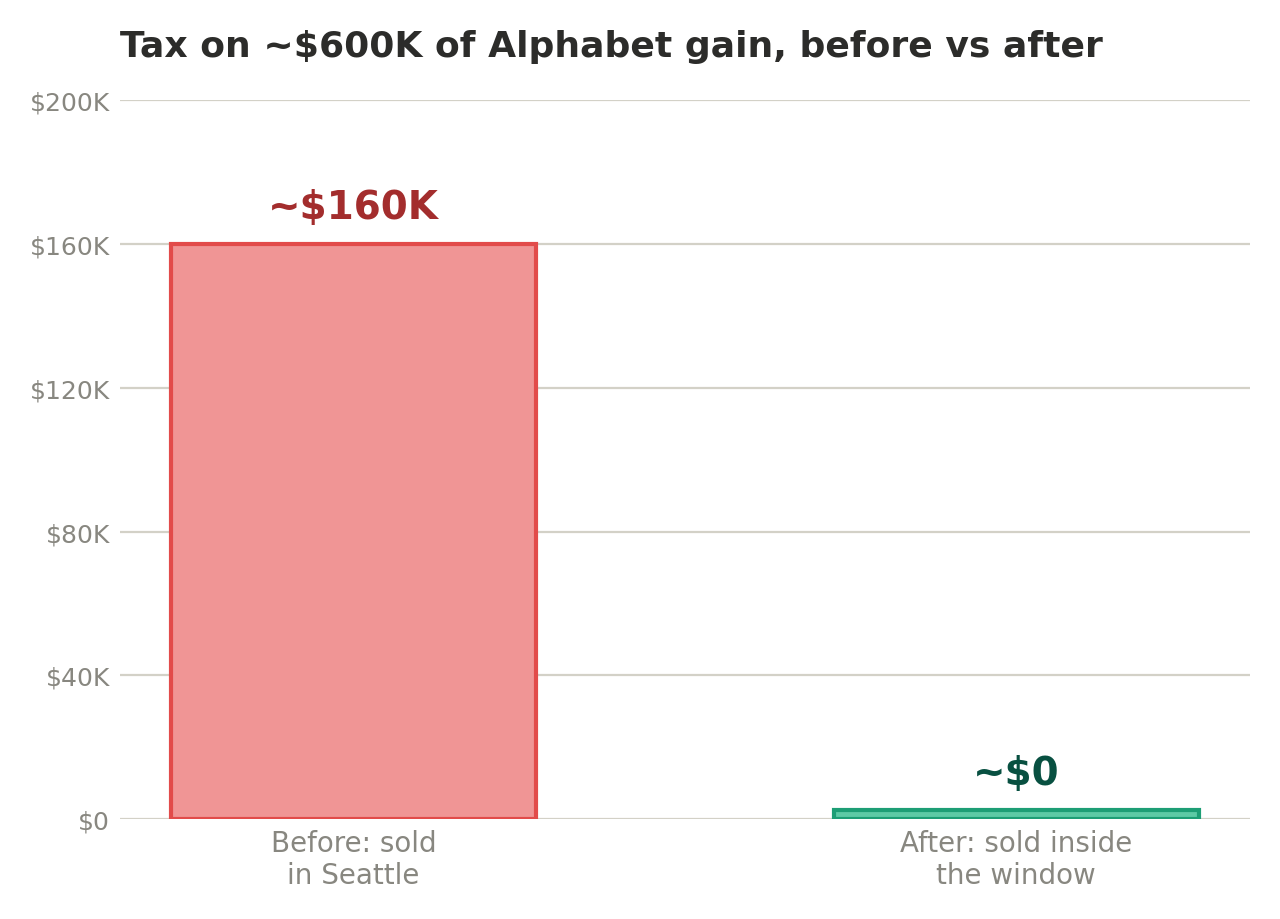
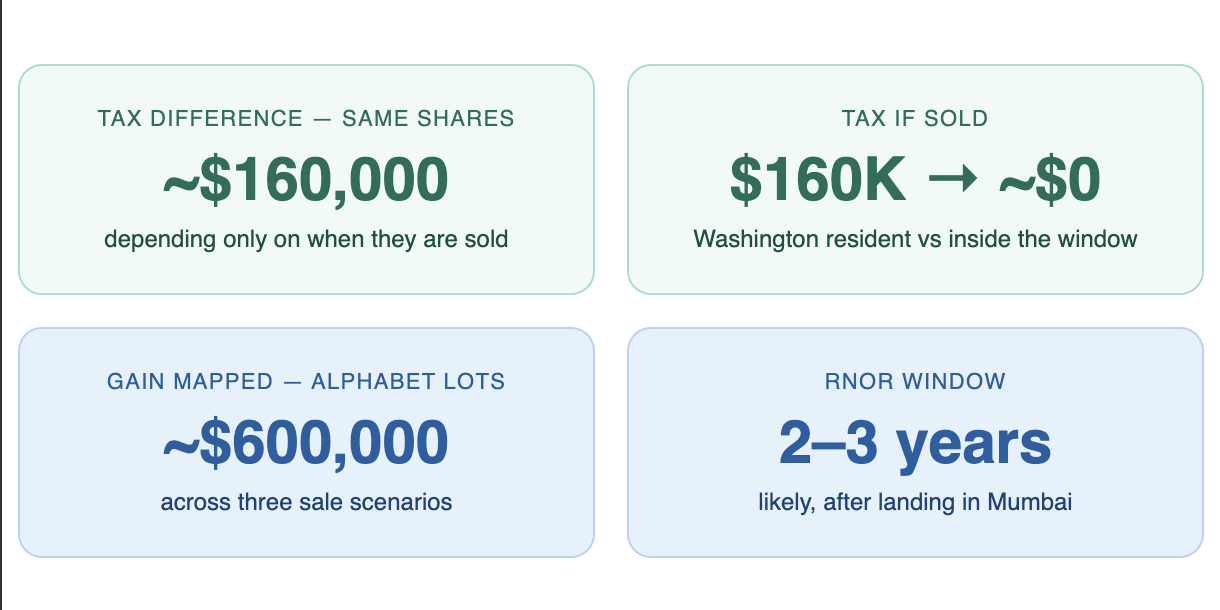
- A roughly $160,000 difference on the same Alphabet shares, depending only on when they are sold, with a written plan for the window if he chooses to use it
- The Mumbai down payment funded at a small taxable gain, from recent high-basis GSU lots
- Every post-move GSU vest pre-allocated between the US and India, so each is taxed once, in the right place
- One plan instead of two: his Seattle CPA and Mumbai CA work from the same numbers, and Arjun is no longer the messenger between them
Why This Worked
Nothing here was exotic. It took one person holding the US return, India's residency rules, the GSU schedule, and a move date in the same conversation, a year before the flight, while every choice could still land in the right tax year. Alphanso charges a flat fee and acts as a fiduciary, so there was no reason to push Arjun toward selling or holding, only toward deciding on purpose. If a move home is on your horizon, the window is worth mapping now. Request a callback.
This case study is a composite illustration based on real Alphanso client scenarios. Names and identifying details have been changed for privacy. Every figure is an example chosen to show how the math works. Cross-border tax treatment depends on residency facts, day counts, and treaty positions specific to each person, and this is not tax or legal advice. Results are not guaranteed and will vary based on individual circumstances. All investing involves risk, including the possible loss of principal. Alphanso LLC is a registered investment adviser.

Schedule demo with our advisors
What to expect