They had given $48,000 a year for six years, and the deduction was worth almost nothing.

The Situation
Dan is 44, a technical program manager at Anthropic, and his husband Paulo is a landscape architect with his own small practice. They have two kids, a house in Berkeley they will be paying off for a long time, and a household income around $460,000.
They are the kind of givers who make you slightly ashamed of your own habits. Four organizations, the same four since 2020, $48,000 a year between them, paid by automatic monthly transfer so it happens whether or not anyone is paying attention. Dan set it up the week his first grant vested at his previous employer and has raised it every year since.
They came to us about something else entirely, a 529 question. The giving came up in passing, in the way that the most valuable thing in a first meeting usually does.
The Gap We Found
Six years of giving, roughly $288,000 out the door, and the federal tax benefit was close to zero.
It was zero for an unglamorous reason. With the state and local tax deduction capped and their mortgage interest where it is, their itemized deductions sat just under the standard deduction in most years. For 2026 the standard deduction for a joint filer is $32,200. In the years they itemized, they cleared it by so little that most of the $48,000 was doing nothing. In the other years it did literally nothing.
Then 2026 added a floor. Charitable contributions are now deductible only above 0.5% of adjusted gross income, which for this household is about $2,300 a year off the top, and the benefit of itemized deductions for top-bracket taxpayers is capped at 35 cents per dollar rather than 37.
And they were giving cash, out of a checking account, while Dan held a position from his previous employer that he had not touched since 2021 and felt vaguely guilty about.
Nobody had done anything wrong. Their CPA files an accurate return and does not advise on how to fund a gift. Their old advisor managed an account and never saw the charitable transfers, because they left from the bank, not the brokerage. The two halves of the same decision were in two different buildings.
What We Did
We changed the asset first, because that is where the largest and simplest money was. Dan's legacy position was worth about $188,000 against a $52,000 basis. Giving shares instead of cash means the $136,000 of embedded gain is never taxed by anyone, worth roughly $50,000 in federal and California tax, and the deduction is the full market value rather than what he paid. The same generosity, funded from a different account, and his concentration came down as a side effect rather than as a project he had to psych himself up for.
Then we did something that runs against the advice I usually give, and I want to explain why.
The standard move here is bunching: put several years of giving into one year, clear the standard deduction by a wide margin, and grant it out slowly from a donor-advised fund. We did part of that. But we deliberately did not bunch all of it, because Anthropic's charitable match program has an annual ceiling, and an annual ceiling does not carry forward. Every year they gave less than the ceiling, the unused match evaporated on December 31 and was gone.
A deduction you cannot use this year carries forward for up to five years. A match you do not use this year is simply not there next year. Those two facts point in opposite directions, and when they conflict, the match wins, because it is the larger number and the more perishable one.
So the plan has two tracks. Every year, a gift of appreciated shares sized to capture the full match ceiling, made directly to the operating charities, because matching programs typically cover direct gifts rather than contributions to a donor-advised fund. Then, on top, a larger contribution into a donor-advised fund in the years it makes sense, to clear the standard deduction and bank deduction value against the year Dan's remaining equity settles.
The last piece took ten minutes and neither of them had ever done it. We opened the benefits portal together and read the actual program terms: what the ceiling is, whether equity qualifies, which recipients are eligible, and how long after a gift you have to file the request. That submission deadline is where most matches are lost. Dan now has a calendar reminder, which is a very boring answer to a question worth five figures a year.
The Result
- About $50,000 in federal and California capital gains tax permanently avoided on the legacy position, with no change to how much they give
- The four organizations receive roughly double what they had been receiving, once the employer match is captured each year
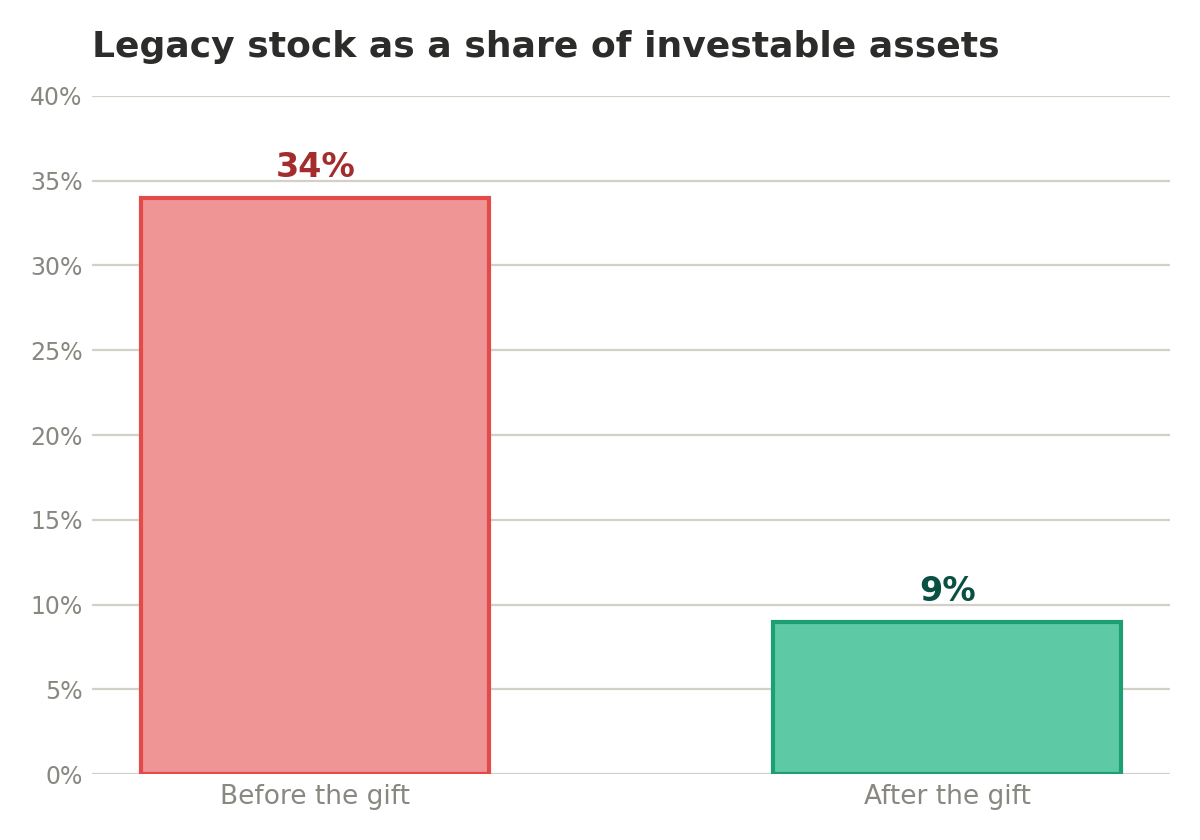
- Dan's single-stock concentration fell from 34% of investable assets to 9%, with no tax owed on the way down
- The charitable deduction is now actually usable, clearing the standard deduction in the years it is bunched instead of disappearing under it
- Paulo's reaction, which I am including because it is the real result: "We have been giving the same money for six years and nobody told us we were doing it the expensive way."
Why This Worked
There is a version of this story where the villain is a lazy advisor, and it is not true. Dan and Paulo were well served by everyone they worked with, inside the boundaries of what each person was hired to do. The gap was structural. Funding a charitable gift touches a brokerage account, a tax return, a benefits portal and a checking account, and the only way anyone notices is if one person is looking at all four. Because Alphanso charges a flat annual fee rather than a percentage of assets, telling Dan to give away $188,000 of his portfolio costs us nothing, which is exactly why the advice can be taken at face value. If you give every year and nobody has looked at how, that is worth an hour. Talk to an advisor.
This case study is a composite illustration based on real Alphanso client scenarios. Names and identifying details have been changed for privacy. Results are not guaranteed and will vary based on individual circumstances. All investing involves risk, including the possible loss of principal. Tax services are for educational purposes and do not constitute legal advice. Alphanso LLC is a registered investment adviser.

Schedule demo with our advisors
What to expect