He spent three years thinking about the equity and none thinking about the $420,000.
The Situation
Ryan is 33, an engineer who joined Anthropic in 2024. He lives alone in San Francisco, runs a lot, and is the sort of person who reads the primary source. Total compensation is right around the company median, about $420,000.
He did not come to us with a problem. He came to us with a question about the tender he had skipped, and he was slightly sheepish about taking up anyone's time, because as far as he could tell nothing was wrong.
Nothing was wrong. That is the point of this one.
The Gap We Found
Ryan had allocated his financial attention exactly backwards, and he is in extremely good company.
Everything he thinks about is the grant. What it might be worth. When it might settle. Whether to have tendered. He has read more about double-trigger RSUs than most advisors have. And the grant is the part of his compensation he cannot control at all.
Meanwhile the $420,000 arriving every year, which is genuinely large and entirely within his control, had been on autopilot since the day he onboarded. He contributed exactly enough to his 401(k) to capture the 4% match and no more. He had $210,000 sitting across checking and savings earning about 0.5%, because vest proceeds and bonuses had accumulated and nobody had ever told them where to go. His taxable account held one high-turnover fund he had picked in an afternoon in 2021. His bonds were in the taxable account and his highest-growth holdings were in the traditional 401(k), which is precisely backwards. He had never used the monthly wellness stipend.
His CPA files an accurate return. He does not have an advisor, because he did not think he needed one, and on the evidence of the equity he was right that he understood the complicated part. The boring part was the expensive one.
What We Did
The cash went first, because it is the fastest money in any engagement. The $210,000 moved into a Treasury bill ladder with the emergency reserve sized deliberately rather than by accumulation. At roughly 4.1% against the 0.5% it had been earning, that is about $7,600 a year.
Then asset location, which is a one-time restructuring with a permanent annual benefit and almost nobody does it. Tax-inefficient holdings moved into the tax-deferred accounts. The highest-growth holdings moved into Roth. Tax-efficient equities stayed in taxable. Nothing about his market exposure changed. Only which account holds what changed, worth about $3,900 a year in reduced tax drag. Replacing the high-turnover fund added roughly $2,400 more.
Then the piece that matters most and pays off latest. We moved his taxable account into a direct-indexed portfolio, which owns the index constituents directly instead of through a fund wrapper. That means losses can be harvested at the individual-stock level all year, every year. In the first year that generated about $38,000 of realized losses with no change to his market exposure.
Those losses are not for this year. They are banked against the year his equity settles, which is the year he will have an enormous gain to offset and will wish very much that somebody had started collecting losses three years earlier. Direct indexing is one of the few strategies where starting early is most of the value, and it is invisible until the year it is not.
We also fixed the 401(k) contribution, checked whether the plan supports after-tax contributions with in-plan conversion, and set up the stipend. That last one took four minutes and he laughed about it, which is fine. It is $6,000 a year he was declining.
The Result
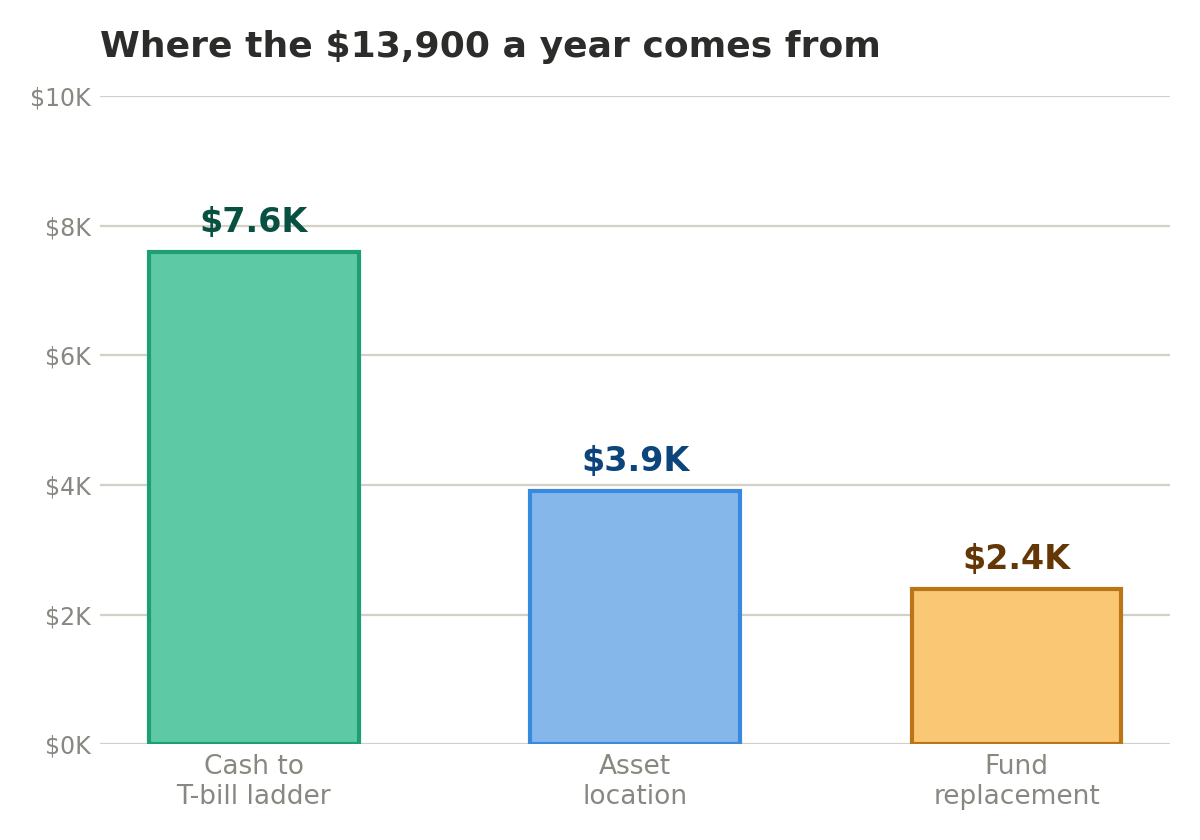
- About $13,900 a year in recurring savings, from cash, asset location and fund selection combined
- $38,000 of harvested losses banked in the first year, waiting for the year the equity settles
- $210,000 moved out of a 0.5% account into a ladder sized around an actual reserve target
- Asset location corrected, which is a one-time fix with a benefit that repeats every year he holds the portfolio
- He now spends less time thinking about the grant, which was the unexpected outcome. It turns out that fixing the part you control makes the part you cannot control easier to sit with.
Why This Worked
Ryan had not been failed by anyone, because he had not hired anyone. He is smart enough to have handled all of this himself, and that is exactly the trap. The equity is interesting, so it gets the attention. Cash allocation, asset location and lot-level harvesting are boring, so they get none, and they are where the recurring money is. Alphanso charges a flat annual fee and requires no asset transfer, so everything above happened in the accounts he already had, at the institutions he already used. If most of your financial attention goes to equity that has not settled, the other side of your balance sheet is probably worth an hour. Talk to an advisor.
This case study is a composite illustration based on real Alphanso client scenarios. Names and identifying details have been changed for privacy. Results are not guaranteed and will vary based on individual circumstances. All investing involves risk, including the possible loss of principal. Alphanso LLC is a registered investment adviser.
.png)
Schedule demo with our advisors
What to expect