He decided how much to sell nine months before there was a price to argue with.

The Situation
Marcus is 40, an engineering manager who joined Anthropic in 2023. He and his wife Renee live in Oakland with two kids, and Renee runs a small architecture practice that is finally profitable after four hard years.
Marcus has watched this movie before, from the cheap seats. Friends at two other companies held everything through a lockup expiry and regretted it. Other friends sold the week the lockup lifted, watched the stock double, and regretted that. He has heard both stories enough times to know that the version he ends up telling depends mostly on luck.
He called us in the spring, before there was anything concrete to react to, which is the entire reason this worked.
The Gap We Found
Every instinct Marcus had about this position was a judgment about his employer, and he is not in a position to be objective about his employer. Neither is anyone else who works there. That is not a character flaw, it is what proximity does.
What he needed was a rule written while the number was still abstract. And underneath that, a set of mechanics nobody had explained to him: when a 10b5-1 plan can be adopted, what the cooling-off period requires between adoption and the first trade, how blackout windows work, and what changes if he is promoted into a role that makes him a Section 16 officer.
His brokerage advisor manages a taxable account and has never handled a lockup. His CPA will see the consequences next March. Nobody had told him the single most important scheduling fact, which is that a 10b5-1 plan has to be adopted at a time when you do not hold material nonpublic information, and for most employees at a company approaching a listing, that window is now and not later.
We also ran the arithmetic he had not run. On his current trajectory, at settlement, the position would be about 78% of the household's net worth. He guessed 50% when we asked.
What We Did
We set the target first, before any price existed. Not "how much should I sell," which is unanswerable, but "what share of our net worth are we willing to have riding on one company." Marcus and Renee talked about it over a weekend and came back with 20%. That conversation is much easier to have about an abstraction than about a number on a screen with a green arrow next to it.
Everything else fell out of that. A systematic sell schedule sized to move from roughly 78% toward the 20% target over eight quarters following the lockup, sequenced across tax years and selected by lot rather than sold indiscriminately. The rest of the portfolio was restructured into a direct-indexed sleeve that deliberately underweights AI and software, so the diversification is real rather than cosmetic, and so harvested losses accumulate all year and are available to pair against the equity sales.
Then we mapped the execution constraints on a calendar: when a plan can be adopted, the cooling-off period that has to elapse before the first trade, the blackout windows, and what changes if his role changes. He now has dates, not intentions.
And we named what the plan gives up, because a plan you do not understand the cost of is a plan you abandon. If the stock runs after the lockup, a pre-set schedule leaves money on the table, and Marcus will feel that. We said so in the meeting where he signed off, not afterwards. Renee's response was the one that decided it: "I would rather be annoyed than wiped out."
The Result
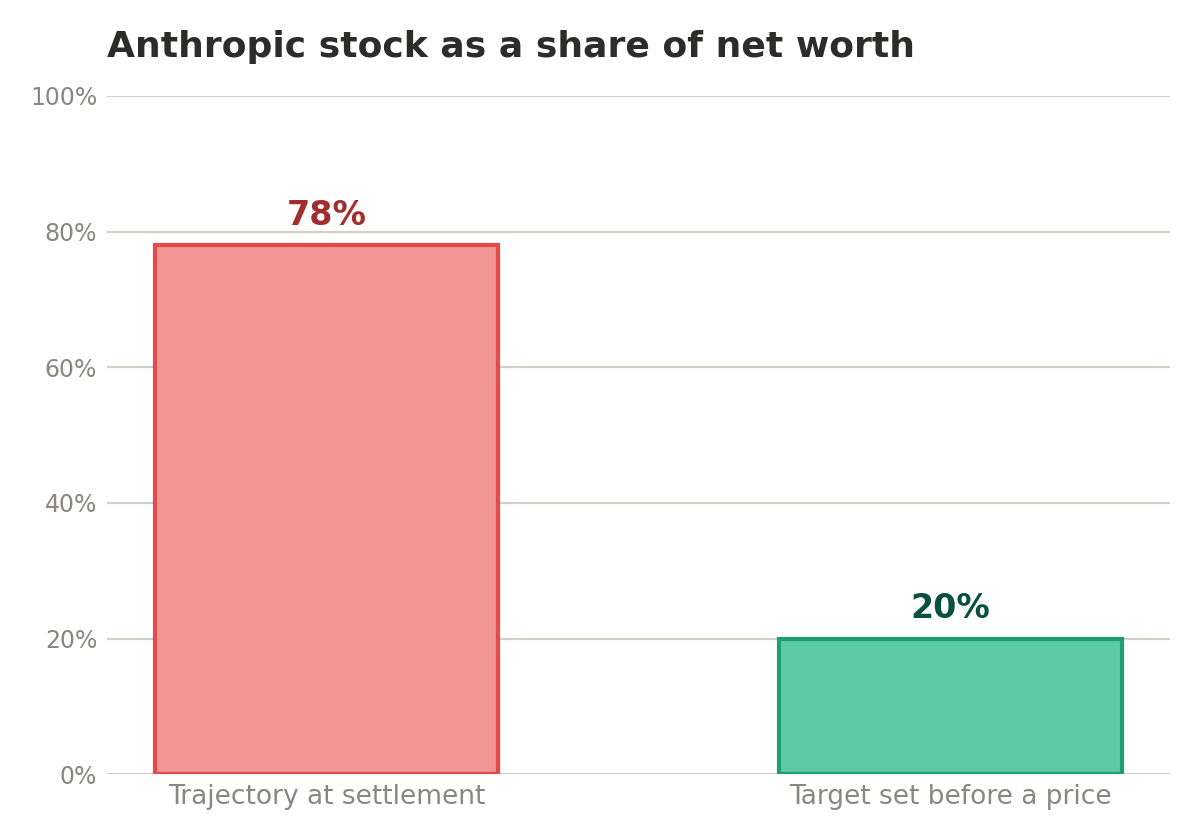
- A target allocation of 20% set before a price existed, against a trajectory that would have put them at about 78%
- A dated sell schedule across eight quarters, sequenced by tax year and selected by lot, rather than a decision made in the week it would be hardest to make well
- A direct-indexed portfolio underweighting the sector he already works in, so the losses harvested all year are available to pair against the equity sales
- The 10b5-1 calendar mapped, including adoption timing and the cooling-off period, so nothing depends on remembering to act during a busy quarter
- The decision is made. Whatever the price does, he is not making it again at 6am on a Tuesday.
Why This Worked
Marcus's advisor and CPA were both doing exactly what they were hired for. Neither was hired to notice that a concentration decision, a trading-plan deadline and a tax-lot strategy are the same decision, made once, well before the event. That noticing requires reading a grant schedule, a portfolio, a tax projection and a securities-law calendar together, which is what an integrated team is for. Alphanso charges a flat annual fee and takes no percentage of assets, so a plan that systematically sells down his largest holding earns us nothing either way. If your company is anywhere near a listing and your plan is to decide later, later is the expensive option. Talk to an advisor.
This case study is a composite illustration based on real Alphanso client scenarios. Names and identifying details have been changed for privacy. Results are not guaranteed and will vary based on individual circumstances. All investing involves risk, including the possible loss of principal. Nothing here is a recommendation to buy, sell or hold any security, and no statement here should be read as a prediction of any company's public offering. Alphanso LLC is a registered investment adviser.
.png)
Schedule demo with our advisors
What to expect