A senior director found a $149,000 tax gap with three weeks to fix it.

The Situation
Marcus is 44, a senior director at NVIDIA, divorced with two kids in middle school, living in Santa Clara. Base salary $340,000, an annual bonus, and RSUs on the legacy schedule that vest every March, June, September and December. In 2026 those vests were worth about $1.15 million.
He had a good CPA, one who had filed his returns cleanly for eight years and had never once given him bad advice. He also had a financial advisor managing an IRA rollover. What he did not have was anyone looking at his pay stub between April and April.
The Gap We Found
NVIDIA, like every large employer, withholds federal tax on supplemental wages at a flat 22% until cumulative supplemental wages pass $1 million, then 37%. Marcus's actual federal marginal rate is 35%. California withholds at a flat 10.23% on supplemental wages while his marginal state rate is 12.3%, and California's disability insurance assessment no longer has a wage cap, so it applies to every dollar of every vest. Each of those is a small gap. Stacked across $1.15 million of vesting, they compounded into a $149,000 federal shortfall and another $24,000 at the state level, all of it silently accruing underpayment penalties from the first quarter forward.
What We Did
Alphanso's AI agents parse client payroll continuously. They pulled Marcus's year-to-date withholding, compared it against a projection of his actual liability including the March, June and September vests, and flagged the gap in late August, with three weeks before the September 15 quarterly deadline.
We sized the payment two ways: the amount needed to reach safe harbor at 110% of his prior-year tax, and the amount needed to actually cover the liability. Safe harbor stops the penalty; covering the liability stops the April surprise. Marcus paid to the second number because he'd rather not owe.
Then we fixed the structure so this wasn't an annual fire drill. The December vest was pre-modeled in November so the Q4 payment was known before the shares hit. We instituted sell-at-vest on all four quarterly tranches, which meant zero capital gains on those lots and a predictable cash flow to pay estimates from. And because the vests now produced cash instead of shares, we could finally do the things a $1.15 million equity year makes possible: a donor-advised fund seeded with his lowest-basis legacy lots, a backdoor Roth for the first time, and a 529 contribution schedule for both kids.
The Result
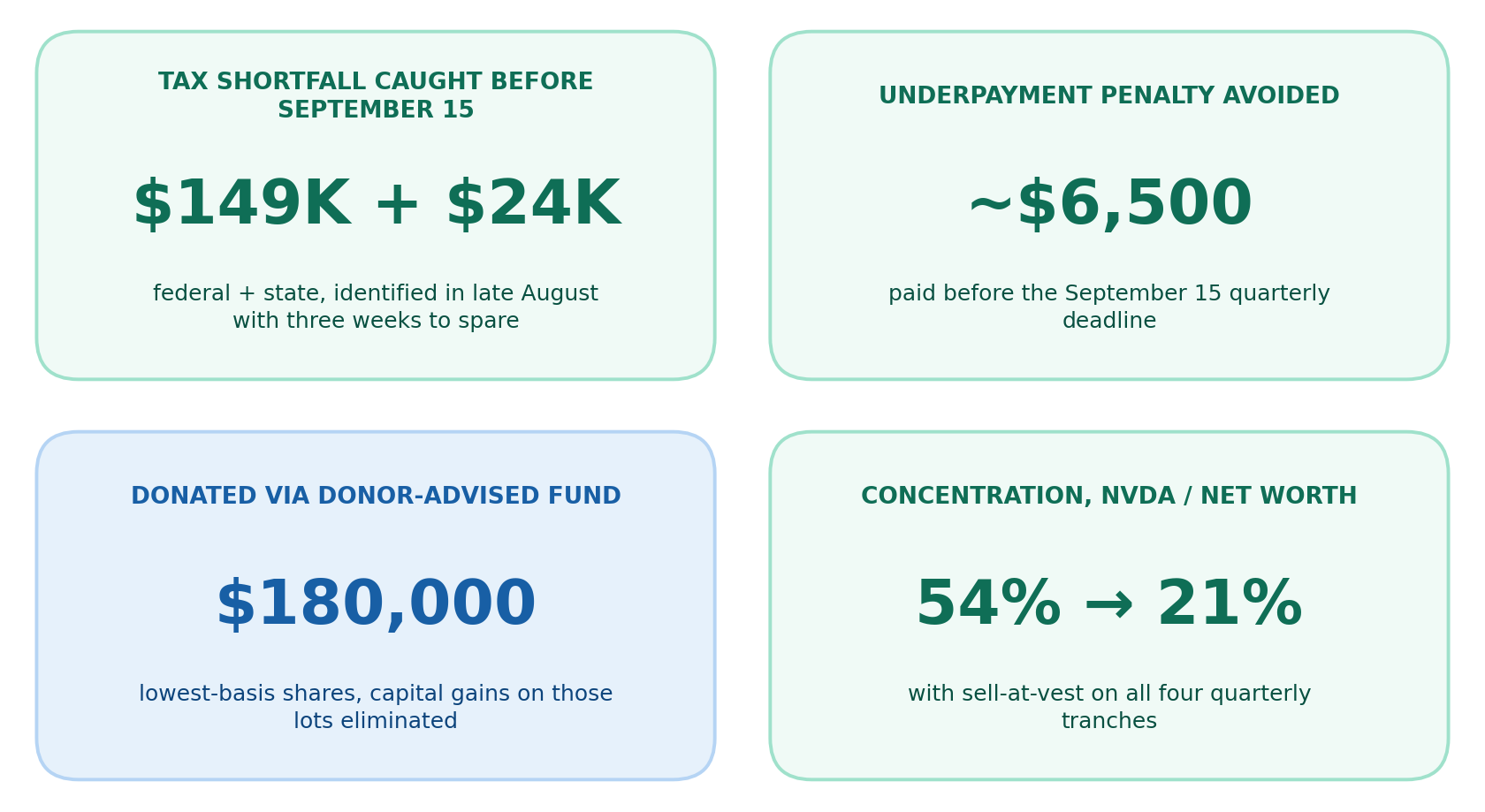
- $149,000 federal and $24,000 state shortfall identified and paid before September 15, avoiding an estimated $6,500 in underpayment penalties
- Q4 payment calculated in November, before the December vest, no April surprise for the first time in six years
- $180,000 donated via a donor-advised fund using his lowest-basis shares, eliminating the capital gains on those lots entirely
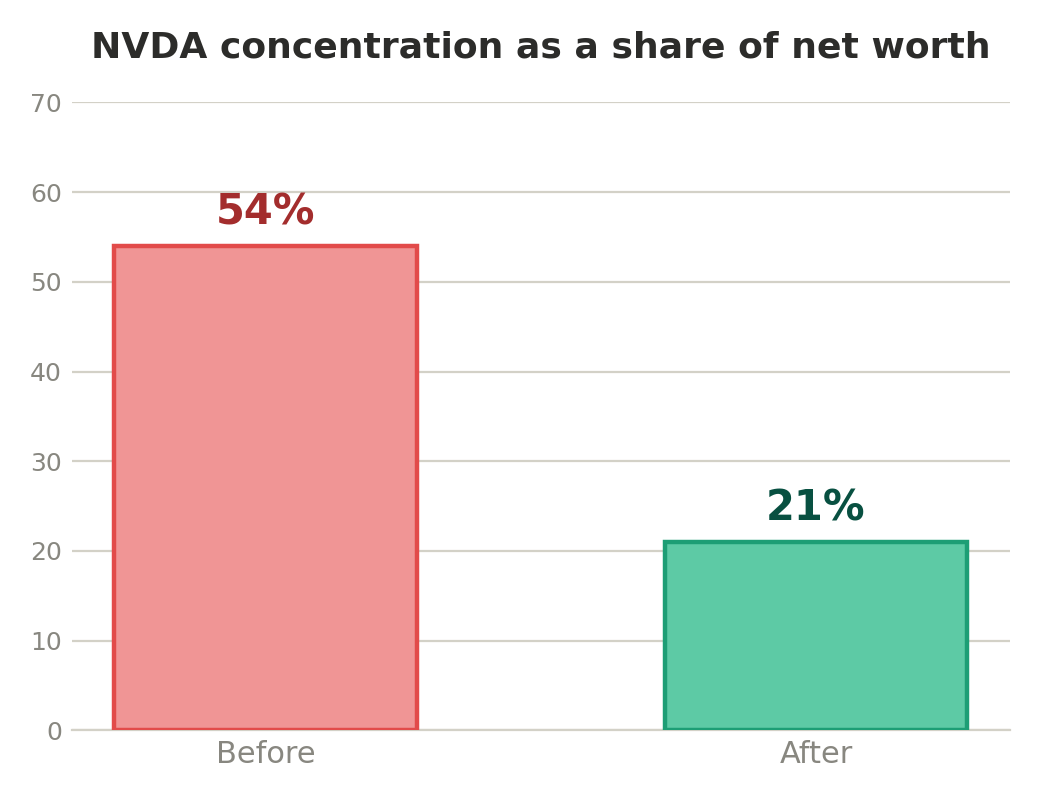
- Concentration in NVDA down from 54% of net worth to 21%
Why This Worked
Marcus's CPA sees his numbers once a year, after the year is over, which is the correct time to file a return and the wrong time to change an outcome. His employer's payroll system applies the statutory withholding rate correctly and has no idea what his marginal rate is. Alphanso sits between them all year, which is the only vantage point from which a September problem is still a September problem.
If you've ever opened a tax bill you didn't see coming, let's make that the last one.
This case study is a composite illustration based on real Alphanso client scenarios. Names and identifying details have been changed for privacy. Results are not guaranteed and will vary based on individual circumstances. All investing involves risk, including the possible loss of principal. Alphanso Inc is a registered investment adviser.

Schedule demo with our advisors
What to expect