He wants to retire at 62. Memory cycles don't care about that.

The Situation
Robert is 58, a senior manufacturing manager at Micron's Manassas fab, twenty-two years with the company. His wife Diane retired from county government two years ago with a small pension. They have $1.9 million in his 401(k), $2.8 million in Micron stock across ESPP lots and vested RSUs, and a paid-off house in Northern Virginia.
Robert's plan was simple and, on the numbers, entirely achievable: retire at 62, travel for a decade, help with grandkids. He'd been telling himself this for years and the stock's 2026 run had made it feel not just achievable but early.
The Gap We Found
The plan worked beautifully in the scenario where Micron's price on his retirement date resembles today's. It did not work in the scenario where memory does what memory does. Micron has drawn down roughly 50% twice in five years. With 68% of the couple's investable assets in one cyclical semiconductor stock, a downturn arriving in 2029 or 2030, exactly when he'd start withdrawing, wouldn't just reduce the balance, it would force him to sell into the decline to fund living expenses. That's sequence-of-returns risk, and it's the specific way early retirements get postponed by four years.
What We Did
We de-risked on a schedule, not a hunch. A 10b5-1 plan sells a set amount of Micron quarterly over four years, running automatically through open and closed windows alike. Proceeds build a five-year bond ladder covering ages 62 through 67, so the first five years of retirement spending are already funded and immune to what the stock does.
Then we mapped the tax window almost nobody uses. Between retiring at 62 and starting required minimum distributions, Robert has years with very little ordinary income, before Social Security, before RMDs. We built a Roth conversion ladder that fills the 24% bracket each of those years, moving money out of a traditional IRA that will otherwise be taxed at a higher rate later, when RMDs and Social Security stack on top of each other. We also modeled health insurance from 62 to 65, where conversion income interacts directly with marketplace premium credits, a tradeoff that has to be solved alongside the conversions, not after them.
Finally, the foundation. Their estate documents dated to 2009 and named a guardian for children who are now in their thirties. We updated the will, established a revocable living trust to keep the Virginia house out of probate, and corrected beneficiary designations on two accounts that still listed Robert's late father.
The Result
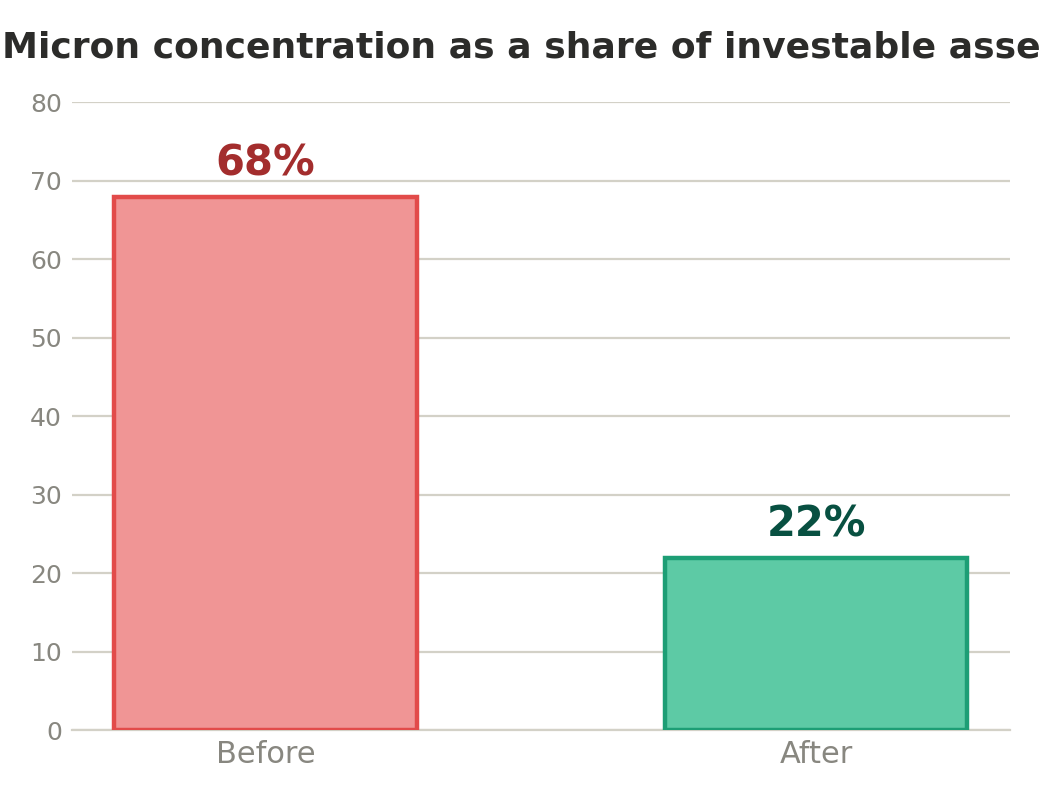
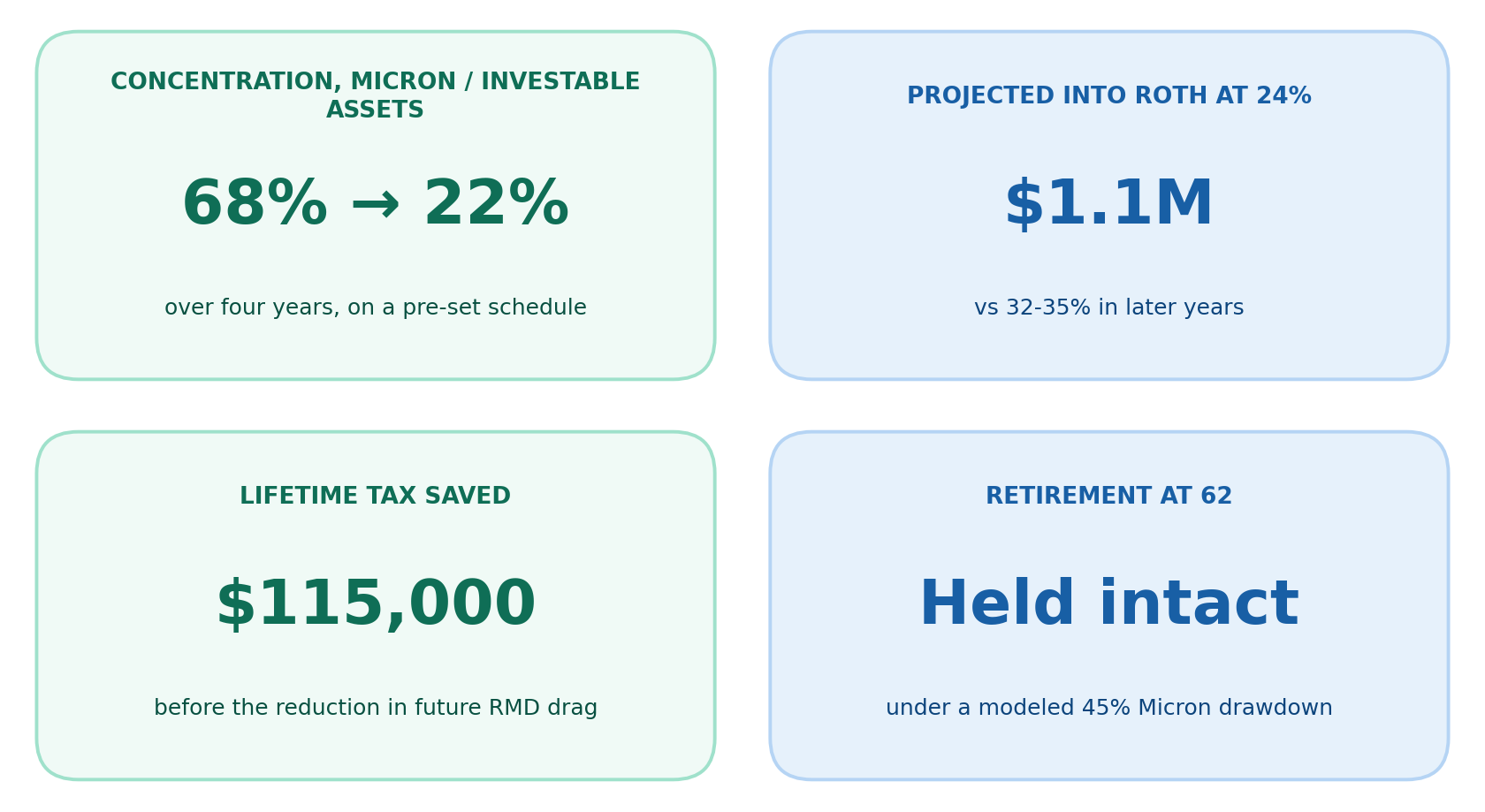
- Micron fell from 68% of investable assets to 22% over four years, on a pre-set schedule
- $1.1 million projected to move into Roth accounts at 24% rather than 32-35% in later years, roughly $115,000 in lifetime tax saved, before the reduction in future RMD drag
- Retirement at 62 held intact under a modeled 45% Micron drawdown, because the first five years are funded from bonds
- Estate documents, trust and beneficiaries brought current for the first time since 2009
Why This Worked
Robert's 401(k) provider showed him a balance. His broker showed him a position. His attorney last saw him when his kids were in middle school. The plan he needed required the drawdown sequence, the conversion ladder, the health insurance bridge and the estate documents to be solved as one thing, because each one changes the answer to the others. Integration is the whole point, and a flat fee means nobody earns more by steering him toward a product.
If retirement is inside five years and a single stock is more than a quarter of the plan, let's stress-test it.
This case study is a composite illustration based on real Alphanso client scenarios. Names and identifying details have been changed for privacy. Results are not guaranteed and will vary based on individual circumstances. All investing involves risk, including the possible loss of principal. Alphanso Inc is a registered investment adviser.

Schedule demo with our advisors
What to expect