Her equity takes seven years to settle. Her visa renews in three.
The Situation
Ananya is 33, an infrastructure engineer who joined Anthropic in 2023. She has been in the United States since 2017, first as a student and now on an H-1B. Her husband Vikram works in product at a healthcare company. Their daughter was born in Oakland, which makes her an American, which is a sentence Ananya still finds strange to say out loud.
She holds double-trigger RSUs and a smaller tranche of early options. On paper the household is in excellent shape.
She reached out after a colleague was laid off at another company and had sixty days to find a new sponsor. Nothing had happened to her. She just wanted to know what would happen if it did.
The Gap We Found
Three clocks were running in her life and nobody had ever put them on the same page.
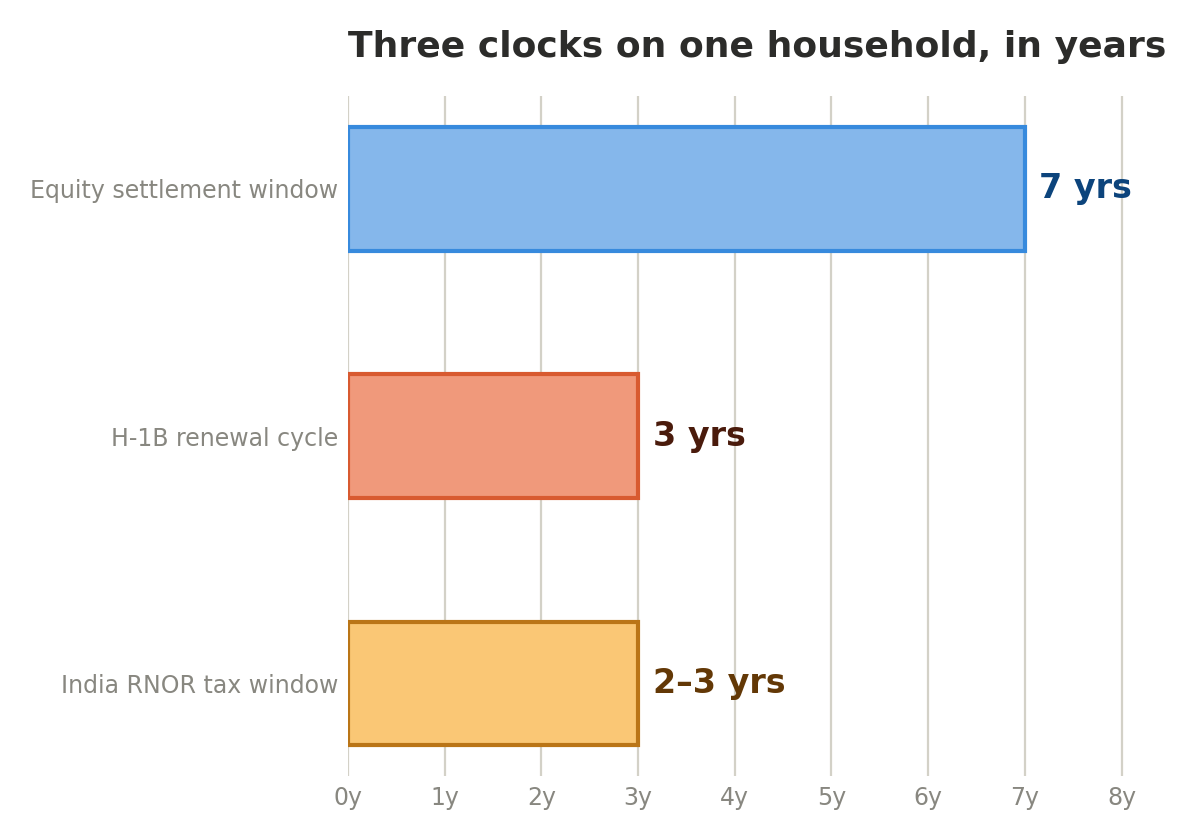
The equity clock is long. Double-trigger units settle only on a qualifying liquidity event, and the window for that to happen runs years out. The immigration clock is shorter and renews on its own schedule. And the green card backlog for Indian nationals is measured in a timeframe that makes both of the others look brief.
Her plan, like most people's, quietly assumed an uninterrupted American career. That assumption had never been examined, because examining it is unpleasant and because no one in her financial life had a reason to raise it. Her CPA files a correct return. Her employer's benefits team handles benefits. Her immigration attorney handles immigration and does not see her cap table.
The specific things nobody had modeled: what happens to unsettled double-trigger units if employment ends, which is generally that they terminate and the paper wealth evaporates. What the US tax treatment of her equity looks like if she becomes a non-resident before it settles. And whether a deliberate return to India, if they ever chose it, could be sequenced inside the RNOR window rather than after it.
That last one is the largest single number in the engagement and it has a hard expiry.
What We Did
We documented the separation scenario first, because it was the one keeping her awake. What terminates, what survives, what the grace period actually gives her, and what the household's runway looks like in that world. It is not a pleasant document. It is considerably less unpleasant than not having it.
Then we modeled the return scenario properly, as a plan rather than a fear. A returning non-resident Indian gets a two to three year RNOR window during which foreign income and gains are not taxed in India. It expires whether or not it is used, and most people discover it after it has closed. Sequencing a Roth liquidation, the equity sales, and the restructuring of their US accounts inside that window, paired with treaty rate optimization under the US-India DTAA, projected about $47,000 of combined planning benefit for their situation.
That number is not a reason to move to India. It is the difference between moving well and moving expensively, and it only exists if the decision is made with two or three years of runway rather than two or three months.
Then we did the layer cross-border families skip almost universally. Beneficiary designations across both countries. Titling on the US accounts. Probate exposure on US-situs assets for a non-citizen spouse, which is a genuinely ugly surprise and entirely avoidable with a revocable trust and an hour of paperwork. Their daughter's US citizenship creates its own set of considerations that neither of them had thought about at all.
I want to be clear about the boundary. We do not advise on immigration. Ananya's attorney handles that and should. What we did was take the immigration facts as given and ask what they mean for the money, which is a question her attorney is not paid to answer and her CPA cannot see.
The Result
- About $47,000 of projected planning benefit identified in the RNOR sequencing, available only if a return is planned years ahead rather than months
- A written separation scenario, including exactly what happens to unsettled equity, which turns a recurring anxiety into a document
- Cross-border estate exposure closed: beneficiaries corrected across both countries, titling fixed, probate risk on US assets addressed
- A plan that holds up under three futures instead of assuming one
- She stopped treating the layoff question as unspeakable. It is now a page in a binder.
Why This Worked
Ananya's immigration attorney is good and her CPA is accurate. Neither of them is in a position to notice that a seven-year equity horizon and a three-year visa horizon are on a collision course, because doing so requires holding a grant agreement, a visa status, an Indian tax rule and an estate plan in view at once. That is the whole job. Alphanso charges a flat annual fee and requires no asset transfer, so none of this advice moves money to us. If you hold significant equity on a temporary status and nobody has modeled what happens if that status changes, that gap is worth closing before it matters. Talk to an advisor.
This case study is a composite illustration based on real Alphanso client scenarios. Names and identifying details have been changed for privacy. Results are not guaranteed and will vary based on individual circumstances. Nothing here constitutes immigration or legal advice. Alphanso LLC is a registered investment adviser.

Schedule demo with our advisors
What to expect