His VMware shares became Broadcom shares. Nobody kept the paperwork.
The Situation
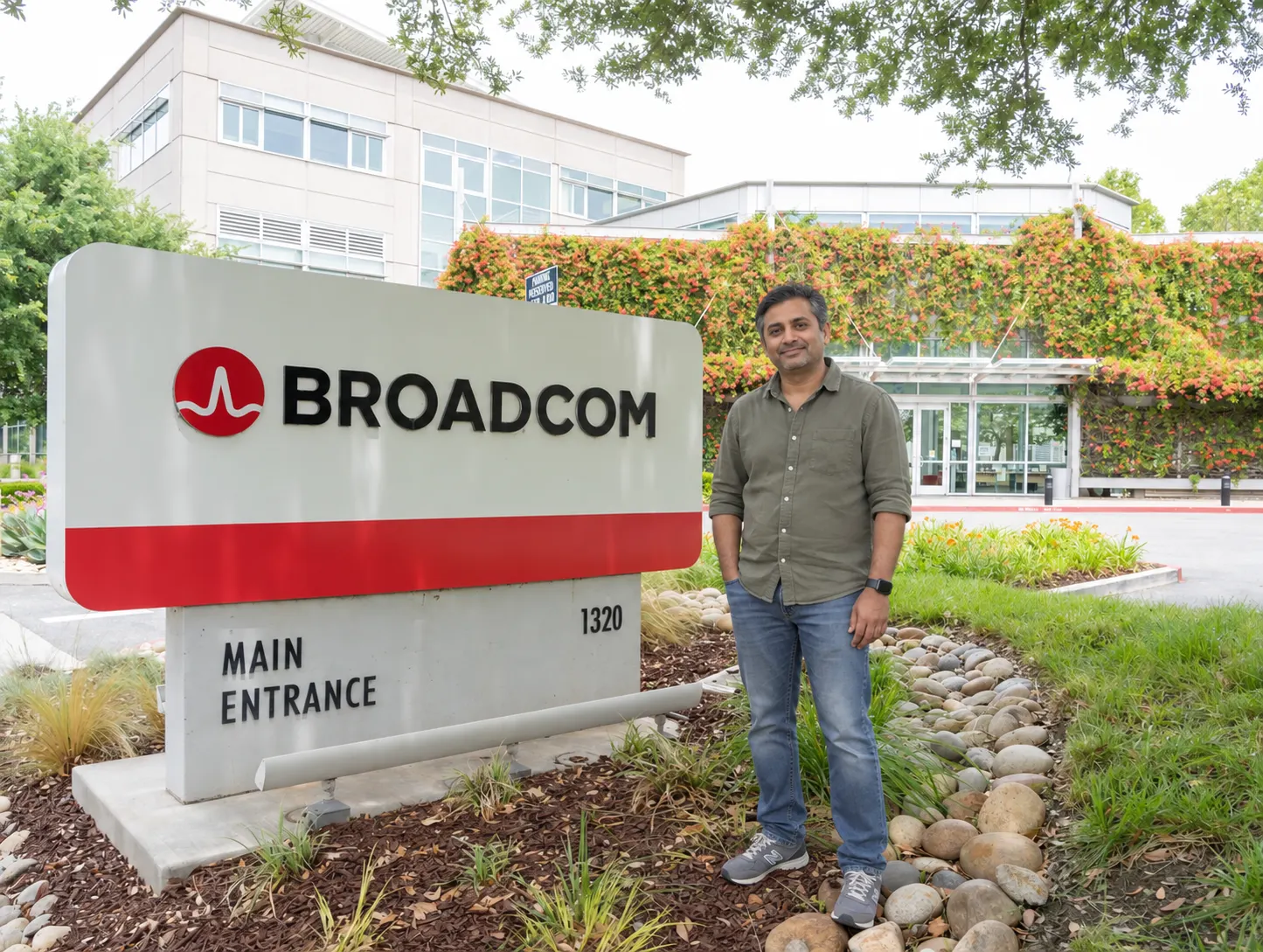
Sanjay is 45, a staff engineer in Palo Alto, married with two kids in elementary school. He spent eleven years at VMware and became a Broadcom employee when the acquisition closed in November 2023. His unvested VMware RSUs converted to Broadcom RSUs on their original vesting schedules. His in-the-money options were settled at close, half in cash and half in Broadcom stock, with no election on his part.
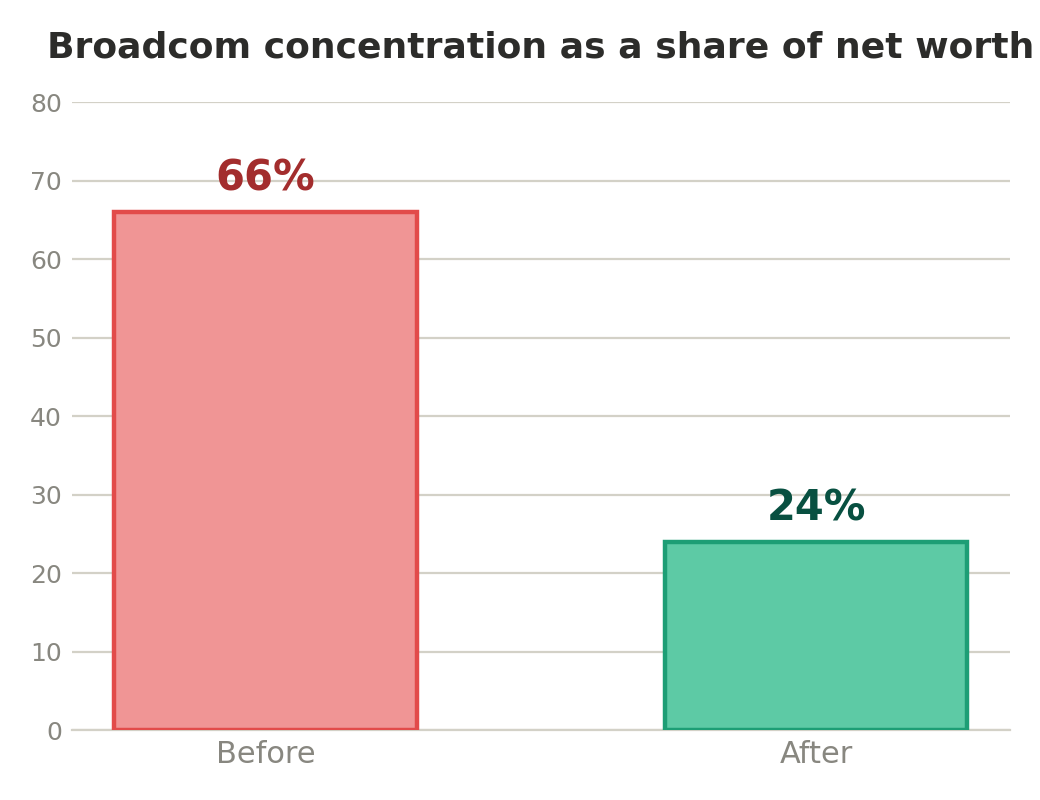
What happened next was good for him and confusing for his records. Broadcom rose sharply through 2024 and 2025. His position grew to about $1.9 million, 66% of the family's net worth, and then gave back a meaningful chunk as the stock traded well below its high through 2026.
The Gap We Found
Sanjay could not tell us what he paid for his own shares. Neither could his brokerage. Between the VMware-to-Broadcom conversion ratio, the cash-and-stock option settlement, the 10-for-1 stock split in July 2024, and eleven years of VMware grants underneath all of it, a large block of his holdings showed an unknown or plainly wrong cost basis. That isn't a bookkeeping annoyance. Without a basis, every share is treated as though it cost nothing, and every sale is taxed on the full proceeds. It had also quietly frozen him: he wouldn't diversify because he didn't know what diversifying would cost.
What We Did
We reconstructed the basis lot by lot. VMware grant documents, the merger conversion terms, the option settlement statements, and the split adjustment, each lot traced back to what he actually paid and when the holding period started. Tedious, and the single highest-value hour of the engagement.
What the reconstruction revealed changed the plan. A meaningful block of shares, roughly $340,000 worth, had a basis above the current price, because Broadcom was trading well below its high. Those were losses, sitting unrecognized. We harvested $81,000 of them and used the losses to offset gains realized on the oldest, lowest-basis VMware-legacy lots in the same year. Diversification that would have cost him real money instead cost him almost nothing.
The rest moved out on a 10b5-1 plan over eighteen months into a direct indexed portfolio, which keeps harvesting losses year-round against whatever gains come next. And because his estate documents still named VMware accounts and a beneficiary arrangement from 2016, we updated the will, put a revocable living trust around the Palo Alto house, and corrected every beneficiary designation.
The Result
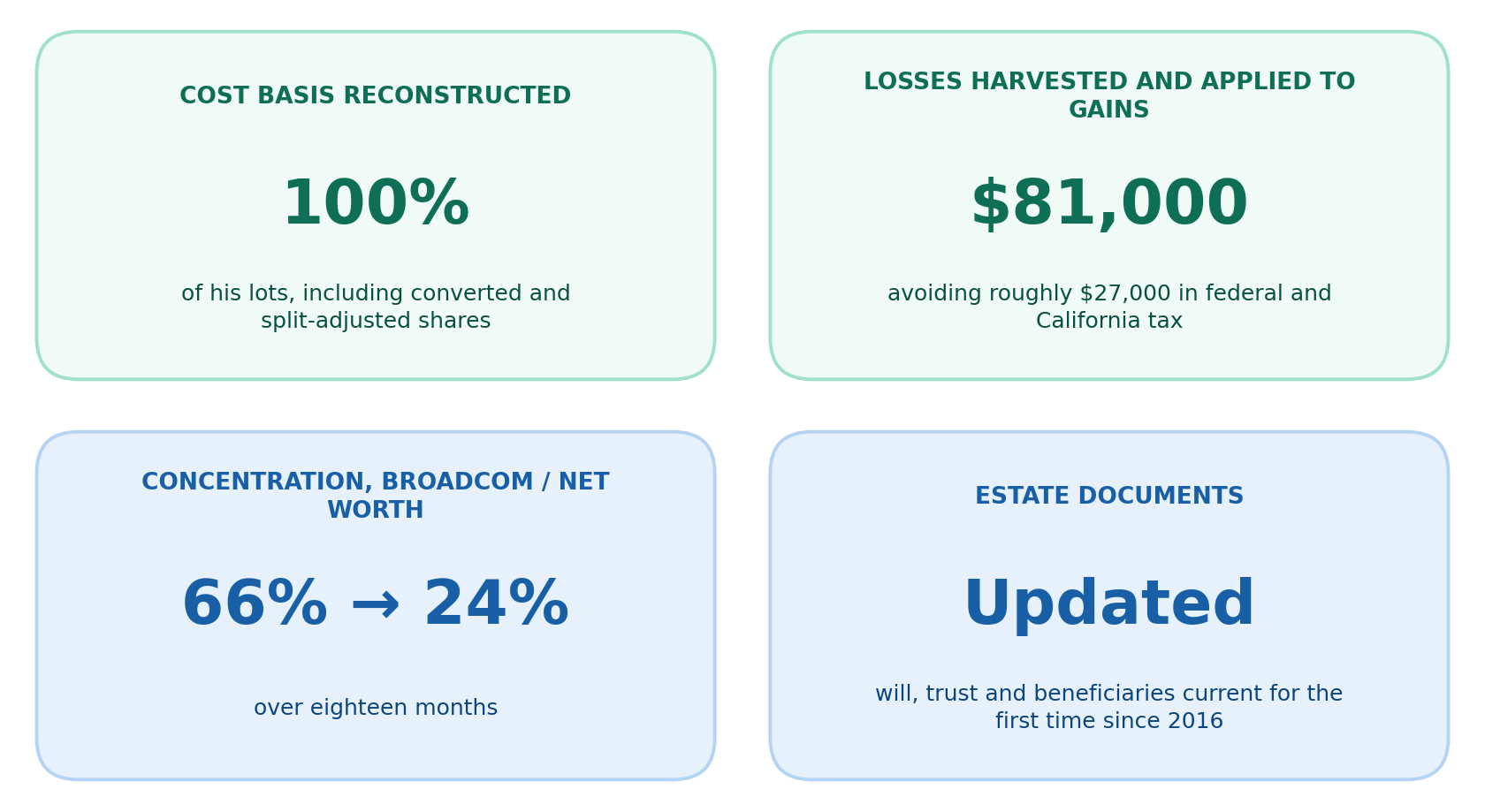
- Cost basis reconstructed on 100% of his lots, including the converted and split-adjusted shares his brokerage had marked unknown
- $81,000 of losses harvested and applied against $81,000 of gains, avoiding roughly $27,000 in federal and California tax
- Broadcom concentration fell from 66% of net worth to 24% over eighteen months
- Will, trust and beneficiary designations updated for the first time since 2016
Why This Worked
Sanjay's broker reports what it was told at transfer, which in a merger is often not much. His CPA works from the broker's numbers. Nobody in that chain is responsible for reconstructing a basis across an acquisition, a settlement and a split; it falls between all of them. Finding it took someone looking at the compensation history, the tax return and the portfolio as one file. Because Alphanso charges a flat fee, the hours spent on that reconstruction weren't a cost center; they were the job.
If your equity came through an acquisition, start with what you actually paid for it.
This case study is a composite illustration based on real Alphanso client scenarios. Names and identifying details have been changed for privacy. Results are not guaranteed and will vary based on individual circumstances. All investing involves risk, including the possible loss of principal. Alphanso Inc is a registered investment adviser.

Schedule demo with our advisors
What to expect