His Xilinx shares became AMD shares. Then they became 64% of everything.

The Situation
Wei is 52, a principal FPGA architect in San Jose. He joined Xilinx in 2014, accumulated eight years of grants there, and became an AMD employee when the acquisition closed in February 2022. His Xilinx shares converted into AMD shares at the exchange ratio, carrying their original cost basis with them.
What followed was a stress test. AMD fell more than half in 2022. It recovered, fell again in 2024, and then ran more than threefold through 2026. Wei held through all of it, partly conviction, partly inertia, and partly because his oldest lots have a basis so low that selling felt like handing money to the IRS. His AMD position reached $2.4 million: 64% of his and his wife's net worth, with a daughter starting college in two years.
The Gap We Found
Wei's reluctance wasn't irrational, it was just incomplete. He was weighing the certain cost of capital gains tax against the uncertain cost of a concentrated position, and the second number is hard to feel until it happens. What nobody had shown him was the third option: that the gains could be substantially offset rather than simply paid, using tools that live in three different professionals' lanes at once.
What We Did
We started with the lots, not the position. Eight years of Xilinx grants plus the conversion plus AMD's subsequent grants meant dozens of tax lots at wildly different bases. We rebuilt the full lot table, then sequenced sales by specific lot identification, highest basis first, which released the largest share of the position for the smallest amount of gain.
For the lowest-basis lots, we used charity instead of a sale. Wei and his wife were already giving about $20,000 a year in cash. We redirected that giving through a donor-advised fund funded with $200,000 of his oldest, lowest-basis shares. He deducts the full market value, the embedded capital gain is never realized by anyone, and the fund distributes to the same causes on the same schedule.
The rest moved through a 10b5-1 plan over 24 months into a direct indexed portfolio, which harvests losses continuously and produces the offsets that make the remaining gains far cheaper to realize. College funding came out of a municipal bond ladder built from the proceeds, so tuition no longer depends on AMD's price in any given September.
The Result
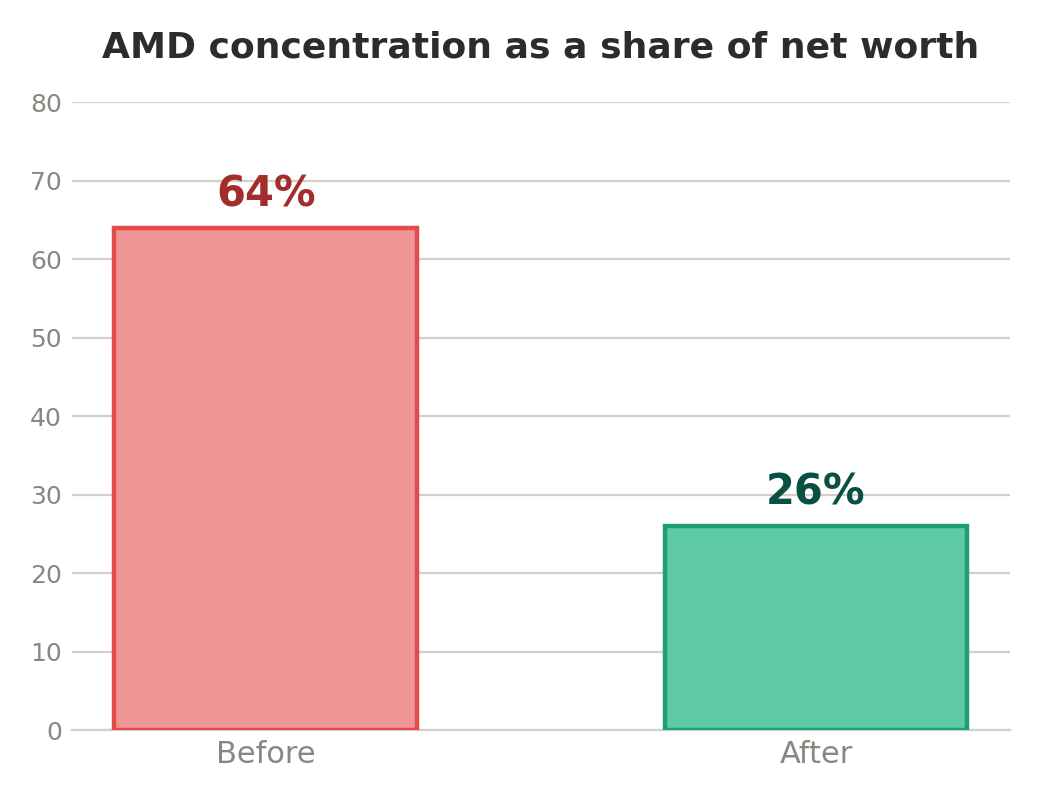
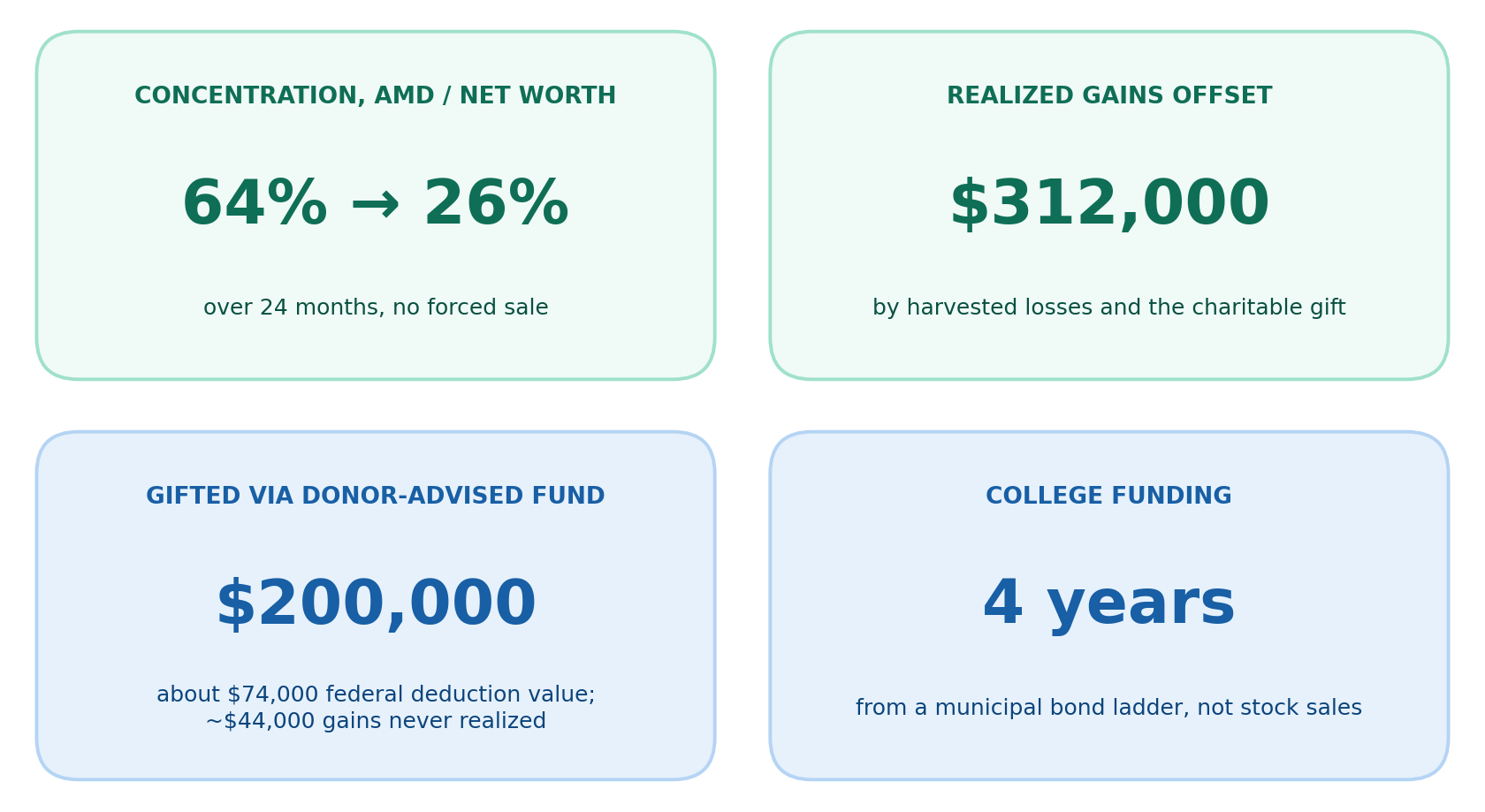
- AMD fell from 64% of net worth to 26% over 24 months, without a forced sale or a single decision made in a panic
- $312,000 of realized capital gains offset by harvested losses and the charitable contribution
- $200,000 gifted through a donor-advised fund, roughly $74,000 of federal deduction value, with about $44,000 of embedded capital gains never realized by anyone
- Four years of tuition funded from a bond ladder rather than from stock sales at whatever price happens to exist that month
Why This Worked
Wei's CPA could have told him the tax cost of selling. His investment advisor could have told him the risk of not selling. His estate attorney could have told him what happens to low-basis stock at death. Each answer was correct and none of them was the plan, because the plan required all three at once: the giving, the harvesting, the lot selection, and the college timeline solved as one problem. That integration is the entire product, and a flat fee means we don't earn more by recommending one piece over another.
If a position you're proud of has quietly become a position you're exposed to, let's build the exit calmly.
This case study is a composite illustration based on real Alphanso client scenarios. Names and identifying details have been changed for privacy. Results are not guaranteed and will vary based on individual circumstances. All investing involves risk, including the possible loss of principal. Alphanso Inc is a registered investment adviser.

Schedule demo with our advisors
What to expect