She moved to Austin in July. California still wanted its share.

The Situation
Elena is 39, a product engineering manager who spent six years at AMD's Santa Clara site before transferring to Austin in July 2026. She and her husband bought a house outside the city, enrolled their two kids in a new school, and did what nearly everyone does when they move from California to Texas: they assumed the state tax problem was now behind them.
Elena had done her homework on the obvious things. She updated her W-4, changed her address with payroll, and confirmed Texas has no state income tax. Her November vest was going to be worth roughly $410,000, and she had it budgeted as Texas income.
The Gap We Found
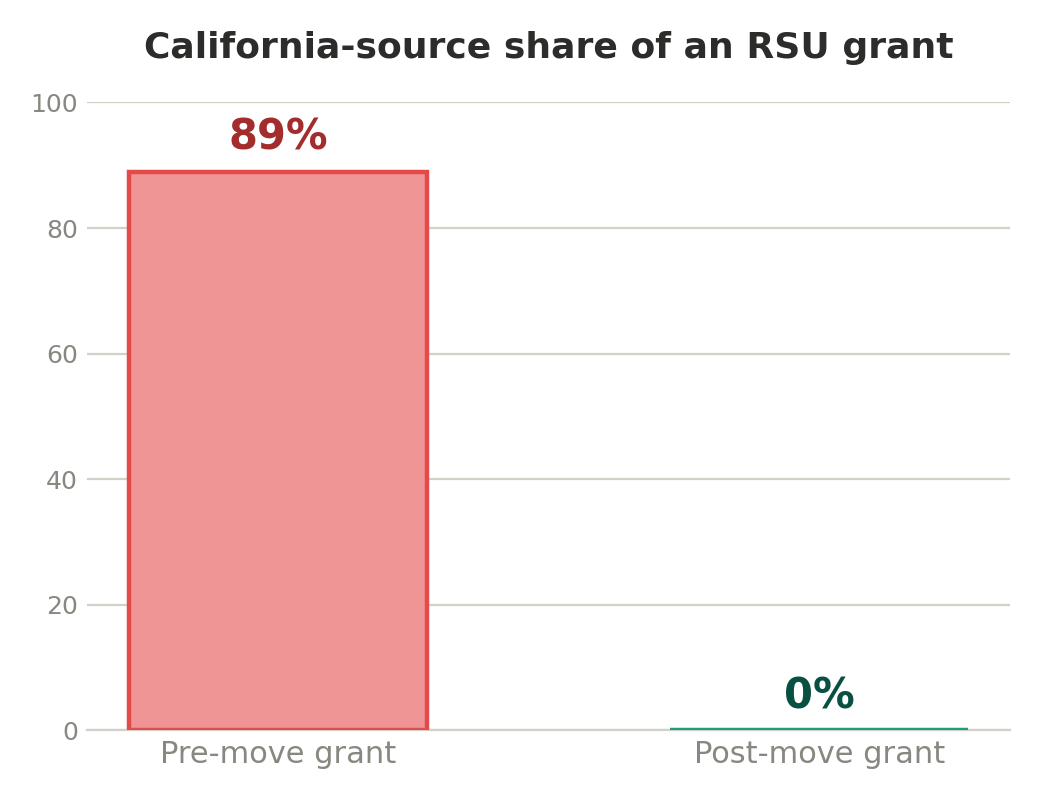
California taxes RSU income based on where the work was performed between the grant date and the vest date, not where you live when the shares land. Her November 2026 vest came from a grant made in November 2023. Of the roughly 36 months between grant and vest, about 32 were worked in Santa Clara, which makes close to 89% of that income California-source, taxable on a nonresident return, regardless of the Austin address on her pay stub. Her 2024 and 2025 grants have their own, different ratios. Nobody had built the allocation, and payroll had already stopped withholding California tax.
What We Did
We built a workday allocation schedule for every outstanding grant: grant date, vest date, days worked in each state, and the resulting source percentage. That's the document that makes a nonresident return defensible years later, and it's the one thing almost nobody creates at the time of the move, when the records still exist.
Then we handled the cash. Because California withholding had stopped, Elena needed to cover the state liability through estimated payments rather than payroll. We sized and scheduled those, and filed the nonresident return with the allocation attached.
The more interesting work was forward-looking. Grants made after the move source almost entirely to Texas, and the California share of the older grants declines every quarter she works in Austin. We charted that curve, and then deliberately moved discretionary income into the years where it's cheapest. Elena converted $160,000 from a traditional IRA to a Roth in her first full Texas year, paying federal tax only. We also timed the sale of a long-held taxable position into the same window, and set up a 10b5-1 plan so future vests diversify on a schedule instead of a decision.
The Result
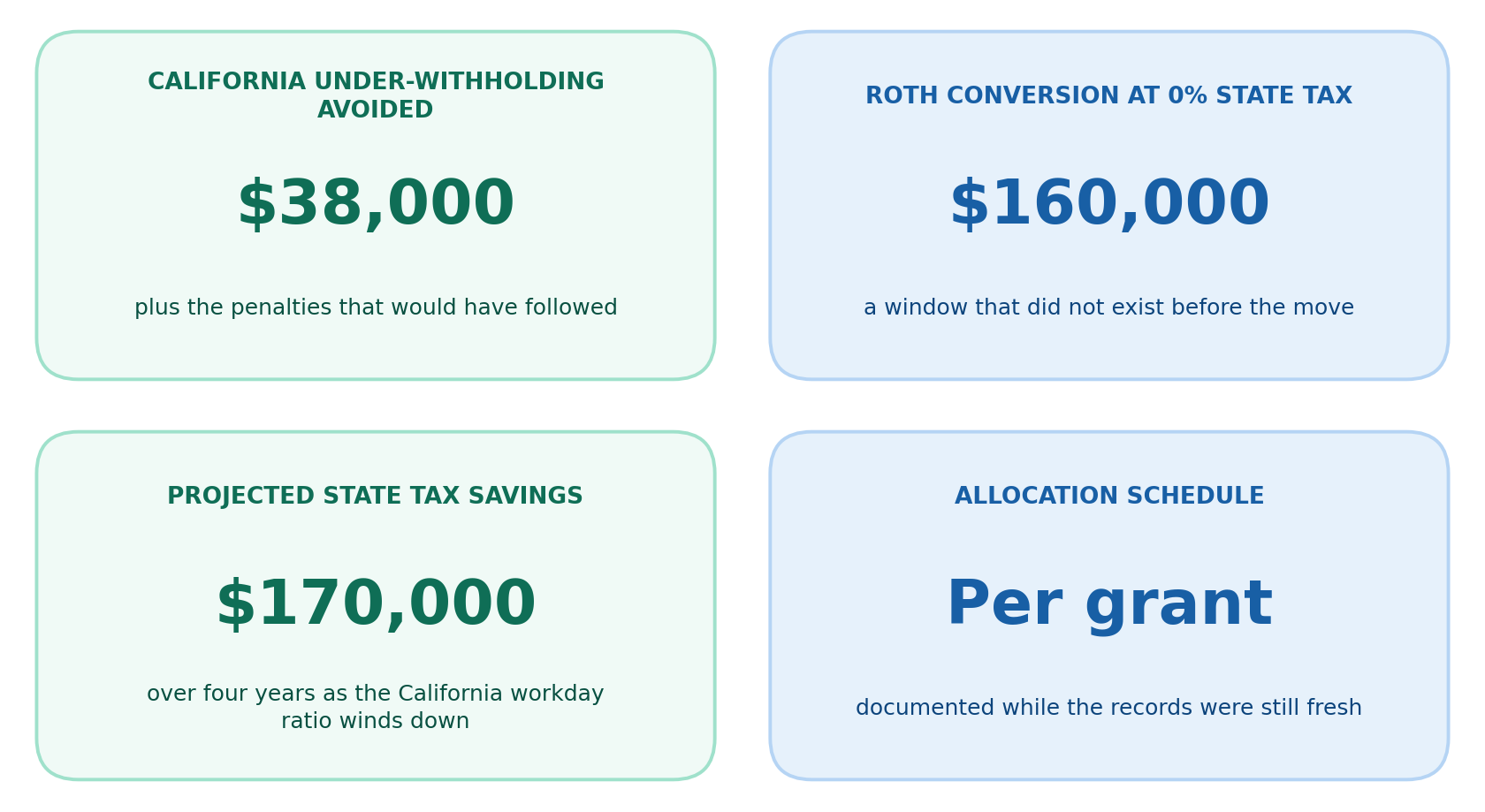
- A $38,000 California under-withholding surprise avoided, along with the penalties that would have followed
- $160,000 converted to a Roth IRA at 0% state tax, a window that did not exist twelve months earlier and will not exist for pre-move grants
- Roughly $170,000 in projected state tax savings over four years as the California workday ratio winds down and new grants source to Texas
- A documented allocation schedule per grant, built while the records were still fresh
Why This Worked
Elena's payroll team correctly followed her new address. Her CPA would have caught the sourcing issue, in April, after the vest, with no time left to do anything but pay. The opportunity wasn't in the filing. It was in the eighteen months around the move, when the same income can be routed through two very different tax regimes depending on when it's recognized. Seeing that requires looking at compensation, residency and the tax return as one question.
If a relocation is on your calendar, the planning window is before the move, not after.
This case study is a composite illustration based on real Alphanso client scenarios. Names and identifying details have been changed for privacy. Results are not guaranteed and will vary based on individual circumstances. All investing involves risk, including the possible loss of principal. Alphanso Inc is a registered investment adviser.

Schedule demo with our advisors
What to expect