Her Adobe stock was down 38%. That made selling easier.
The Situation
Adriana is 41, a staff engineer at Adobe in San Jose, nine years in. Her husband teaches high school. Two kids, a mortgage they refinanced at a rate they are happy about, and a 401(k) she has maxed out every year without anyone telling her to. She is good with money in all the ordinary ways.
Then Adobe reported its third quarter on September 10. Revenue up 13% to $6.76 billion, non-GAAP earnings of $6.13 a share, both ahead of estimates. AI-first ARR up more than 150%. A billion monthly active users. The stock fell anyway, on a soft fourth-quarter guide and net new ARR of $390 million against $640 million a year earlier. ADBE has spent most of 2026 sliding, and Adriana's vested shares are now worth roughly 38% less than they were on the day they landed in her account.
The Gap We Found
Adriana was not frozen. She had a plan, and the plan was to wait until ADBE climbed back to what her grants had been worth, then sell. Her CPA had never seen her brokerage statements. Her brokerage had never seen her tax return. So nobody had put the two documents side by side and said the uncomfortable part out loud: she had already paid ordinary income tax on $984,000 of stock now worth $612,000. That tax is spent. Holding the shares does not recover it. The grant price is a number in her memory, not a fact about what ADBE does next.
What We Did
We started with the question sitting underneath her plan. If Adobe handed her $612,000 in cash tomorrow, would she use every dollar of it to buy ADBE at today's price? She said no immediately. That is the same decision she was making every morning by holding.
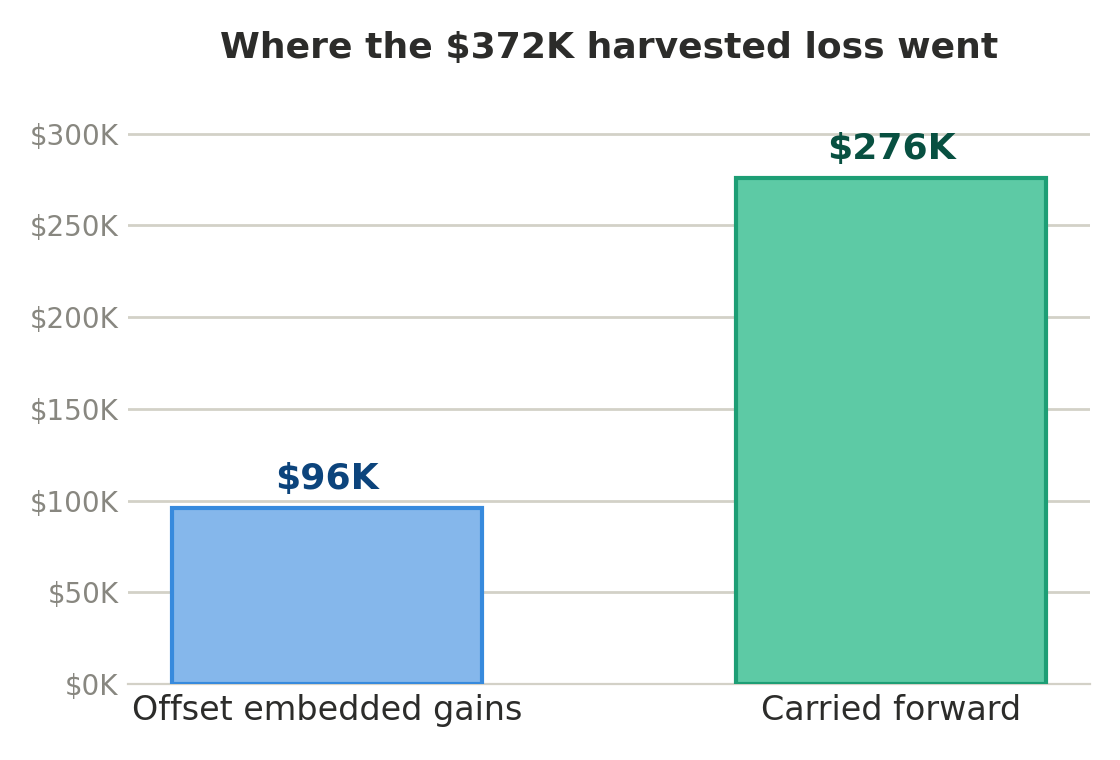
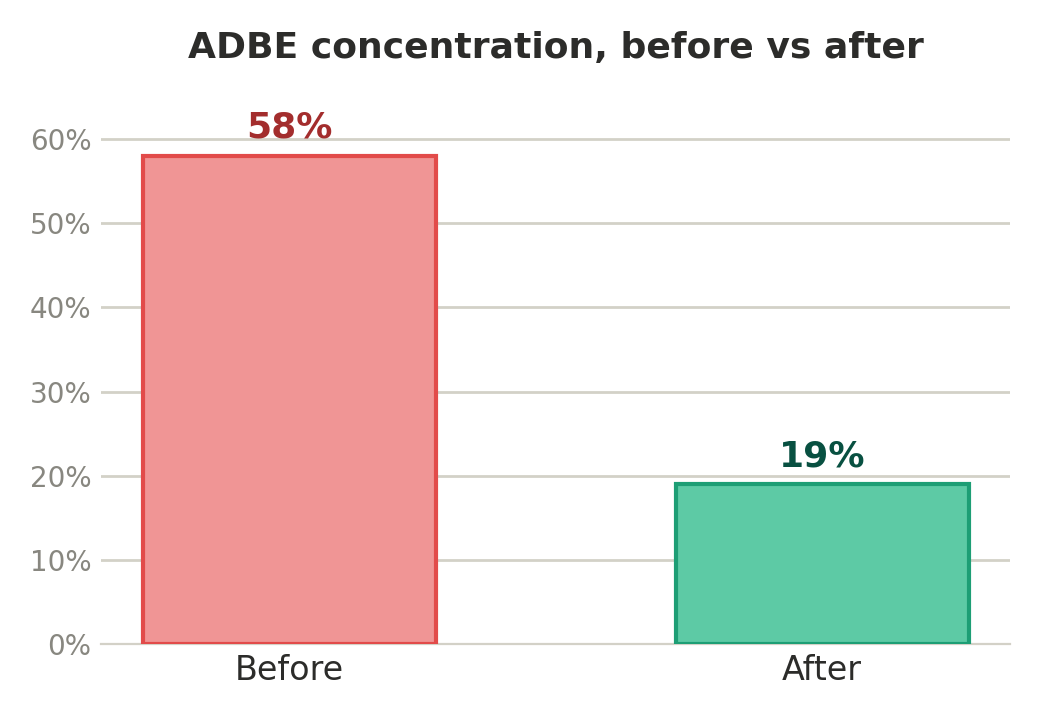
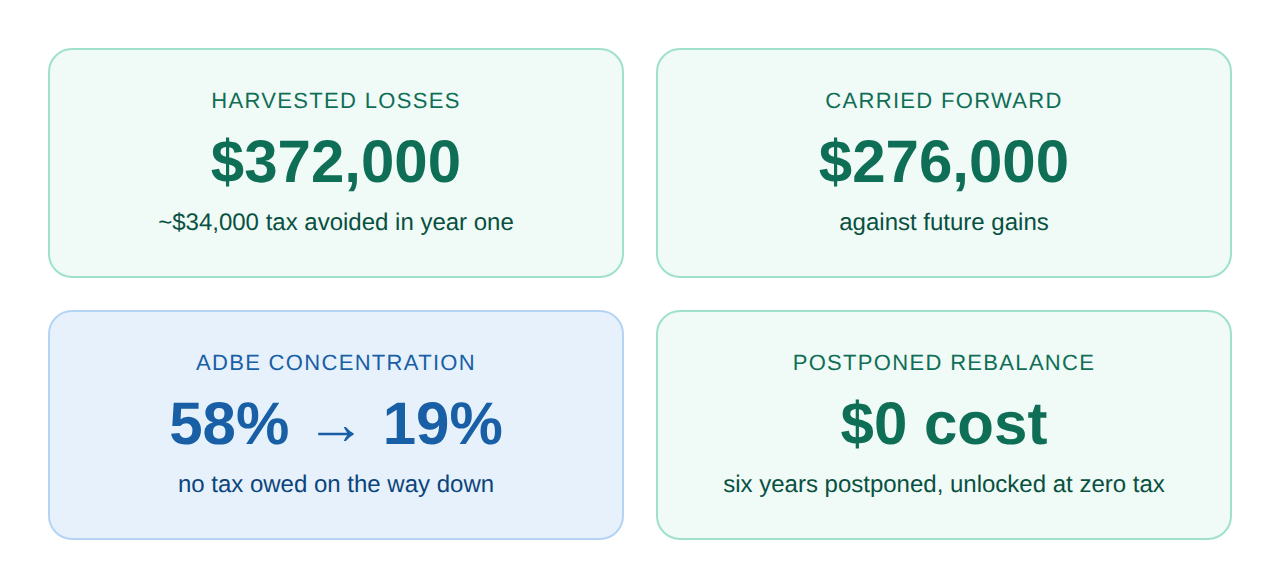
Then we made the loss useful. Selling at a loss is not a defeat to be avoided. It is the one thing that makes a concentrated position cheap to unwind. Using specific lot identification, we sold her deepest-underwater lots first and realized $372,000 in capital losses, moving the proceeds the same day into a direct-indexed portfolio that deliberately underweights software so she was not buying the same risk back in a different wrapper. She was never out of the market.
That loss then paid for something else. Adriana had been sitting on about $96,000 of embedded gains in legacy positions from a previous employer, holdings she had avoided touching for years because of the tax bill attached to them. The Adobe loss offset those gains completely, so the rebalance she had been postponing since 2019 cost her nothing.
Her vesting election changed too. Future vests now sell automatically at vest, where the shares carry no gain and no tax friction, so the concentration stops rebuilding while she is not watching. Adobe RSUs vest quarterly and every vest counts as a purchase, so our agents track each sale against the 30-day wash sale windows on both sides of it and recalculate her estimated payments whenever a realized loss changes the picture. Her advisor calls before each vest rather than after.
The Result
Why This Worked
Nobody in Adriana's financial life was doing a bad job. Her CPA filed accurately, her brokerage executed cleanly, and both stayed in their lane. But a loss only becomes an opportunity when someone is reading the tax return and the portfolio at the same time, and no one was. Because Alphanso charges a flat fee, the recommendation to sell down a position does not cost us anything, which is exactly why you can trust it. If your grants are underwater and your plan is to wait, that is worth a conversation. Talk to an advisor.
This case study is a composite illustration based on real Alphanso client scenarios. Names and identifying details have been changed for privacy. Results are not guaranteed and will vary based on individual circumstances. All investing involves risk, including the possible loss of principal. Alphanso Inc is a registered investment adviser.

Schedule demo with our advisors
What to expect