Can I sell RSUs to fund my mega backdoor Roth? How the paycheck swap works at Meta

Not directly. After-tax 401(k) contributions can only come out of your paycheck, so vested RSU shares cannot be moved into the plan. What a Meta employee can do is the swap: sell vested shares to cover living costs while payroll diverts up to $35,250 of 2026 salary into after-tax contributions that convert to Roth.
Key takeaways
- Under IRS Notice 2025-67, the 2026 401(k) employee deferral limit is $24,500 and the total limit on all contributions to one plan is $72,000 (or $80,000 with the $8,000 catch-up for people 50 and older).
- The IRS defines after-tax contributions as "contributions from compensation," which is why no plan accepts a transfer of shares or brokerage cash into the after-tax bucket.
- RSUs are taxed as wages on the day they vest, so selling shares at about the vest price to replace the salary you redirected into the plan adds roughly no tax.
I get a version of this question every autumn from someone who has just opened Fidelity NetBenefits and realised that another $35,000 into the plan means a much smaller paycheck. The answer has two halves.
Why can't vested RSUs go into a 401(k)?
Because every dollar that enters a 401(k) as an employee contribution has to be withheld from pay. The IRS describes after-tax contributions as "contributions from compensation (other than Roth contributions) that an employee must include in income". Shares sitting at Schwab or Morgan Stanley are not compensation anymore; they are property you already paid wage tax on. There is no form that moves them into the plan.
The Blind threads get this right, usually in the second reply. One Oracle engineer asked whether vested RSUs could be moved into the mega backdoor "without selling"; the consensus answer was that you can only add money through payroll contributions of after-tax dollars. So the shares are not the funding source. Your salary is. The RSUs are what let you afford to redirect that salary.
How does the paycheck swap actually work?
You raise your after-tax contribution percentage so the plan takes more of each paycheck, and you sell vested shares to put the same cash back into your checking account. Your spending does not change. What changes is that $35,250 that would have sat in a taxable brokerage account as Meta stock is now in a Roth account.
Here is the Meta plan for 2026, as described by the planning guides that cover it. Meta matches employee deferrals dollar for dollar up to 50% of the IRS limit, so a full $24,500 deferral earns a $12,250 match for someone under 50. That is $36,750 of the $72,000 total. The remaining $35,250 is the after-tax space, converted to Roth automatically in-plan through Fidelity. After-tax dollars are not matched. For the limit itself, see how the $72,000 limit breaks down.
2026 Meta 401(k), employee under 50, as described by third-party guides
- Employee deferral (pre-tax or Roth): $24,500, from your paycheck
- Meta match (dollar for dollar, capped at 50% of the IRS limit): $12,250, from Meta
- After-tax contributions, converted to Roth in-plan: $35,250, from your paycheck only
- Total annual additions limit (IRS Section 415(c)): $72,000
Now the persona. Take Rohan, 31, a senior engineer at Meta in Menlo Park, single, $240,000 base salary and roughly $300,000 of RSUs vesting in quarterly tranches. He already defers the full $24,500, about 10% of base. Adding $35,250 of after-tax contributions means another 15% of base leaves each paycheck before it reaches him, and his take-home from salary drops to around $8,500 a month. Rent in Menlo Park does not care that the money went to a good place.
The swap fixes that. Each quarter, roughly $75,000 of RSUs vest and Meta withholds shares for tax at the 22% federal supplemental rate plus state. Rohan sells about $8,800 of the remaining shares each quarter to replace the $35,250 of annual salary now going to the plan. His monthly cash is back where it started. The Roth account is $35,250 larger. His Meta position is $35,250 smaller, which, for someone holding 30% to 70% of net worth in one employer's stock, is rarely a side effect they mind.
Does selling RSUs to fund the contributions cost extra tax?
Almost none, if the shares you sell are the ones that just vested. RSUs are taxed as ordinary wage income on the vest date, at the fair market value that day, whether you hold or sell. That value becomes your cost basis. Sell within days at roughly the same price and the capital gain is a rounding error. The wage tax was owed either way.
Let me say that again: the income tax on an RSU happens at vest. Selling right after does not add a second tax; it only prevents a future one.
The answer changes if you sell older lots. Shares from a vest two years ago at a lower price carry a real long-term gain, taxed at 15% or 20% federal plus the 3.8% net investment income tax above $200,000 of modified adjusted gross income for a single filer. Keep those lots for a different purpose, such as a charitable gift, and sell the fresh lots for the swap. Lot selection is a setting in your brokerage account; check it before the first sale.
What the swap buys fits in one chart. The same $35,250, grown at an illustrative 7% a year for 20 years, ends at about $136,400 either way. In a taxable account, selling at the end triggers tax on roughly $101,200 of gain, about $24,100 at a 23.8% combined rate, leaving $112,300. In the Roth it is $136,400, tax free, and that ignores the dividend tax the taxable account would have paid along the way.
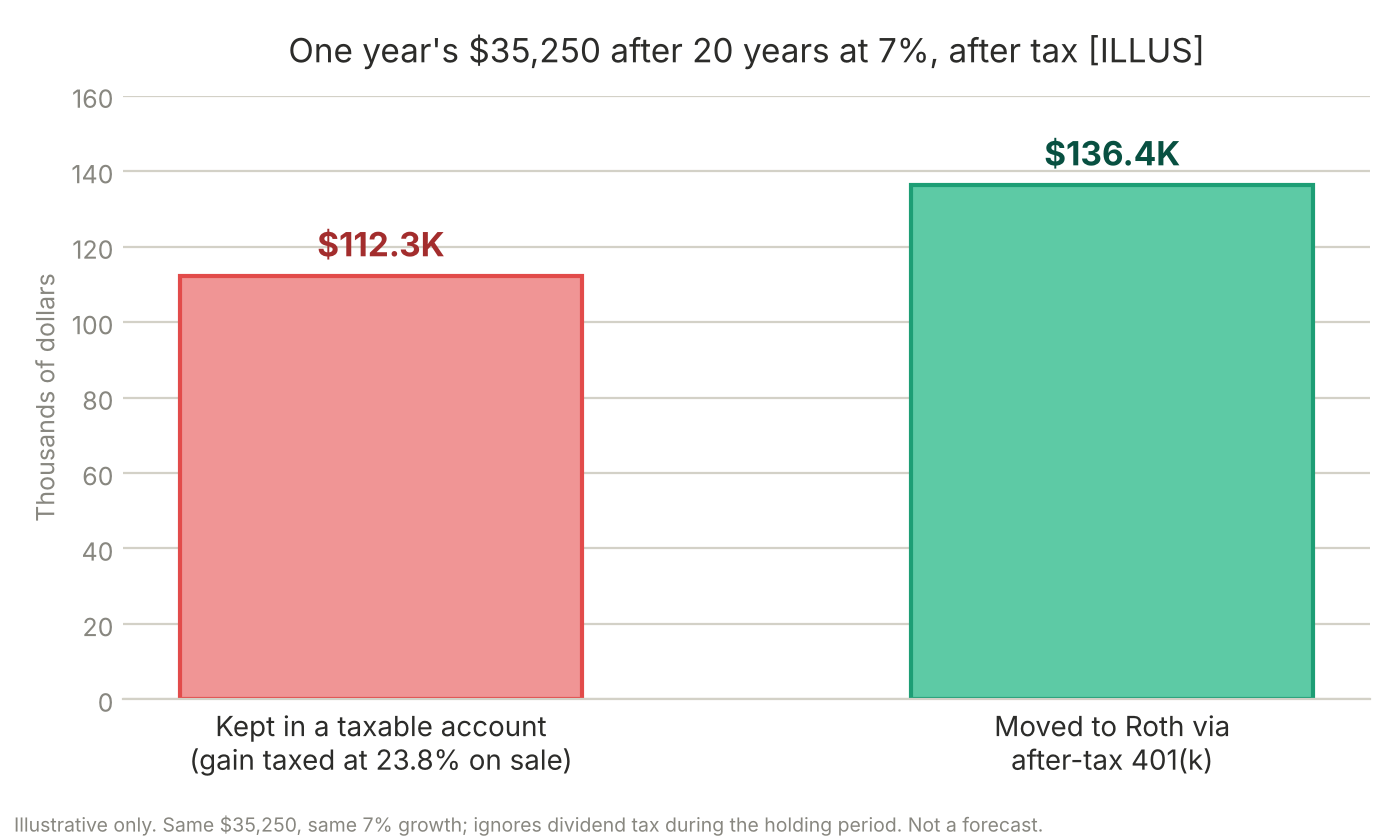
Repeat the swap for ten vesting years and the difference stops being a rounding error.
What are the steps to set up the swap at Meta?
- Confirm the plan features in NetBenefits. Look for the after-tax contribution election and the automatic Roth in-plan conversion setting. If conversion is not automatic for your destination, each one has to be triggered by hand, and the earnings between contribution and conversion are taxable when converted.
- Size the percentage from your base, not your total comp. The election is a percentage of eligible pay per paycheck. Whether RSU income counts as eligible pay is set by the plan document, and none of the public guides says, so assume salary and bonus only until the plan confirms otherwise. $35,250 on $240,000 of base is about 14.7%.
- Front-load or spread, deliberately. Spreading across 24 paychecks keeps each quarter's swap small. Front-loading finishes earlier but means living on vest proceeds for a few heavy months. Either works; hitting the $72,000 total early and finding the match capped does not, so check whether the plan "trues up" the match.
- Sell the newest lots and record the sales. Set the brokerage to specific-lot identification, sell from the most recent vest, and keep the confirmations. The Form 1099-B basis for RSU lots is often wrong and needs correcting at filing.
- Watch the $150,000 line if you are 50 or older. From 2026, catch-up contributions must be Roth for anyone whose prior-year FICA wages exceeded $150,000, and RSU vest income counts in that number. The $8,000 catch-up still fits inside the $80,000 total.
When does the swap not make sense?
Three situations. When the vest is already spoken for: if RSU proceeds are the down payment, the emergency reserve or the Q4 estimated payment, redirecting salary into a Roth you cannot touch without penalty for years creates a cash problem the Roth does not solve. When the plan caps contributions per paycheck: if your base is low relative to total comp, you can run out of paycheck before you run out of after-tax room, so start in January, not October. And when no new lots are coming: once vesting has ended, the swap means selling appreciated stock at 23.8% to fund a Roth, a different calculation that belongs next to the rest of your financial planning for Meta employees.
None of this is advice to sell or hold Meta stock. The swap is a plumbing decision about which dollars you spend; the concentration decision is separate, and plenty of readers will keep every share they are not forced to sell. See a Meta manager whose simple setup was leaking $20K a year for what a full-picture review usually turns up.
The bottom line
Vested RSUs cannot be contributed to a 401(k). Salary can. The mega backdoor Roth at Meta, as the plan is described, lets up to $35,250 of 2026 salary become Roth money, and selling freshly vested shares to replace that salary costs almost no tax because the RSU tax was paid at vest. The swap works when the plan allows it, the cash flow survives it, and you sell the right lots.
If you want the contribution percentage, the lot selection and the estimated payments worked out together, that is exactly the kind of analysis we do, and then we set the elections up with you. Alphanso Inc is a flat-fee fiduciary wealth advisory for employees with equity compensation (RSUs, ISOs, NSOs and ESPP); advisors are paid a flat annual fee, never a percentage of assets or commissions. Book a call or see the flat annual fee.
FAQ
Can I transfer vested RSUs into my 401(k) without selling them? No. The IRS defines employee contributions, including after-tax contributions, as contributions from compensation, so they must be withheld from pay. Shares already delivered to your brokerage account are property, not compensation, and no 401(k) accepts them in kind.
How much can a Meta employee put into the mega backdoor Roth in 2026? About $35,250 for an employee under 50, as described by the guides covering Meta's plan: the $72,000 IRS total minus the $24,500 deferral and the $12,250 match. For 50 and older the total rises to $80,000 with the $8,000 catch-up, which changes the match and the after-tax room, so confirm your own figure in NetBenefits.
Is it worth selling RSUs to pay my bills so I can max out my after-tax 401(k)? It depends on whether you would have kept those shares anyway. If the alternative is holding more employer stock in a taxable account, the swap moves the same dollars into an account where growth is never taxed, at almost no tax cost when you sell freshly vested lots. If the vest proceeds are already assigned to a house, a reserve or a tax payment, the Roth does not replace that cash.
Do I owe tax when my after-tax contributions convert to Roth? Not on the contributions, because you already paid income tax on them, but any earnings that accrued between the contribution and the conversion are taxable at conversion. Automatic in-plan conversion keeps that gap to days, which is why it matters whether your plan offers it.
Does RSU income count toward the $150,000 Roth catch-up threshold? Yes. The 2026 rule looks at prior-year FICA wages above $150,000, and RSU vest income is reported as wages subject to Social Security and Medicare tax. Most senior engineers at large tech companies cross the line on RSU income alone.
This content is for educational purposes and does not constitute personalized financial, tax or legal advice. Tax services are for educational purposes and do not constitute legal advice. Registration does not imply a certain level of skill. Alphanso Inc.
Sources: 2026 deferral, total and catch-up limits: IRS, IR-2025-111, Nov 13, 2025; Roth catch-up wage threshold: IRS, Notice 2025-67; Section 415(c) annual additions limit: IRS, Retirement topics, contribution limits, reviewed Apr 8, 2026; After-tax contributions as contributions from compensation: IRS, Retirement topics, Contributions, reviewed Jan 29, 2026; After-tax rollovers: IRS, Rollovers of after-tax contributions, reviewed Feb 26, 2026; In-plan Roth rollover taxation: IRS, FAQs on designated Roth accounts; RSUs taxed as wages at vest: IRS, Publication 525; Supplemental withholding at 22%: IRS, Publication 15; Net investment income tax: IRS, Topic 559; Meta plan terms: Safe Landing Financial, 2026 update; Meta plan terms: TrueWealth Financial Partners; Meta plan terms: Avier Wealth Advisors.

Plan with an expert
What to expect