How a Cerebras Engineer Turned a $48B IPO Into a Real Financial Plan
.webp)
The Situation
Arjun had been heads-down at Cerebras since 2022, when the company was still a $4 billion startup building wafer-scale chips most people had never heard of. By the time CBRS started trading on the Nasdaq on May 14, 2026 - opening at $350 a share and closing at $311 after a 68% first-day pop - his equity wasn't theoretical anymore. It was life-changing. He was 32, married to Priya (a senior engineer at Google), renting a two-bedroom in Sunnyvale, and suddenly sitting on a portfolio that looked nothing like it had six months ago.
He held 15,000 ISOs with a $12 strike price from his original offer letter and 8,000 double-trigger RSUs granted during his first year. Outside of Cerebras and Priya's Google RSUs, the couple had about $280,000 between their 401(k)s and savings. They had no kids yet, no house, and no financial advisor. What they did have was a tax bill arriving faster than either of them expected.
The Gap We Found
The IPO triggered the second vest on Arjun's double-trigger RSUs - all 8,000 shares settled at the $185 IPO price, creating a $1.48 million ordinary income event in a single day. But here's the catch: the 180-day lockup meant he couldn't sell a single share to cover the tax bill. Withholding would capture some of it, but not nearly enough at a 37% federal bracket plus California's 13.3%. Meanwhile, his ISOs carried a $4.49 million bargain element if exercised at today's prices - triggering a massive AMT liability that could dwarf his liquid cash. And across the household, roughly 85% of their combined net worth was now concentrated in two AI companies. No one was looking at all of this together: the RSU tax timing, the ISO exercise decision, the lockup liquidity crunch, the household concentration, and the fact that every passing week changed the math.

What We Did
Lockup liquidity plan. Before anything else, we modeled the exact tax liability from the RSU settlement - $1.48 million in ordinary income, with supplemental withholding covering roughly $330,000. The remaining estimated tax gap of approximately $220,000 needed to be funded from existing savings and a structured quarterly payment plan, timed so Arjun wouldn't face underpayment penalties. Alphanso's AI agents parsed his payroll data alongside Priya's Google pay stubs to calculate household withholding already paid and generate precise quarterly estimates for both California and federal - well before the Q3 and Q4 deadlines.
ISO exercise strategy. Exercising all 15,000 ISOs at once would have generated $4.49 million in AMT preference income - enough to trigger a six-figure AMT bill with zero liquidity to pay it. Instead, we modeled a phased exercise plan: exercise a targeted tranche of approximately 3,000 ISOs before year-end, calibrated to keep AMT exposure under $85,000 (fundable from savings), while preserving long-term capital gains eligibility for shares held more than one year post-exercise and two years post-grant. The remaining 12,000 ISOs would be exercised in subsequent tax years as lockup expired and liquidity became available - spreading the AMT hit across three filing years instead of one.

Post-lockup diversification roadmap. We built a 10b5-1 plan framework - a pre-scheduled selling program - ready to activate the day lockup expires in November 2026. The plan would systematically reduce Cerebras concentration from roughly 65% of household net worth to under 30% over 12 months, selling in tranches to manage capital gains brackets. Proceeds would flow into a direct-indexed portfolio for ongoing tax-loss harvesting, plus a muni bond allocation sized to Priya's California income. Combined with a structured Google RSU sell-at-vest policy for Priya's future grants, the plan brought projected household single-stock concentration below 25% within 18 months.

The Result
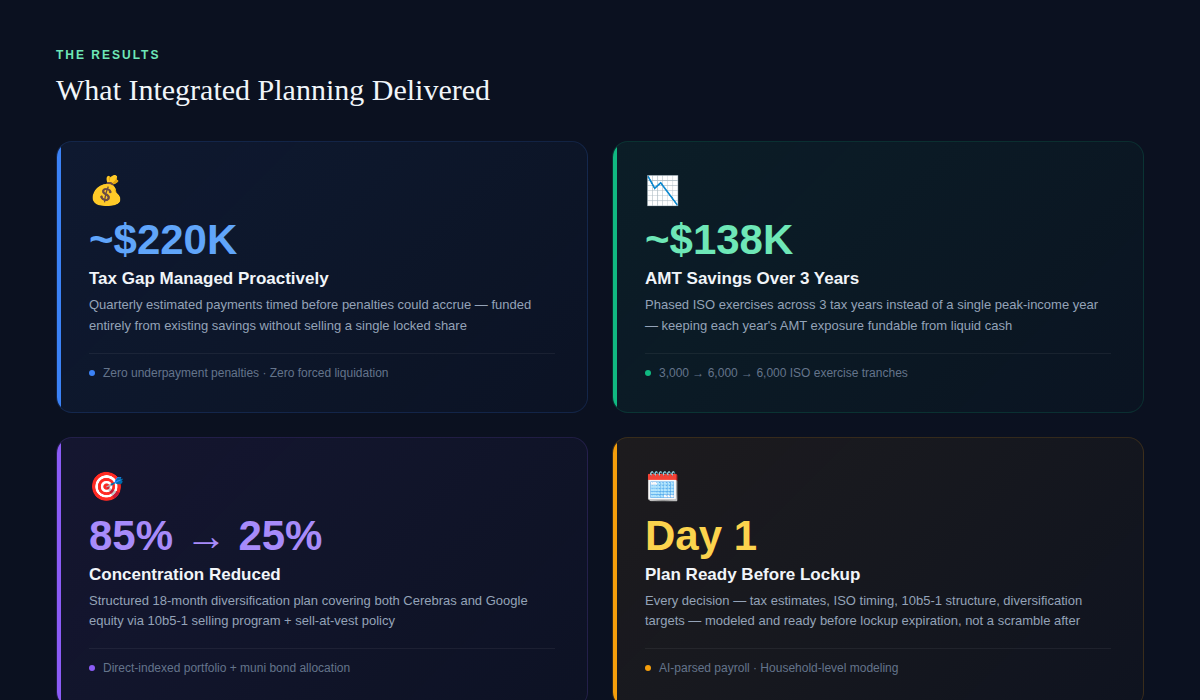
- ~$220,000 in estimated tax managed proactively through quarterly payments timed before penalties could accrue - funded without selling a single locked share
- ~$138,000 in AMT savings over three years by phasing ISO exercises instead of exercising all at once in a peak-income year
- Household concentration reduced from 85% to under 25% across a structured 18-month diversification plan covering both Cerebras and Google equity
- A plan that existed before lockup expired - not a scramble after
Why This Worked
The insight wasn't any single strategy - it was seeing the RSU tax event, the ISO exercise decision, the lockup constraint, and the household concentration as one connected problem instead of four separate ones. A CPA would have seen the income. A stockbroker would have seen the shares. But nobody was modeling how the ISO exercise in December affected the quarterly estimate due in January, or how Priya's Google vesting schedule changed the diversification math. That integration - across tax, investment, and timing - is what Alphanso does as a flat-fee fiduciary. If your equity just became real and you're not sure what to do before lockup expires, we should talk.
This case study is a composite illustration based on real Alphanso client scenarios. Names and identifying details have been changed for privacy. Results are not guaranteed and will vary based on individual circumstances. All investing involves risk, including the possible loss of principal. Alphanso LLC is a registered investment adviser.
Schedule demo with our advisors
What to expect