Harvesting losses helped an Amazon engineer unwind his AMZN pile

The Situation
Marcus is a 42-year-old principal software engineer at Amazon in Seattle, married, with two kids in middle school. Between a strong base salary and a decade of RSU grants, his total comp had climbed past $520K a year — and along the way, the AMZN kept piling up. He'd been disciplined about maxing his 401(k), funding the kids' 529s, and keeping a healthy cash buffer. On paper, he was doing everything right.
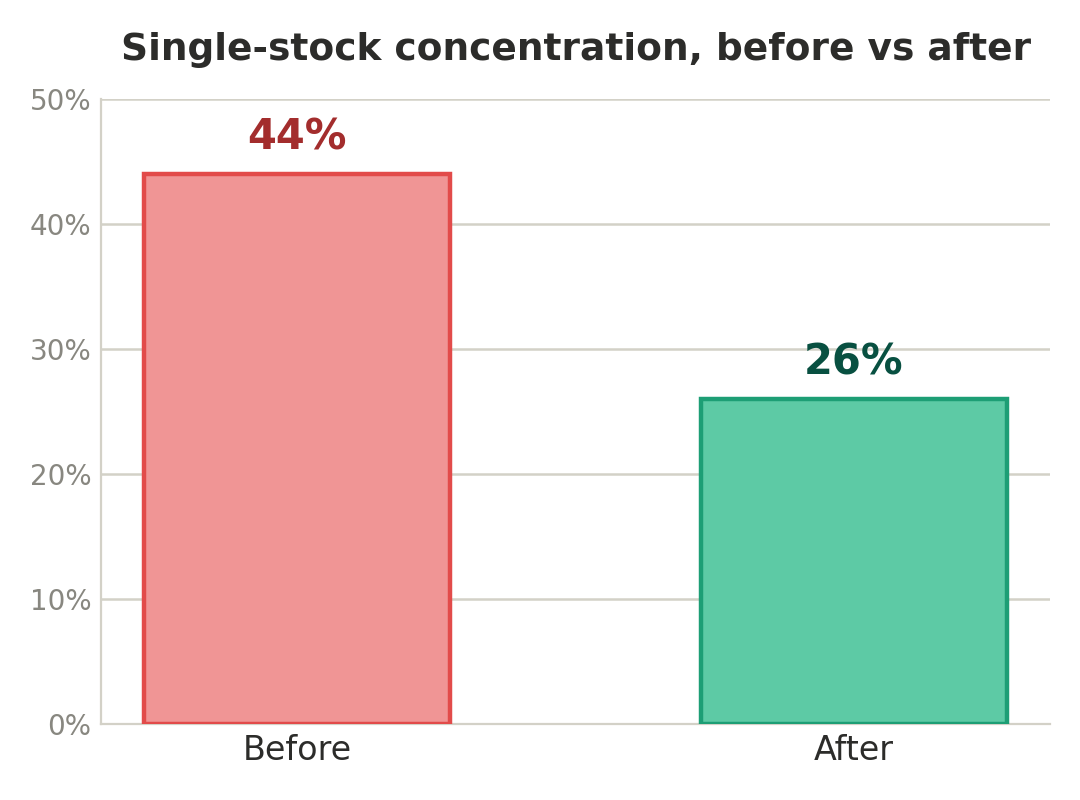
The problem was quieter than that. Marcus had never sold a share of the stock he'd vested. Every quarter, more AMZN landed in his brokerage account, and he left it there — partly out of loyalty, partly because selling felt like it would mean a painful tax bill. By the time he came to us, roughly $610K, or about 44% of his investable assets, sat in a single stock.
The Gap We Found
Marcus's CPA filed a clean return every April, and his 401(k) was invested sensibly. But no one was looking at the concentration and the tax picture at the same time. His accountant saw last year's numbers; his employer's stock plan portal saw the shares; nobody was connecting "you're dangerously undiversified" with "and here's how to fix it without handing the IRS a huge check." A big vest was also coming in the fall — another ~$180K of AMZN about to land — which would push his concentration even higher if nothing changed.
What We Did
First, we set a target: get his single-stock exposure from 44% down under 20% over about 18 months, deliberately rather than all at once. To make the selling tax-efficient, we used specific-lot identification — choosing which tranches of AMZN to sell first based on cost basis, starting with the highest-basis lots to keep realized gains small on each trade.
The real lever was pairing that with a direct-indexing portfolio funded with the proceeds. Instead of buying a plain index fund, direct indexing holds the individual stocks that make up the index, which lets us harvest losses automatically whenever individual names dip — even in a year the overall market is up. Those harvested losses became a bank of capital losses we used to offset the capital gains from trimming his AMZN, so he could diversify further each year without the gains fully hitting his return.
We also got ahead of the fall vest. Alphanso's AI agents flagged the vesting date in advance, ran the tax scenario before it happened, and built a plan to sell a portion of the newly vested shares immediately — at vest, shares are taxed as ordinary income, so selling right away means little to no additional capital gain on that lot. That kept the new grant from quietly re-concentrating everything we'd just unwound.
The Result
- Roughly $41,000 in harvested losses in the first year, which offset the gains from trimming his AMZN position and carried forward into year two.
- Single-stock concentration cut from 44% to 26% in twelve months — on track to land under 20% — with a substantially lower realized tax cost than a straight sell-down would have triggered.
- The fall vest was diversified on arrival instead of adding to the pile.
- Marcus stopped treating his AMZN like something he couldn't touch, and started seeing it as one holding in a real plan.
Why This Worked
None of these moves is exotic. What made them work was doing them together: the diversification decision, the lot selection, the loss harvesting, and the vest timing were all managed as one integrated plan rather than four disconnected chores. Because Alphanso is flat-fee and fiduciary, there was no incentive to churn his account or steer him into products — just to get him out of a risky position as cleanly as the tax code allows. If your net worth is riding on one ticker, there's usually a calmer way down than you think. Request a callback and we'll walk through yours.
This case study is a composite illustration based on real Alphanso client scenarios. Names and identifying details have been changed for privacy. Results are not guaranteed and will vary based on individual circumstances. All investing involves risk, including the possible loss of principal. Alphanso LLC is a registered investment adviser.
.png)
Schedule demo with our advisors
What to expect