Where Should the Money From Your RSUs Live?
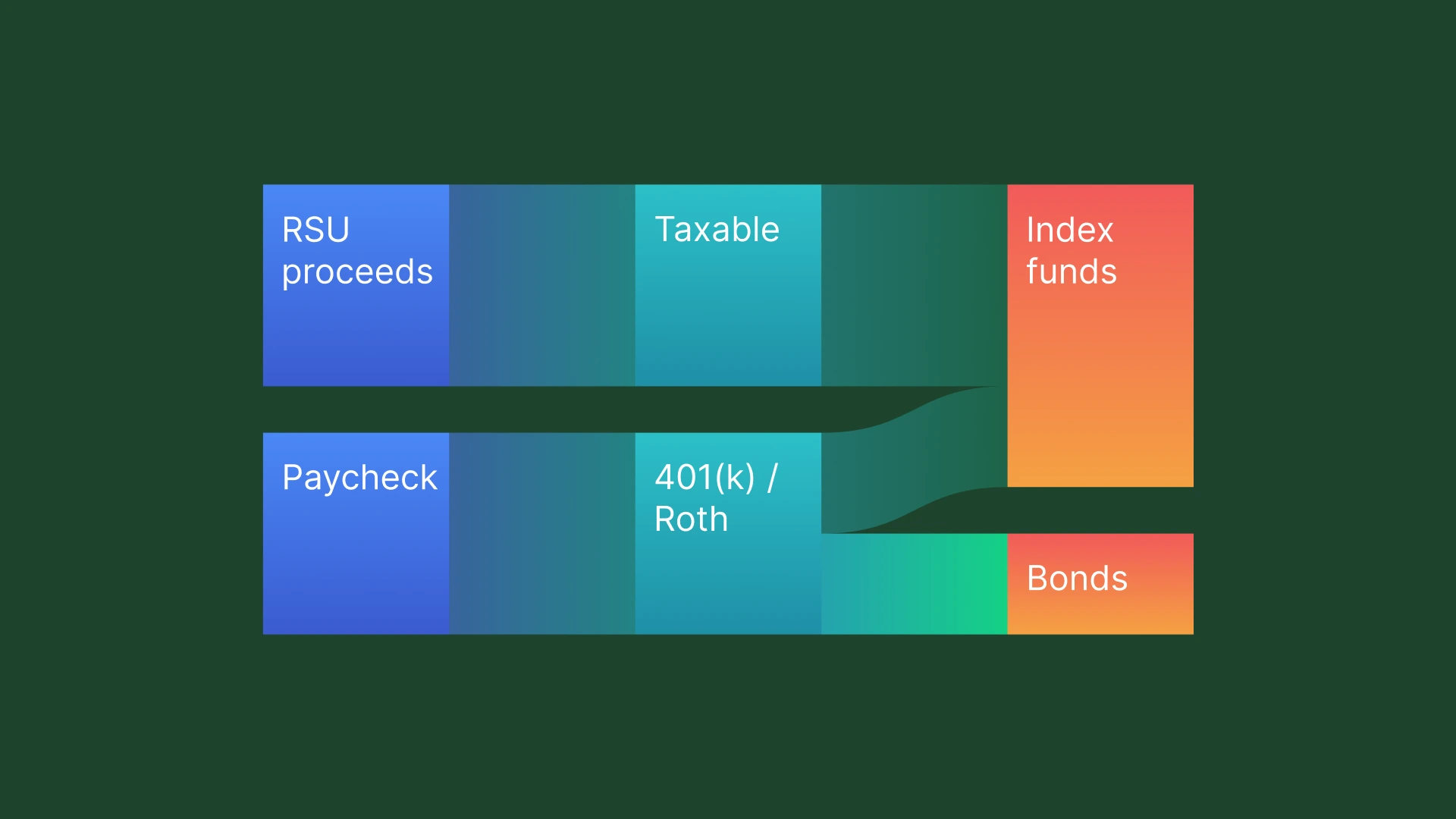
You sold some of the shares that vested this year. The money is sitting in your brokerage account. Your 401(k) is already maxed. And now you are asking the question I hear from senior engineers more than almost any other: should this go into index funds in the brokerage account, into the after-tax 401(k), or somewhere else?
Most people answer that question by picking an investment. That is the wrong order. The account you put money in decides how much of the return you get to keep, and for a household that will hold meaningful money in a taxable account for decades (which describes almost everyone paid in RSUs), the account decision is worth real dollars every single year.
Advisors call this asset location. Not allocation (how much in stocks versus bonds), location (which account holds which). Two engineers can own identical portfolios and end up with meaningfully different after-tax wealth, purely because of where each piece sits.
What's Actually Happening
Start with the three kinds of accounts a tech employee typically has, and how each one taxes what is inside it.
Taxable brokerage. This is where RSU proceeds land by default. Every year, interest is taxed as ordinary income (up to 37% federal in 2026, plus the 3.8% Net Investment Income Tax, or NIIT, above $200,000 of modified adjusted gross income single or $250,000 married filing jointly). Qualified dividends and long-term capital gains get the lower rates: 15% for most of our readers, 20% once taxable income passes $545,500 single or $613,700 joint in 2026, plus the same 3.8% NIIT. Nothing is sheltered, but the rate depends heavily on what the asset throws off.
Pre-tax 401(k). Up to $24,500 of elective deferrals in 2026 ($32,500 if you are 50 or older). Nothing inside is taxed year to year. Every dollar that comes out in retirement is ordinary income.
Roth (Roth 401(k), Roth IRA, and the after-tax 401(k) converted to Roth). Nothing inside is taxed, and qualified withdrawals are never taxed. The direct Roth IRA door is closed for most of our readers (the 2026 phase-out starts at $153,000 single and $242,000 joint), which is why the question on Blind is always about the after-tax 401(k). The 2026 overall limit on everything going into a 401(k) is $72,000: your $24,500, your employer's match, and after-tax contributions up to whatever is left. Many large tech 401(k) plans allow those after-tax contributions and an in-plan conversion to Roth. That is the mega backdoor Roth, and we covered how to execute it here.
The HSA deserves a line too: $4,400 self-only or $8,750 family in 2026 (plus $1,000 at age 55 and over), deductible going in, untaxed growing, untaxed coming out for medical costs. It is the only account that gets all three.
Now the asset side. Here is what $100,000 of each holding costs in federal tax in a year, sitting in a taxable account, for a married couple in the 35% bracket who are over the NIIT threshold. These are illustrations with stated assumptions, not forecasts.
A bond fund yielding 4.5%: $4,500 of interest, taxed at 35% plus 3.8%, is about $1,746 of tax per year. A broad US index fund with a 1.3% dividend yield, 90% of it qualified: about $270 of tax per year. Those same two holdings inside a 401(k) or Roth: $0 this year, and in the Roth, $0 forever.
[CHART: Illustrative annual federal tax drag on $100,000, taxable account vs. 401(k) or Roth, bond fund vs. US index fund]
The gap between $1,746 and $270 is the whole idea. The bond fund is more than six times as expensive to hold in a taxable account as the index fund is. So if you are going to own both (and most households should own some of both), the bonds belong in the account that does not tax them every year, and the index fund belongs in the account that taxes it lightly.
Let's make it a person. Marcus is 34, an L6 at Google in Atlanta, married, and sells most of each vest. Say he and his wife have $400,000 invested: $200,000 in 401(k)s and $200,000 in the brokerage account from RSU sales. They want 75% stocks and 25% bonds overall.
The default most people fall into is the same 75/25 mix in every account. That puts $50,000 of bonds in the brokerage account, costing about $873 a year, plus $150,000 of index fund costing about $406. Call it $1,279 of annual tax drag.
The located version holds all $100,000 of bonds inside the 401(k)s and makes the brokerage account 100% index funds. Same 75/25 overall. Annual drag: about $541. Roughly $740 a year kept, on a $400,000 portfolio, for doing nothing but choosing which account holds which fund.
That number scales with the portfolio, and RSU households grow fast. At $1.2 million with the same mix, the same move keeps roughly $2,200 a year. Over 20 years, compounding at a modest return, the difference between the two versions runs into the tens of thousands of dollars. Same investments. Same risk. Different accounts.
Why This Catches People
Three reasons, and none of them is that engineers are bad at math.
The accounts were built one at a time. The 401(k) got set up on day one at a target-date fund. The brokerage account got opened the first time a vest was sold, and it bought whatever felt safe that month. Nobody ever looked at the two together, because they live on different websites and were opened years apart.
The money cannot move between them. You cannot transfer RSU shares into a 401(k). After-tax 401(k) contributions come out of payroll, which is the detail behind every "sell RSUs to fund the mega backdoor" thread: what you are really doing is diverting more paycheck to the plan and living on the RSU proceeds instead. That is a perfectly good plan. It also means the brokerage account stays big for a long time, so what you hold there matters more, not less.
"Bonds in the 401(k)" feels backwards. Bonds grow slower, and a 401(k) full of bonds will be a smaller 401(k) in 30 years. That is true, and it is the honest trade-off: you are accepting a slower-growing tax-deferred account in exchange for less tax every year on the taxable side, and smaller required withdrawals later. For most readers in a 32% to 37% bracket with a large taxable account, the annual savings win. For someone whose taxable account is tiny, or who expects a very low retirement bracket, the math can flip. It is a calculation, not a slogan.
What You Can Do About It
These are options with trade-offs, not instructions. Where your money should live depends on your bracket, your plan's features and how much of your net worth is already in company stock.
- Fill the accounts in order of tax treatment, with the dollars you have already decided to invest. If you have decided to sell a vest, the usual order is: the pre-tax 401(k) to $24,500, the HSA if you are on a qualifying high-deductible plan, then the after-tax 401(k) up to the $72,000 overall cap if your plan allows the in-plan conversion, then the taxable brokerage. The cost is cash flow: more of your paycheck disappears into the plan and you live on the proceeds.
- Put the tax-inefficient holdings in the sheltered accounts first. Bond funds, REIT funds, high-turnover or actively managed funds and anything paying non-qualified income belong in the 401(k). On the $100,000 example above, that is the $1,746-a-year holding, not the $270-a-year one.
- Make the taxable account the home for broad index funds, and for the direct-indexing or tax-loss harvesting work if you do it. Qualified dividends and long-term gains are what the taxable account taxes least, and losses harvested there can offset gains from the RSU shares you sell. The rule of thumb is that the taxable account should be the most boring account you own.
- Save the Roth for the highest expected growth. Growth in the Roth is never taxed, so the asset you expect to compound the most belongs there. For most people that is broad equity, not the bond sleeve.
- Do the move once, in the right order. Rebalancing inside the 401(k) and Roth is free of tax consequences, so that is where the swap happens: sell the stock funds there, buy the bonds there, and let the taxable account drift toward all equity as new RSU proceeds come in. Selling existing taxable positions to speed it up can trigger gains, which defeats the purpose, so the taxable side is usually fixed with new money and harvested losses, not with sales.
One warning about the holding that is not on this list. Company stock you decide to keep is a taxable-account asset by definition, and it is the one position asset location cannot help with. Whether to hold it or sell it is a separate decision, and reasonable people at the same company land in different places on it. Asset location is about everything else.
The Bottom Line
The account decides what you keep. A bond fund in a taxable account can cost more than six times as much tax each year as an index fund in the same account, and nothing at all inside a 401(k) or Roth. Hold the same portfolio you already wanted, just put the pieces where they are taxed least.
That is a one-time restructuring with a recurring benefit. For a household that sells a vest every quarter and sends the proceeds somewhere, it is one of the quietest returns available, and it never shows up on a brokerage statement.
If you have RSU proceeds piling up and want someone to lay out your accounts side by side and run the numbers, we do this as part of a flat-fee, fiduciary plan, and we implement the moves with you rather than handing you a list. Book a call.
This content is for educational purposes and does not constitute personalized financial, tax, or legal advice. Tax services are for educational purposes and do not constitute legal advice. All dollar figures, yields and account balances are hypothetical illustrations based on 2026 federal limits and rates; state taxes are excluded. Alphanso Inc.
Sources: 2026 401(k) deferral $24,500, catch-up $8,000, IRA $7,500, Roth IRA phase-outs: IRS IR-2025-111, Nov 13, 2025; 2026 overall defined contribution limit $72,000: ASPPA, Nov 2025, citing Notice 2025-67; 2026 HSA limits $4,400 and $8,750: IFEBP, May 1, 2025, citing Rev. Proc. 2025-19; 2026 long-term capital gains breakpoints, 37% thresholds and NIIT thresholds: ustax.tools, updated Aug 23, 2026, citing Rev. Proc. 2025-32.

Plan with an expert
What to expect