Do Not Donate Shares That Just Settled
This one comes up every time a company gets close to a liquidity event, and it always arrives as a good idea.
"My shares are settling. I'm going to donate some of them to charity, so I get the deduction and I avoid the capital gains."
Half of that is right. The deduction is real. But the part people are actually excited about, avoiding the capital gains, does not exist in that transaction, and understanding why changes the whole plan.
Why There Is No Gain to Avoid
When double-trigger RSUs settle, the full value of the shares becomes ordinary income on your W-2 that year. You are taxed on it at your marginal rate, the same as salary.
Then your cost basis in those shares is set at that same settlement value, and your holding period starts on that day. Zero. Not one day of it existed before settlement.
So on the morning after settlement, you hold shares with a basis equal to their market value and a holding period of about twelve hours.
Donate them that week and there is no appreciation to escape, because there is no appreciation. And because you have held them less than a year, they are short-term property, where your deduction is limited to cost basis rather than fair market value.
Basis equals fair market value here, so the limitation happens to cost you nothing. But look at what you are left with: a deduction equal to the value of the shares, and nothing else.
That is exactly what you would have gotten by selling the shares and donating the cash.
The entire appreciated-stock advantage, the one that makes charitable giving so efficient for people holding long-held positions, is absent. You donated the one asset in your portfolio that had no embedded gain.
What People Should Have Donated Instead
Almost everyone in this situation is holding something else that has been appreciating for years. Shares from a previous employer. An index position from 2019. Stock exercised at a strike price that now looks absurd.
That is the asset to donate. It carries a large unrealized gain, it has been held well past a year, and giving it away wipes out the capital gains tax entirely while producing a fair market value deduction.
And here is why the settlement year is still the right year to do it: the deduction is worth the most in the year your income is highest.
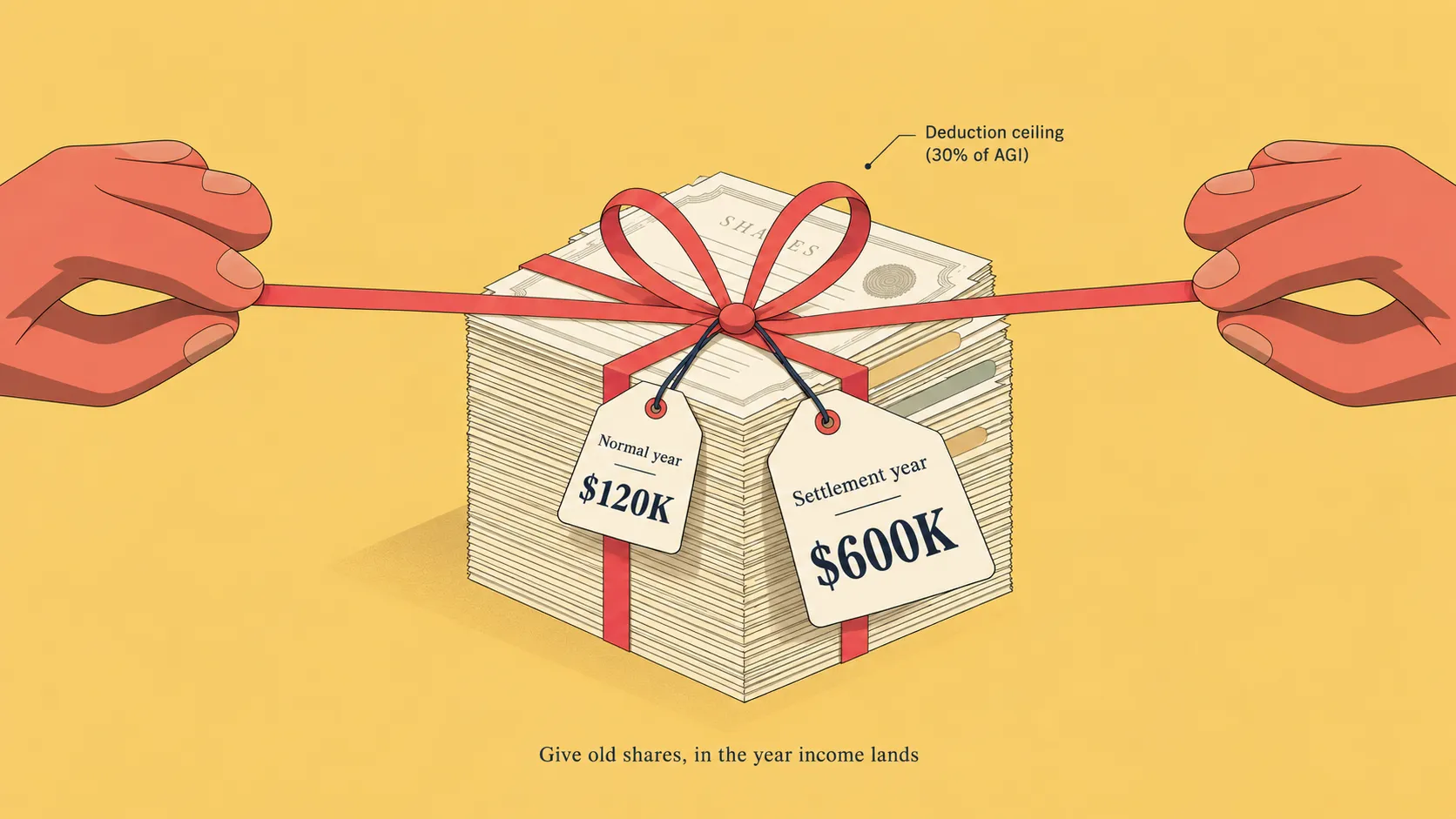
So the play is not "donate the shares that just settled." It is "donate the oldest, most appreciated thing you own, in the year the new income lands."
Same year. Different asset. Materially different outcome.
The Ceilings Work In Your Favor This Year, For Once
The AGI ceilings usually constrain people. In a settlement year they do the opposite.
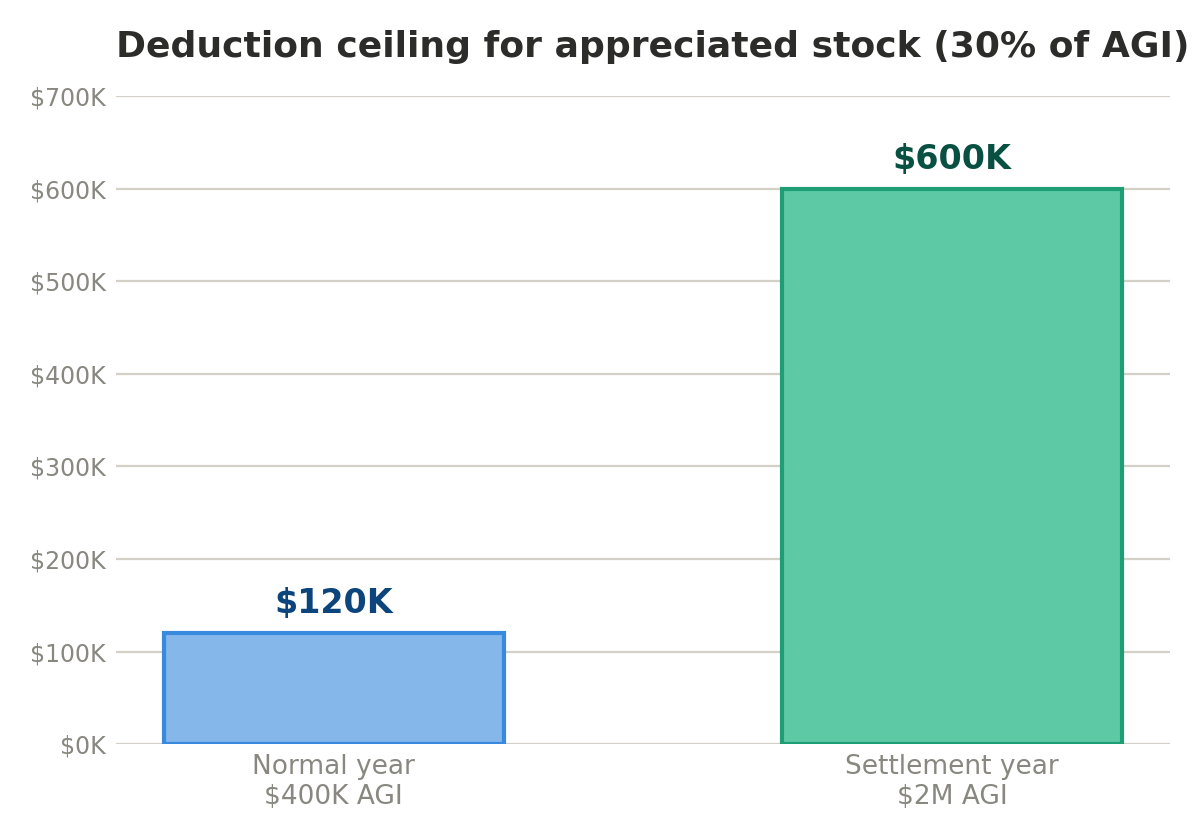
Appreciated long-term property is deductible up to 30% of adjusted gross income. Cash is 60%.
In a normal year, on a $400,000 AGI, that caps appreciated-property gifts at $120,000. Fine, but limiting if you are thinking about a large gift.
In the year a large equity position settles, your AGI might be $2,000,000 or more. Now the ceiling is $600,000 of appreciated property, or $1.2 million in cash.
For most people this is the only year of their life when the ceiling is not the binding constraint. If you have been carrying an intention to make a significant gift, this is the year the tax code stops arguing with you.
The Carryforward Runs the Other Direction Too
The flip side is just as useful and almost nobody uses it.
If you made a large charitable gift in an earlier, lower-income year and blew through the ceiling, that excess carries forward for up to five years. It has been sitting there doing nothing.
The settlement year is when it becomes valuable. A carryforward that was worth very little against a modest salary is now offsetting income taxed at the top rate.
There is a 2026 detail worth knowing here. Contribution carryovers generated before January 1, 2026 are not subject to the new 0.5% AGI floor when you use them in later years. If you made a big gift in 2024 or 2025 and carried part of it forward, that carryforward is grandfathered, and the order in which it gets used matters.
Three Things That Are Not True
"I should wait a year and then donate the shares." Maybe. If the stock rises over that year, yes, and meaningfully so, because now you have real appreciation to give away. If it falls, absolutely not. Then you sell, harvest the capital loss, and donate cash. You never donate a position worth less than your basis, because the loss simply disappears.
Given that a lot of newly public stocks decline over their first year, this is a real coin flip, not a default.
"The deduction will cover the tax on the settlement." It will not come close. The settlement income is taxed at your full marginal rate. The deduction, starting in 2026, is worth at most 35 cents per dollar for a top-bracket taxpayer, and only on the portion above 0.5% of your AGI. On a $2,000,000 AGI that floor alone is $10,000 of giving that produces nothing.
Charitable giving reduces a large tax bill. It does not solve one. If your plan for the settlement-year tax bill is "I'll donate a bunch," you need a different plan, and it starts with safe harbor estimated payments.
"I'll sort out the charitable piece after the lock-up." The deduction has to land in the year the income lands. If the income is in year one and you give in year two, you have separated the deduction from the bracket it was supposed to offset. The gift is still good. It is just worth substantially less.
What I Would Actually Do
1. Inventory what you hold with real appreciation in it, before settlement. Pull the lot-level cost basis on every taxable position. You are looking for anything held more than a year with a large gain. That is your charitable inventory. The shares about to settle are not on the list.
2. Decide the amount before you know the number. Pick a percentage of the settlement value you intend to give. Deciding after you see the wire is a different and much harder conversation.
3. Use the settlement year, and use a donor-advised fund to separate the timing. Fund it with the appreciated positions, take the deduction in the high-income year, and grant to the actual organizations over the following decade on whatever schedule you like. The deduction is bound to the year. The giving does not have to be.
4. Check for carryforwards from prior years before you add new ones. Free money that is already sitting on your return.
The Bottom Line
The instinct to give away some of your equity when it finally becomes real is a good one, and I have never talked anyone out of it.
I have talked a lot of people out of giving away the wrong shares. The ones that just settled have no gain in them, which means the most valuable feature of charitable giving does not apply.
Give away the old stuff. In the new year. That is the whole trick.
If you have a settlement or liquidity event coming and giving is part of your plan, we are happy to inventory what you hold and work out which shares should actually go.
This content is for educational purposes and does not constitute personalized financial or tax advice. Tax rules change and individual circumstances vary. All examples are hypothetical and illustrative. Alphanso LLC is a registered investment adviser.

Plan with an expert
What to expect


.png)
.jpg)
.png)
.png)