Your IRA Cannot Fund Your DAF
Here is a sentence I have said out loud more times than any other in the last two years:
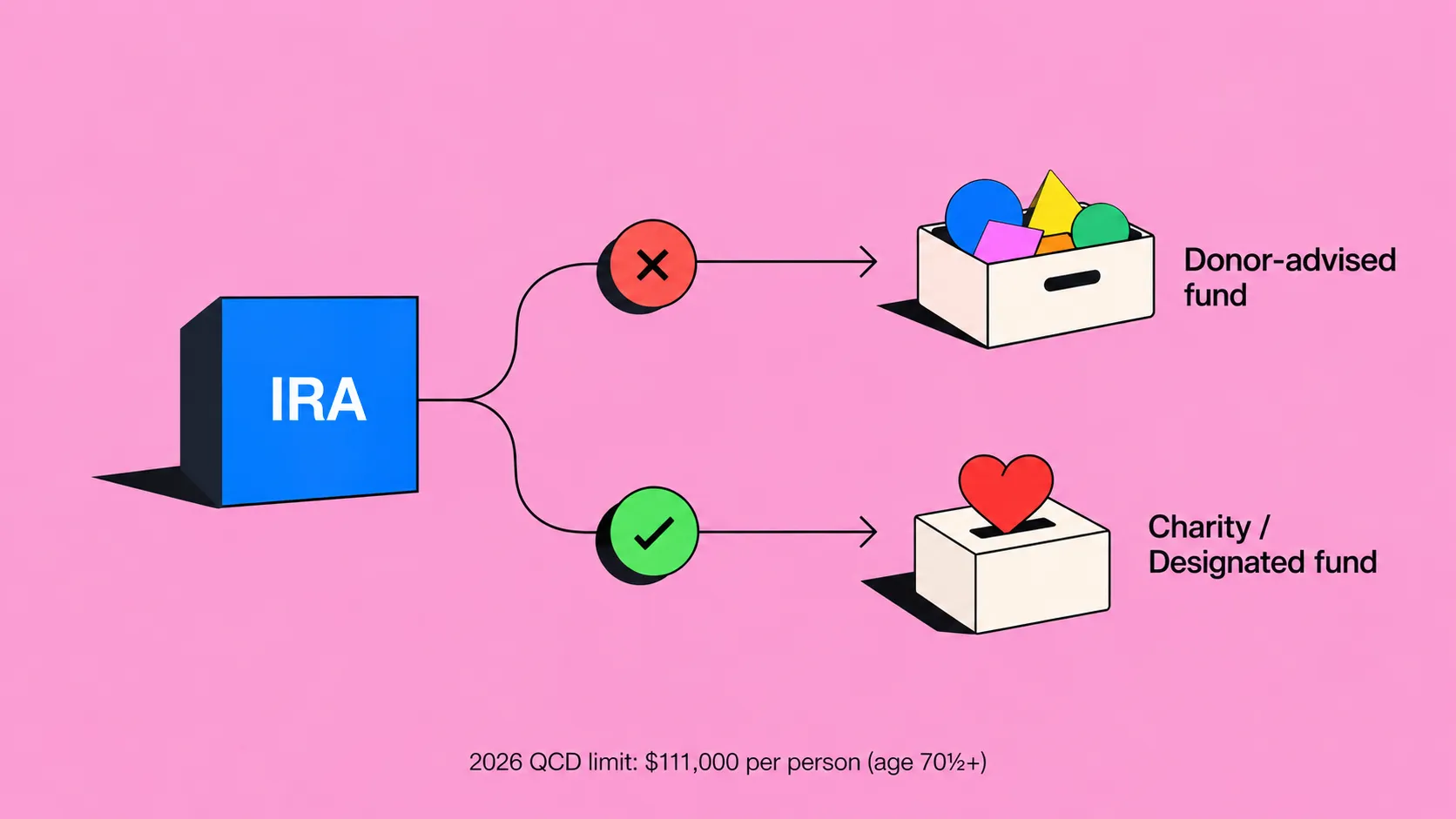
"You can't send a QCD to your donor-advised fund."
It lands badly every time, because by the time someone asks, they have usually already decided it was the plan. They have the fund. They have the IRA. They are over 70 and a half. The two things look like they were designed to fit together.
They were not, and the reason is worth understanding, because there is a clean way to get most of what people are after.
First, Why the QCD Is So Good
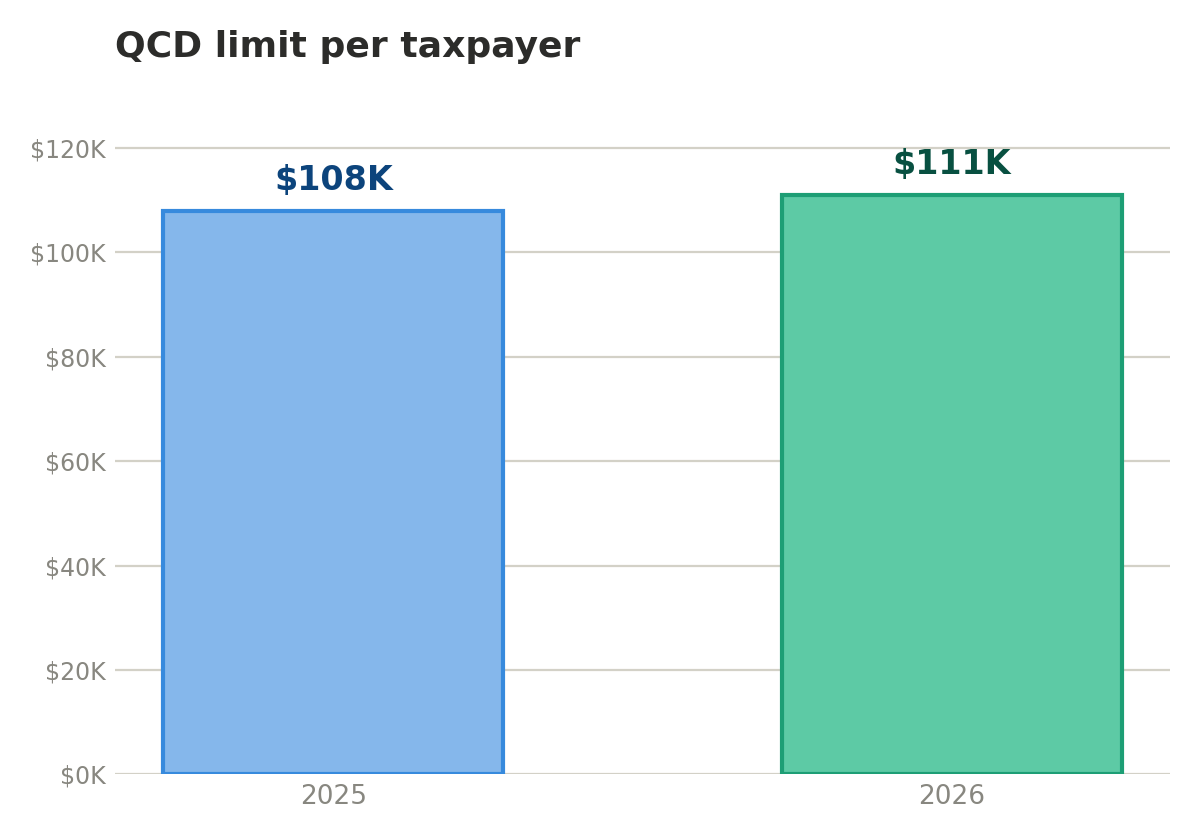
A qualified charitable distribution lets someone aged 70 and a half or older send money directly from an IRA to a qualifying charity. For 2026 the limit is $111,000 per taxpayer, up from $108,000.
The distribution counts toward your required minimum distribution. And here is the part that matters: it is excluded from your income entirely. It never shows up in AGI.
That is categorically better than a deduction, and most people underestimate by how much.
A deduction reduces taxable income. An exclusion reduces adjusted gross income, and AGI is the number that drives almost everything else on the return. Lower AGI means:
- Less of your Social Security is taxable
- You are further from the net investment income tax threshold
- Your Medicare IRMAA surcharge bracket may drop, which is a real cash difference of thousands per year for a couple
- The new 0.5% charitable floor, which is calculated on AGI, is smaller
And there is one more, specific to 2026. The QCD is an exclusion, so the new 0.5% floor never touches it and the 35% cap on itemized deduction benefit never touches it either. Both of those changes made the itemized charitable deduction worse this year. Neither of them applies to a QCD.
For a retiree taking the standard deduction, which is most retirees, the QCD is not just better. It is the only version that produces any tax benefit at all.
So Why Can't It Go to a DAF?
Because the IRS does not want money leaving a tax-advantaged account, escaping income entirely, and landing somewhere the donor still controls when it gets spent.
A donor-advised fund gives you advisory privileges. You decide which charities get grants and when. From the IRS's point of view, the money has not really arrived anywhere yet.
So QCDs are specifically barred from going to donor-advised funds. They are also barred from going to private foundations and to supporting organizations, for the same underlying reason.
There is a bipartisan proposal that would change this. It has been floated more than once. It is not law, and I would not build a plan around it.
What You Can Do Instead
This is the part people do not know, and it is the whole reason this article exists.
The prohibition is on donor-advised funds specifically, not on community foundations generally. A community foundation can hold several different fund types, and most of them do accept QCDs:
- Designated funds, where you name the specific charity or charities up front and the fund supports them on an ongoing basis
- Field-of-interest funds, where you specify a cause or a geography and the foundation directs grants within it
- Unrestricted funds, where the foundation allocates to community needs as they arise
What you give up relative to a DAF is the year-by-year discretion. You cannot redirect a designated fund to a different organization on a whim.
What you keep is substantial: the money leaves your IRA, satisfies your RMD, never enters your AGI, and supports the work you actually care about on a permanent, named basis.
For a lot of people that trade is fine. They already know which three organizations they support. The annual discretion was never the point.
The Combination Most People Miss
If you are over 70 and a half, itemizing, and giving meaningfully, you can run both at once, and they do different jobs.
The QCD handles your recurring annual giving to the organizations you have supported for years. It comes out of the IRA, satisfies the RMD, and stays out of AGI.
The donor-advised fund handles the lumpy stuff. A big year, a property sale, a concentrated stock position you want to unwind. Funded with appreciated securities rather than cash, bunched into a single high-income year, granted out over time.
One tool for the steady giving, one for the episodic giving. They do not compete and they cannot be combined in a single transfer, which is the confusion that started this whole article.
Two Execution Details That Cause Real Problems
The money has to go directly from the IRA to the charity. If the distribution hits your checking account first and you write the check yourself, it is not a QCD. It is a taxable distribution plus a charitable deduction, which is a materially worse outcome and cannot be undone. Your custodian has to send it.
Your 1099-R will not distinguish it. The form reports the full distribution with no indication that part of it was a QCD. It is on you, or your preparer, to exclude it correctly on the return. I have seen people execute the QCD perfectly and then pay tax on it anyway because nobody told the preparer.
The Bottom Line
The QCD is one of the few provisions in the code that is simply, unambiguously good, and it got relatively better in 2026 while the itemized charitable deduction got worse.
It cannot fund your donor-advised fund. It can fund almost every other structure you might have had in mind, and a designated fund at a community foundation gets you most of the way to what the DAF was going to do.
If you are over 70 and a half and giving out of your checking account, stop. The money should be coming out of the IRA.
If you are taking RMDs and giving to charity and nobody has connected the two, we are happy to look at what that is costing you each year.
This content is for educational purposes and does not constitute personalized financial or tax advice. Tax rules change and individual circumstances vary. Alphanso LLC is a registered investment adviser.

Plan with an expert
What to expect


.png)
.jpg)
.png)
.png)