Sitting on $800K of Micron Stock? An Exchange Fund Can Diversify It Without the $215K Tax Bill
Micron is up more than 900% over the past year. If you held your RSU vests through that run, congratulations: you are wealthier than you have ever been, and probably more concentrated than you have ever been. Selling means handing roughly a third of your gain to the IRS and your state. Holding means your net worth rides on one ticker. Most people think those are the only two options. They are not.
What's Actually Happening
There is a third path that most tech employees have never heard of: the exchange fund. Not an exchange-traded fund. A completely different animal.
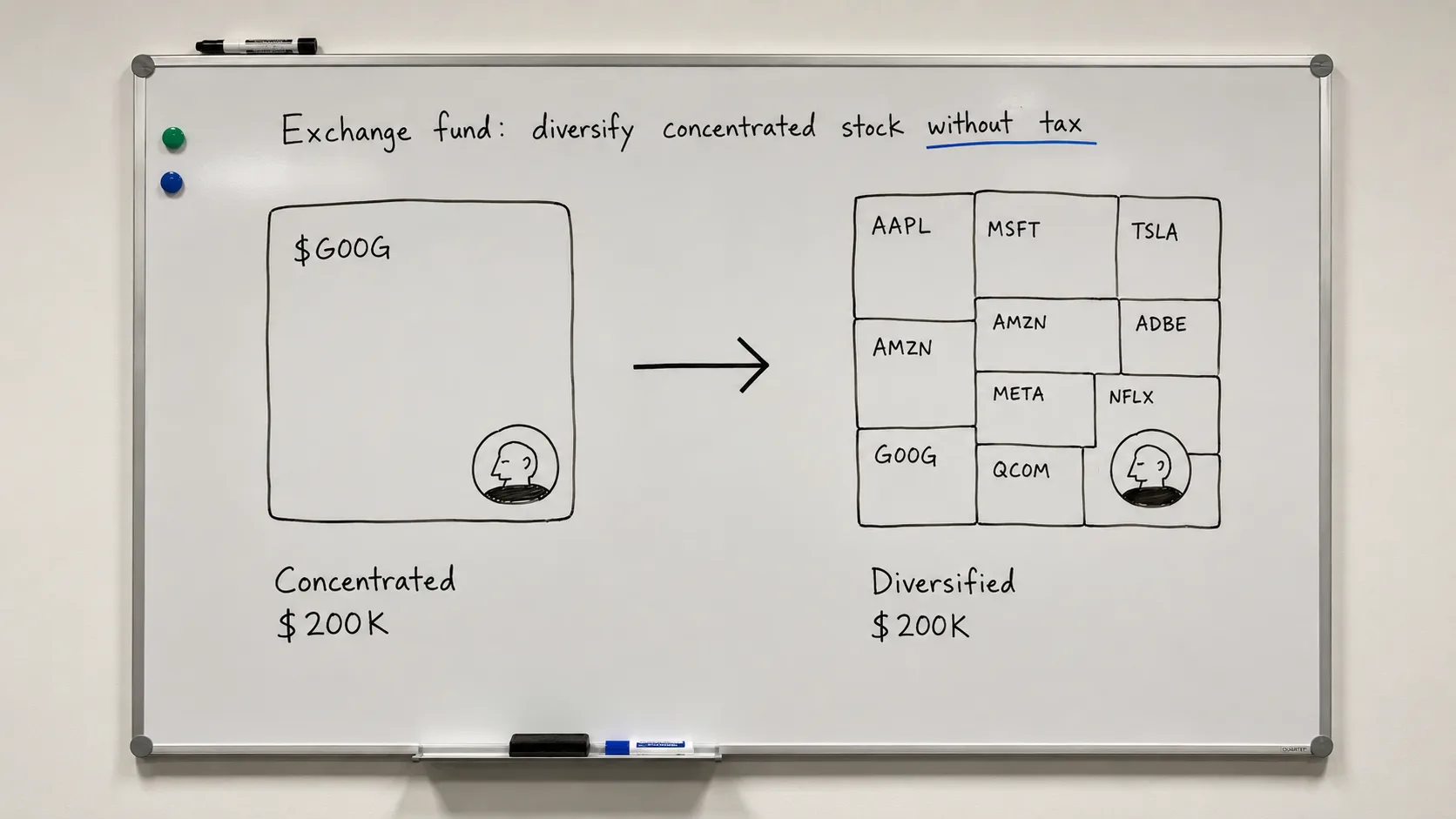
Here is the mechanic. An exchange fund is a partnership that pools concentrated stock from many investors who all have the same problem you do. You contribute your shares, someone at Nvidia contributes theirs, someone at Meta contributes theirs. Under Section 721 of the tax code (the rule that lets you contribute property to a partnership without recognizing a gain), the contribution is not a taxable event. You have not sold anything. No gain, no tax bill, no April surprise.
In exchange, you receive a partnership interest in the pooled fund. From day one, your exposure is spread across every stock in the pool instead of riding on one company. Hold that interest for seven years (the minimum required by the tax rules), and you can redeem it for a diversified basket of stocks from the fund. Your original cost basis carries over the entire way.
Let me make that concrete. Say you are a staff engineer at Micron. Call him Ravi. His MU position is worth $800,000 with a cost basis of $150,000, so he is sitting on a $650,000 unrealized gain, and Micron is roughly 60% of his net worth.
If Ravi sells everything this year, he pays 23.8% federal on the gain (20% long-term capital gains plus the 3.8% Net Investment Income Tax, which applies above $250,000 of income for married filers) and 9.3% to California. That is roughly $215,000 in tax. His $800,000 becomes about $585,000 of investable money.
If Ravi contributes the shares to an exchange fund instead, his tax bill this year is $0. The full $800,000 goes to work in a diversified pool. Seven years from now, he redeems a basket of 20 or more stocks with his original $150,000 basis intact. Taxes come due only when he eventually sells pieces of that basket, on his schedule, potentially spread across many years and lower brackets.
Same starting position. One path sends $215,000 to the government this year. The other sends $0 and diversifies anyway.
Why This Catches People
If this works so well, why have you never heard of it? Two reasons, and neither one is that you missed something obvious.
First, access. For decades, exchange funds were offered almost exclusively by Morgan Stanley (through Eaton Vance) and Goldman Sachs, with minimums of $500,000 to $1 million and a requirement that you be a qualified purchaser: at least $5 million in investments. These funds were built for family offices, not for engineers with a big vest schedule. That changed recently. Newer providers like Cache now accept accredited investors (roughly, $200,000 in income, $300,000 jointly, or $1 million in net worth excluding your home) with minimums starting at $100,000 and management fees of 0.40% to 0.95%. The strategy did not change. The front door did.
Second, the fine print genuinely matters, and it is scattered across places nobody reads. Three pieces worth knowing:
The seven-year clock is real. Redeem before year seven and the fund hands you back your original shares (or the lesser of their value and your fund interest), not a diversified basket. Some funds also charge early redemption fees of up to 2%. Leave early and you are roughly back where you started, minus fees.
Roughly 20% of the fund is illiquid by design. To avoid being classified as an investment company (which would kill the tax deferral), exchange funds must hold at least 20% of assets in qualifying illiquid investments, usually real estate. Your "diversified" pool includes a real estate sleeve whether you want one or not.
Deferral is not elimination. Your $150,000 basis follows you into the fund and out of it. This strategy moves the tax bill to a time of your choosing. It does not erase it. Anyone who tells you otherwise is selling something.
What You Can Do About It
If you are 30% or more concentrated in one stock, here are the realistic options, with the trade-offs stated plainly:
These are not mutually exclusive. Plenty of people put half their position into an exchange fund and unwind the rest through a 10b5-1 plan with harvesting layered on. The right split depends on your liquidity needs, your other assets, and how much of the stock you would buy today if you did not already own it.
The Bottom Line
You do not have to choose between a $215,000 tax bill and betting your net worth on one ticker. An exchange fund lets you diversify a concentrated position without selling, without a taxable event, and without waiting. The price is a seven-year commitment and the discipline to remember that the tax is deferred, not erased. Say it once more: deferred, not erased.
If a big chunk of your net worth is sitting in one stock and you are not sure which of these paths fits, we are happy to dig into your specific situation and run the numbers side by side.
This content is for educational purposes and does not constitute personalized financial or tax advice. Exchange funds involve eligibility requirements, liquidity restrictions, and fees. Consult a qualified professional about your specific circumstances.

Plan with an expert
What to expect


.png)
.jpg)
.png)
.png)