The Match Bigger Than Your 401(k)
.webp)
Everyone knows about the 401(k) match. People will change their contribution rate mid-year to make sure they capture all of it, and they are right to.
On a 4% match against a $400,000 salary, that is $16,000 a year of free money. Worth paying attention to.
Almost nobody applies the same attention to the charitable matching program sitting two tabs away in the same benefits portal, and at a lot of high-growth companies, particularly the late-stage private ones, that program is considerably more generous than the retirement match.
Some of them match charitable gifts dollar for dollar up to a meaningful annual cap. A smaller number, and this is the one worth knowing about, will match gifts of equity, sometimes up to a percentage of your entire grant.
I want to walk through why that combination is unusually powerful, because it stacks three separate benefits on top of each other and most people capture at most one.
The Three Layers
Say you donate appreciated shares you have held more than a year, worth $100,000, with a cost basis of $20,000.
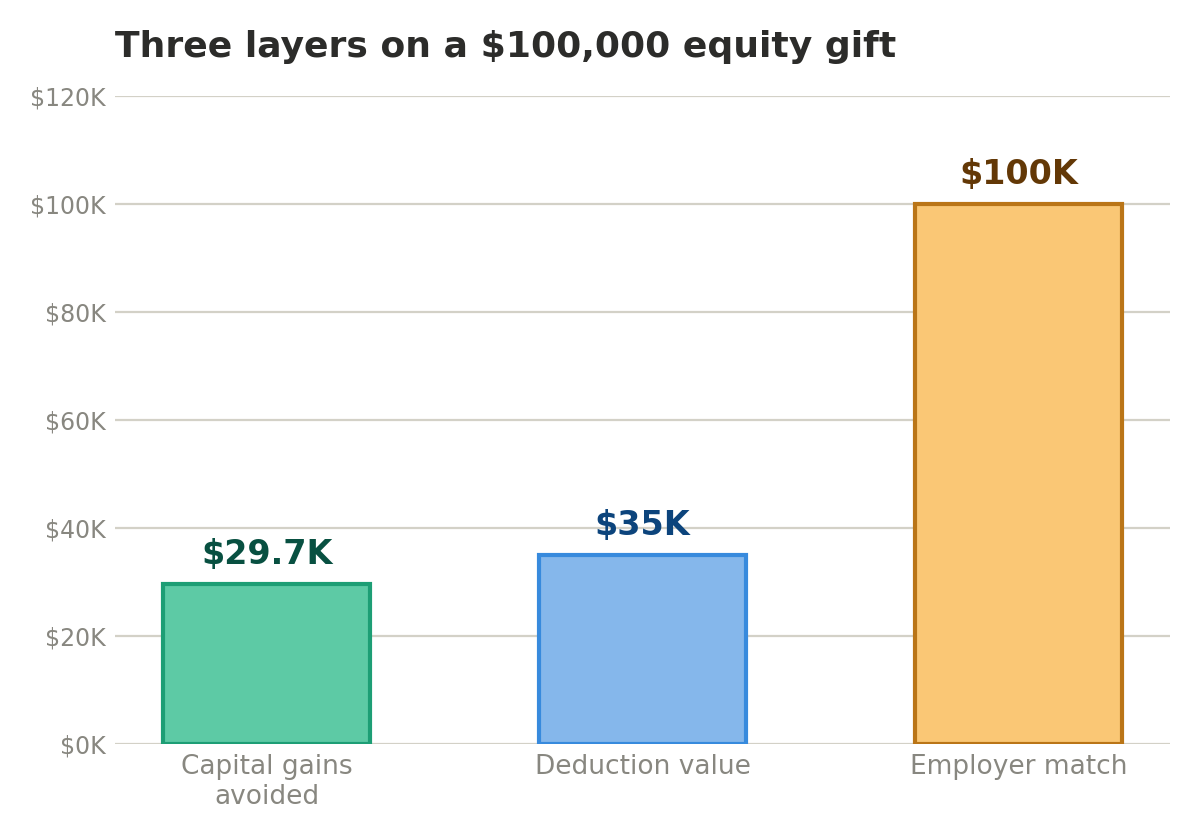
Layer one: the capital gains you do not pay. Had you sold, the $80,000 gain would be taxed at 23.8% federal plus state. In a high-tax state, call the combined bill roughly $29,700. Donating the shares directly means nobody pays it. Not you, not the charity.
Layer two: the deduction. You deduct the full $100,000 fair market value, not your $20,000 basis. At a 35% benefit that is $35,000, subject to the AGI ceilings below.
Layer three: the match. If your employer matches equity donations one for one, the charity receives another $100,000 that did not come from you at all.
Add it up. The organization receives $200,000. Your out-of-pocket cost, measured against simply selling the position and keeping the cash, is roughly $35,300 rather than $100,000, because $29,700 of avoided capital gains and $35,000 of deduction value came back to you.
That is close to six dollars of charitable impact per dollar of real cost. I do not know of another lever in a normal comp package that produces that ratio.
Why Almost Nobody Captures It
Four reasons, and I have seen every one of them.
The cap is annual and it does not roll over. Matching programs almost always reset each year. The amount you did not use in 2025 is gone. People who intend to "give a lot once this is liquid" are letting the match expire annually while they wait.
The equity version is hidden. Most people find the cash matching program, if they find anything, and never learn that gifts of stock qualify too, often at a much higher ceiling. The cash program might cap at a few thousand dollars. The equity program might be expressed as a percentage of your grant, which is a different order of magnitude.
There is a process and a deadline. Matches typically require submitting a request through a specific portal within a window after the gift, with documentation from the receiving organization. Miss the window and the gift still counts for your deduction but the match is forfeited. This is the single most common way the money gets left behind.
Not every recipient qualifies. Programs usually restrict matches to registered public charities, and frequently exclude donor-advised funds, private foundations, religious organizations, and political entities. If your plan is to fund a DAF, the match may not apply to that transfer even though the deduction does. This is worth checking before you design the gift, not after.
That last point matters enough to say plainly: the most tax-efficient vehicle and the vehicle that qualifies for the match are not always the same vehicle. Sometimes the right answer is a direct gift to the organization rather than a DAF contribution, precisely because the match is larger than the flexibility is worth.
The Questions to Actually Ask
Open your benefits portal and find answers to these six. It takes twenty minutes and it is the highest hourly rate you will earn this quarter.
- Is there a charitable matching program, and what is the annual cap per employee?
- Does it match gifts of stock or equity, or only cash?
- If it matches equity, is the cap a dollar figure or a percentage of your grant?
- Are contributions to a donor-advised fund eligible, or only direct gifts to operating charities?
- What is the deadline to submit a match request after the gift is made?
- Does unexercised or unsettled equity count, or only shares you actually hold?
That sixth question is the one that trips up people at private companies. If you hold unexercised options, you do not hold stock, and you cannot donate stock you do not have. If you hold double-trigger RSUs that have not settled, the same is true. In both cases the match may be theoretically available and practically unreachable until something changes.
The Sequencing Problem
Here is the thing that makes this genuinely hard rather than merely overlooked.
The years you have the most equity to give are often the years you have the least income to deduct against.
Appreciated property is deductible up to 30% of adjusted gross income. If you are at a private company with a modest salary and an enormous paper position, 30% of your AGI is a small number, and a large gift will exceed it and carry forward for up to five years.
That carryforward is not lost, and in fact it frequently lands in exactly the right place: the year the liquidity event pushes your income into a bracket where the deduction is worth the most.
But the match does not carry forward. The match is annual, use it or lose it.
Which means the optimal plan is often not one big gift. It is a smaller gift every year, sized to capture the full match, with the deduction carrying forward to meet the income when it arrives.
That is the opposite of the bunching advice I give most people, and it is the right answer here specifically because a match ceiling behaves differently from a deduction ceiling.
One 2026 Note
New this year, charitable contributions are deductible only to the extent they exceed 0.5% of AGI, and the benefit of itemized deductions is capped at 35 cents per dollar for top-bracket taxpayers.
Both of those shave the deduction layer slightly. Neither touches the capital gains layer, and neither touches the match at all.
The match is the largest of the three layers and it is completely unaffected by any of this year's changes. If you were going to check one thing, check the match.
The Bottom Line
You would not leave a 401(k) match on the table. People restructure their whole contribution schedule to avoid it.
An equity donation match, where it exists, is frequently worth several times more, expires annually the same way, and sits behind a page almost nobody opens.
Twenty minutes in the benefits portal. Six questions. Then decide.
If you have equity you have been meaning to give away and you are not sure what your employer's program actually covers, we are happy to read the plan documents with you and work out the sequencing.
This content is for educational purposes and does not constitute personalized financial or tax advice. Matching gift programs vary significantly by employer. Tax rules change and individual circumstances vary. All examples are hypothetical and illustrative. Alphanso LLC is a registered investment adviser.

Plan with an expert
What to expect


.png)
.jpg)
.png)
.png)