The Pre-IPO Giving Window Closes Early

Most people at late-stage private companies who intend to be generous have the same plan, and it is the same plan in almost the same words:
"Once this is liquid, I'll give some away."
It is a completely reasonable thing to say. It is also, in tax terms, the most expensive possible version of the intention, and the reason is a piece of doctrine most people have never heard of.
The Rule That Ends the Window
The IRS has a principle called anticipatory assignment of income. It says, roughly, that you cannot give away an asset after the gain on it has already become a sure thing and expect to escape the tax.
If you transfer shares to a charity at a point where the sale is effectively locked in, a signed merger agreement, a binding tender, a transaction that is a formality away from closing, the IRS can treat the gain as yours. You gave away the asset. You keep the tax bill. It is the worst of both outcomes and people walk into it every year because the charitable conversation starts after the deal conversation.
The practical translation is blunt. The charitable planning has to happen while the outcome is still genuinely uncertain. Not after the announcement. Not during the quiet period on a filed S-1, when your options are narrower than you think. Months earlier.
The people who get this right started the conversation a year before anything happened, at a valuation that felt embarrassingly speculative at the time.
What You Actually Get for the Trouble
When it works, the benefit is larger for pre-IPO shares than for almost any other asset.
Donate stock you have held more than a year to a public charity or a donor-advised fund and you deduct its fair market value, not what you paid for it, and the unrealized gain is never taxed. Not by you, not by the charity.
For an early employee who exercised at a strike price that now looks like a rounding error, the gap between basis and value is enormous, and all of it escapes capital gains tax.
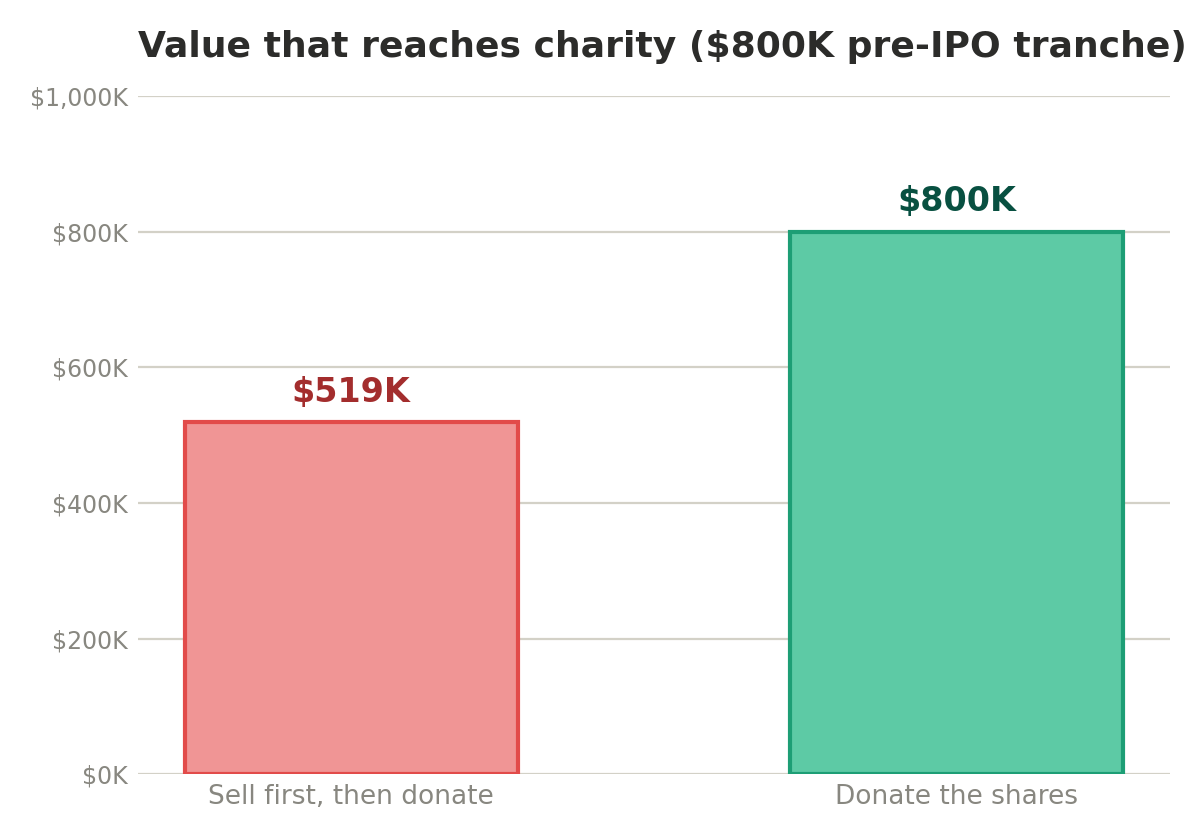
Run the shape of it. Suppose you exercised early, your basis across a tranche is $40,000, and a qualified appraisal puts the current value at $800,000.
Sell first, then donate. The $760,000 gain gets taxed. At 23.8% federal, that is about $180,900, and in a high-tax state you could add $100,000 more. You would have roughly $519,000 left to give.
Donate the shares. The charity or your donor-advised fund receives $800,000 of value. You deduct $800,000, subject to the ceilings below. No capital gains tax is paid by anyone.
The difference is not a rounding adjustment. It is most of a house.
The Four Things That Will Actually Stop You
This is where I want to be honest, because the upside above is real and the friction is also real, and most articles on this topic skip the friction entirely.
1. You cannot donate an option. Unexercised ISOs and NSOs are not property you can transfer to charity in any useful way. You have to exercise first, which means writing a check and, for ISOs, potentially triggering alternative minimum tax on the spread. Only then do you hold shares you can give.
This alone rules out a lot of people, and it is the first question to answer, not the last.
2. If you hold double-trigger RSUs, you hold nothing yet. Double-trigger units do not settle until both the time vesting and the liquidity event have occurred. Until that second trigger fires, there is no share, and there is nothing to donate. Everything in this article is about people who hold actual stock, usually because they exercised options years ago.
3. The company has to let you. Private company shares almost always carry transfer restrictions, rights of first refusal, and a board or general partner approval requirement. A charity cannot accept shares the issuer will not permit to be transferred. This approval process takes weeks at best, and the answer is sometimes no.
Start here. If the answer is no, the rest of the plan is academic.
4. Most charities will not take them. Private stock is illiquid, hard to value, and can carry embedded liabilities and unrelated business income tax exposure. A lot of organizations, reasonably, decline. Donor-advised fund sponsors that do accept non-cash assets typically run real due diligence on shareholder agreements and transfer restrictions, and many expect the asset to become liquid within a defined window, often around 120 days.
This is not a transfer you initiate in the last week of December.
The Appraisal Is Not a Formality
For non-publicly-traded property valued above $5,000, you need a qualified appraisal as of the transfer date, and it has to be attached to the return. Publicly traded stock is exempt from this. Private stock is not.
Two things about that appraisal surprise people.
The value is generally not the last preferred round price. A minority, non-controlling, illiquid common position is typically appraised at a discount to that headline number. Your deduction is based on the appraised value, which will usually be lower than the figure in the press release.
And the appraisal is the deduction's foundation. A weak one is where charitable deductions of this size get challenged.
One more structural point, mostly for people holding LP or LLC interests rather than corporate stock: if you contribute an interest in a partnership or S corporation, your deduction can be reduced by the ordinary income you would have recognized had you sold it at fair market value. That can take a large chunk out of the benefit, and it needs to be modeled specifically rather than assumed away.
The Ceilings and the Carryforward
Appreciated long-term property given to a public charity is deductible up to 30% of adjusted gross income, with a five-year carryforward for the excess. Cash is 60%.
For most pre-IPO employees, AGI before the liquidity event is modest, salary and not much else. Which means a large gift of appreciated shares in a pre-liquidity year will blow straight through the 30% ceiling and carry forward.
That is not a problem. It is frequently the design. The carryforward lands in the year the income arrives, which is exactly the year a deduction is worth the most.
And starting in 2026, remember that contributions are deductible only above 0.5% of AGI, and that the benefit of itemized deductions is capped at 35 cents per dollar for top-bracket taxpayers. Neither touches the capital gains you avoid, which is the larger half of this strategy.
The Honest Trade-Off
Here is the part that keeps people from doing this, and I do not think it should be argued away.
Giving away pre-IPO shares means giving them away before you know what they are worth. If the company triples after you transfer, you gave away three times what you thought. The deduction is locked at the appraised value on the transfer date. The upside belongs to the charity.
That cuts the other way too, and people forget it. If the company disappoints, you gave away shares at a valuation that never materialized, and you took a deduction based on it.
There is no version where you keep the optionality and the tax treatment. The tax benefit exists precisely because you gave up the outcome.
What I tell people is this: decide the percentage of your position you are willing to give away, not the dollar amount. A percentage is a decision you can make honestly today, before the number exists. A dollar amount is a decision you will second-guess every time the valuation moves.
The Bottom Line
The charitable window on pre-IPO stock is open when the outcome is uncertain and closes when the transaction becomes a sure thing. That is the opposite of most people's instinct, which is to wait until things are settled.
If you hold actual shares, if the company will approve a transfer, and if you were going to be generous anyway, the planning starts now and takes months.
If you are holding unexercised options or unsettled double-trigger units, you have a different and earlier set of decisions to make first.
If you hold pre-IPO equity and charitable giving is somewhere in your plans, we are happy to look at what you actually hold, what can be transferred, and what the timing needs to be.
This content is for educational purposes and does not constitute personalized financial or tax advice. Tax rules change and individual circumstances vary. All examples are hypothetical and illustrative. Alphanso LLC is a registered investment adviser.

Plan with an expert
What to expect


.png)
.jpg)
.png)
.png)