You Are Donating the Wrong Asset
Every December I have roughly the same conversation.
Someone tells me they gave $50,000 to charity that year. I ask how. They say they wrote checks, or set up a recurring card payment, or moved money from savings. Good people, doing a generous thing, in the most expensive possible way.
Because almost every one of them was also sitting on appreciated stock they had held for years and had no plan to sell.
That combination, cash out the door and appreciated stock sitting untouched, is the single most common and most expensive charitable giving mistake I see. It costs the donor money. More importantly, it costs the charity money. And it is entirely avoidable.
The Mechanic
When you donate appreciated stock that you have held longer than one year directly to a public charity, two things happen at once.
You deduct the full fair market value of the shares, not what you paid for them.
And the capital gain never gets taxed. Not by you, and not by the charity, because charities do not pay capital gains tax.
That second part is the whole game. The unrealized gain simply evaporates, in your favor, permanently.
What It Looks Like With Numbers
Take a position worth $50,000 today that you bought for $10,000 several years ago. A $40,000 unrealized gain. You want to give $50,000 to an organization you care about, and you are in the top bracket in California.
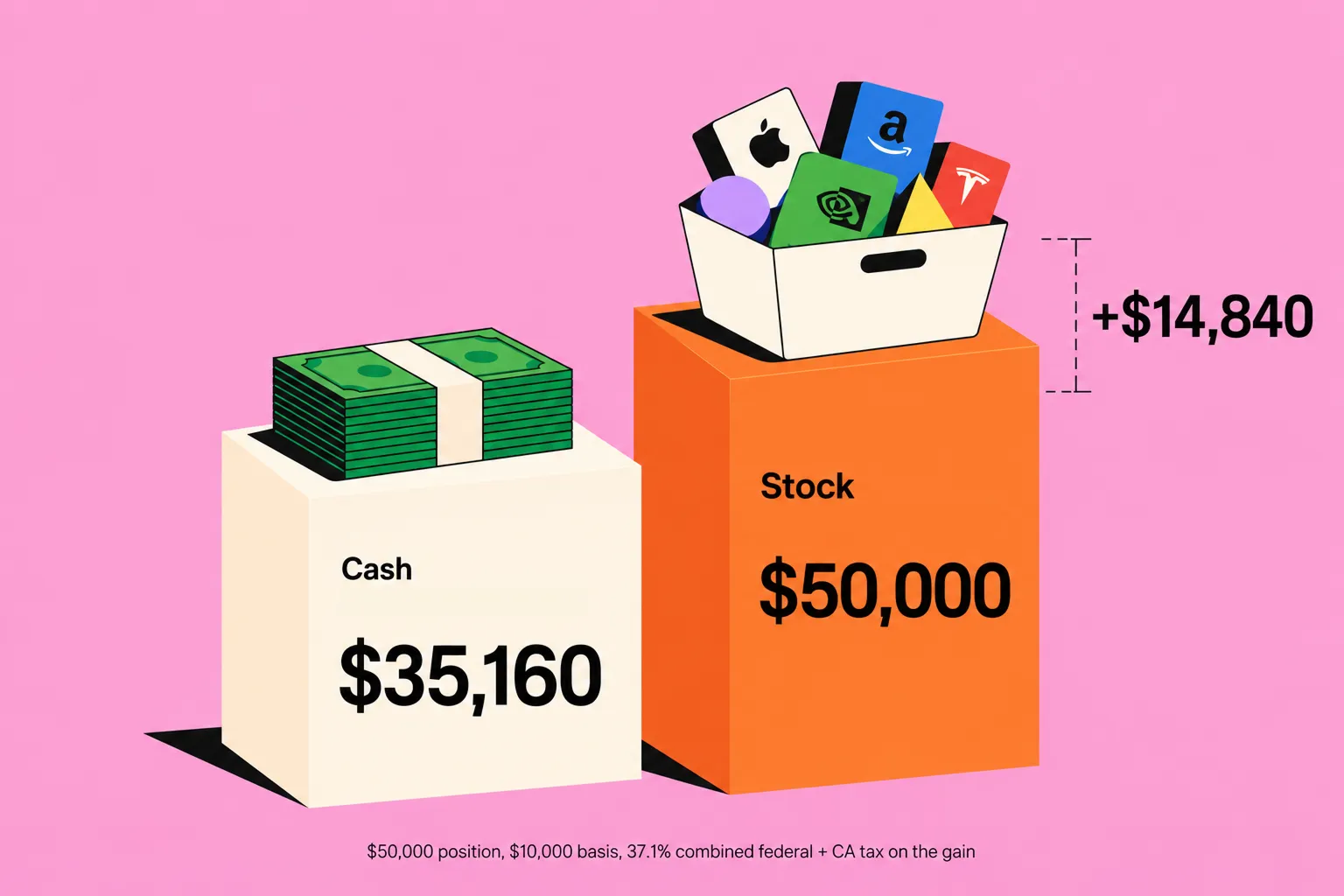
The way most people do it. You sell the stock. The $40,000 gain is taxed at 20% federal long-term capital gains plus 3.8% net investment income tax, so 23.8% federal, plus California at 13.3%. Call it 37.1% combined, or about $14,840 in tax. You have $35,160 left. You donate that.
Your charity receives $35,160. Your deduction is $35,160.
The way it should work. You transfer the shares themselves to the charity, or to your donor-advised fund, which then grants to the charity.
Your charity receives $50,000. Your deduction is $50,000. You pay no capital gains tax at all.
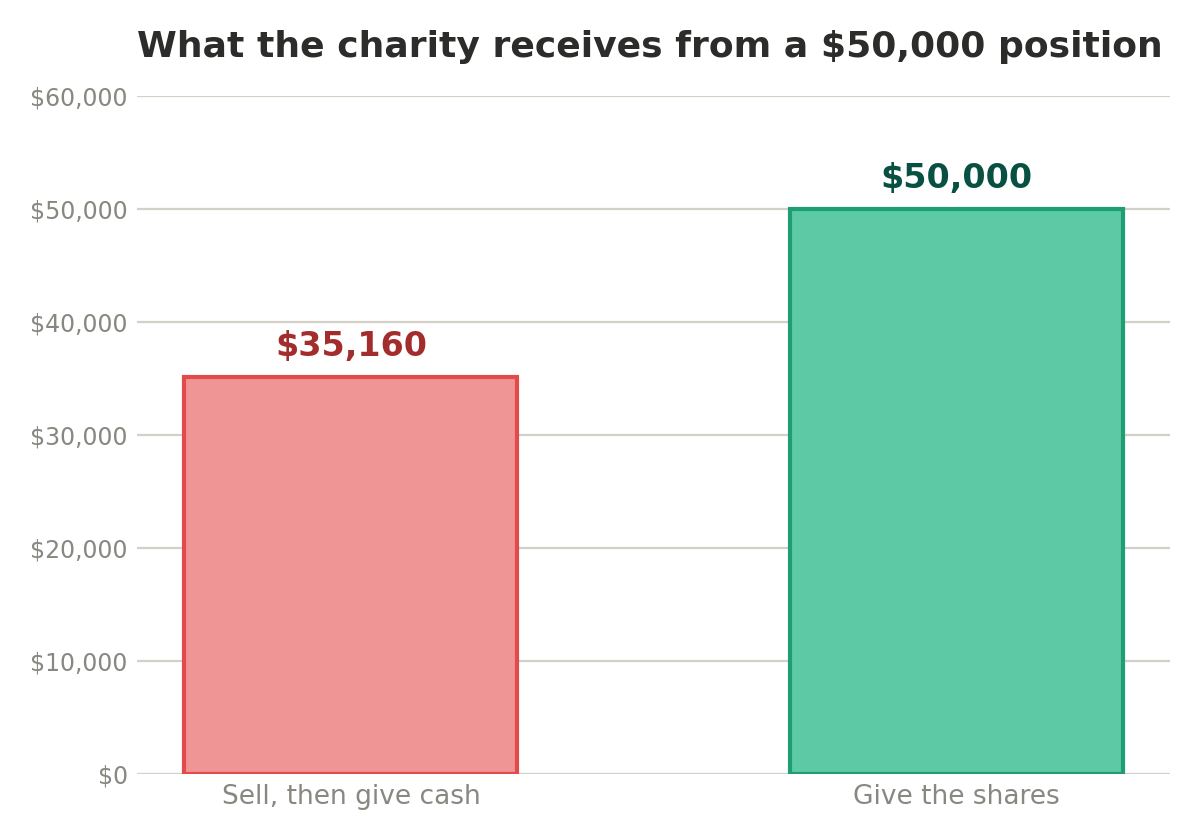
Same position, same intent, same year. The charity ends up with $14,840 more. Your deduction is $14,840 larger, worth about another $5,200 to you at a 35% benefit. The total swing is close to $20,000 on a $50,000 gift.
I have never had a client hear that math and decide they preferred the first version.
The Four Rules That Actually Govern This
This is where people get into trouble, so it is worth being precise.
1. The holding period is not optional. The shares must be held more than one year. Donate something you have held for eleven months and your deduction is limited to your cost basis, not fair market value. On the position above, that turns a $50,000 deduction into a $10,000 deduction. Same gift, one fifth the benefit, for the sake of a few weeks.
This is the single most expensive unforced error in this entire area. Check the lot dates before you transfer anything.
2. The AGI ceiling is different. Cash gifts to public charities are deductible up to 60% of adjusted gross income. Appreciated long-term property is capped at 30% of AGI. Anything above the ceiling carries forward for up to five years.
So on a $600,000 AGI, you can deduct up to $180,000 of appreciated stock this year. A larger gift is not wasted, it just spreads out. But if you are planning a very large gift, the ceiling determines the schedule.
3. Never, ever donate a losing position. If a stock is worth less than you paid for it, donating it throws away the loss. Nobody gets to use it. Not you, not the charity.
Sell it instead. Harvest the capital loss, which offsets other gains and, beyond that, up to $3,000 of ordinary income per year. Then donate the cash proceeds. You get the deduction and the loss.
Winners get donated. Losers get sold. That rule alone is worth the read.
4. Publicly traded shares are easy. Everything else is not. Listed stock requires no appraisal and transfers in days. Anything not publicly traded, including private company shares, LP interests, and real estate, generally requires a qualified appraisal for gifts over $5,000, plus a receiving charity willing to take it and a transfer the issuer will approve. Those gifts are very much worth doing, and they need to start months earlier than you think.
The Part Nobody Connects
Here is what makes this genuinely valuable rather than merely clever.
If you are a tech employee with vested equity, you are probably holding a concentrated position you know you should trim, and you have been putting it off because of the tax bill attached to selling.
And separately, you are giving money to charity every year out of cash.
Those are the same problem. Donating the most appreciated lots of your concentrated position accomplishes three things in one transfer: the charity gets more, your deduction gets bigger, and your concentration goes down without triggering a single dollar of capital gains tax.
I have watched people spend years agonizing over how to unwind a position while simultaneously writing charitable checks out of their paycheck. The two decisions were sitting on the same balance sheet and nobody had put them in the same conversation.
One 2026 Wrinkle
New this year, charitable contributions are deductible only to the extent they exceed 0.5% of your AGI, and the benefit of itemized deductions is capped at 35 cents per dollar for top-bracket taxpayers.
Neither of those changes the appreciated-stock argument. If anything they sharpen it, because the capital gains you avoid are avoided in full, at 23.8% federal plus state, untouched by any floor or cap. The deduction side got slightly worse. The gain-avoidance side did not change at all.
Which means the ratio between the two strategies moved further in favor of donating the asset rather than the cash.
The Bottom Line
You almost certainly hold something that has gone up a lot and that you have been reluctant to sell.
You almost certainly also give money away every year.
If those two facts are true about you and you have never connected them, that is a several-thousand-dollar-a-year oversight, and it is not the kind that shows up on any statement. Nobody's quarterly report has a line for the deduction you did not take.
If you are giving out of cash while holding appreciated stock you have not touched in years, we are happy to look at both sides together and show you what the swap is worth in your situation.
This content is for educational purposes and does not constitute personalized financial or tax advice. Tax rules change and individual circumstances vary. All examples are hypothetical and illustrative. Alphanso LLC is a registered investment adviser.

Plan with an expert
What to expect


.png)
.jpg)
.png)
.png)