Why Your Direct-Indexed Portfolio Is Still Harvesting Losses With the Dow at 53,000

The Dow just closed at a record 53,055. Small caps had their best first half since 1991. And a lot of people sitting on appreciated NVIDIA or Google stock have quietly decided there's no point in tax-loss harvesting this year, because everything is up.
That's the assumption I want to take apart. Because it's wrong, and it's costing people who are trying to diversify out of concentrated stock a lot of money they don't need to leave on the table.
What's Actually Happening Inside an "Up" Market
Here's the thing most people miss: an index going up does not mean every stock in it went up.
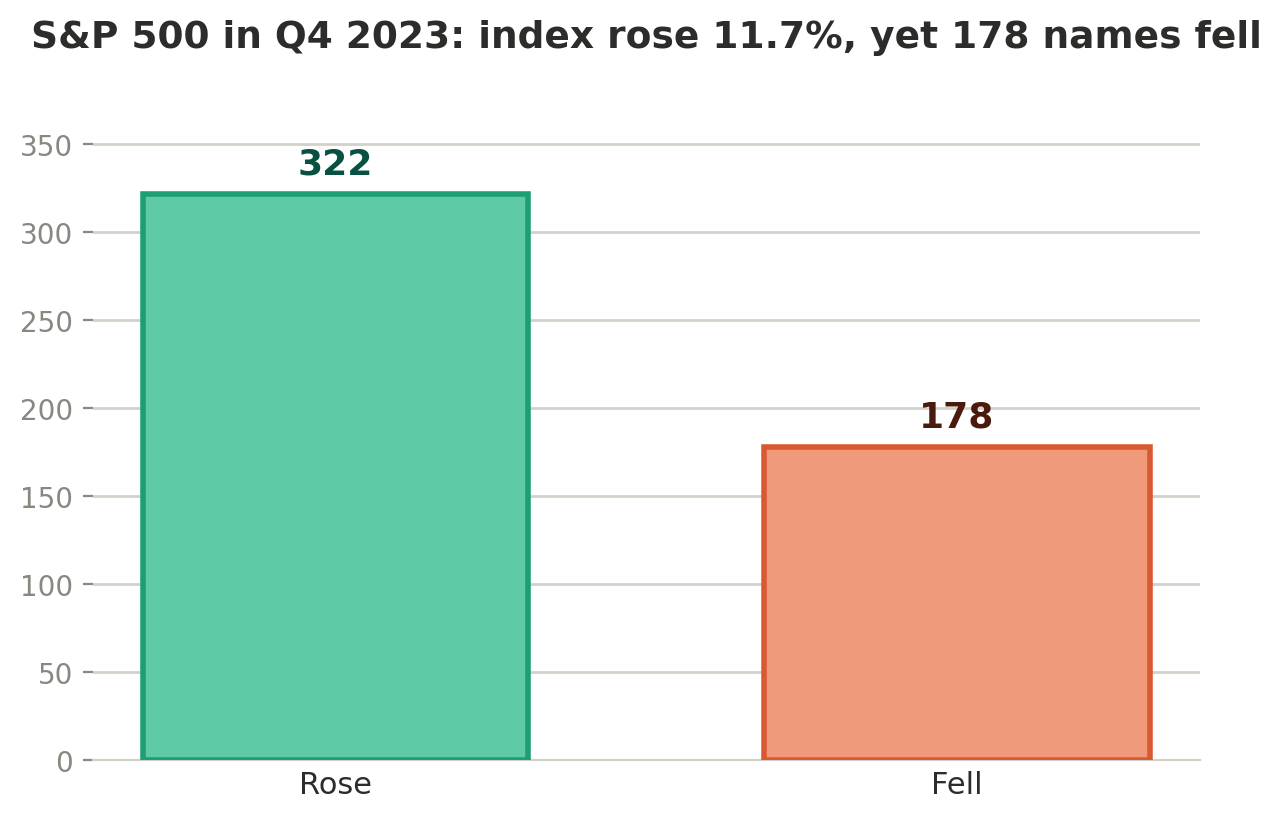
The S&P 500 is 500 companies. In any given quarter, a big chunk of them fall even while the index climbs. This isn't a bad year. It's a normal year. Look at Q4 2023 as the clean example: the S&P 500 rose 11.7% in three months, and yet 178 of its companies lost value over that same stretch. The index went up double digits. More than a third of the names inside it went down.
Now, if you own the S&P 500 through a normal index fund (VOO, SPY, whatever's in your 401k), you can't touch any of that. You own one thing: a fund share. If the fund is up, you have a gain, and there's nothing to harvest.
Direct indexing changes the unit you own. Instead of holding one fund share, you hold the actual individual stocks that make up the index, a few hundred of them, weighted to track it. Your overall portfolio can be up 11% for the year and still have 150 individual positions sitting at a loss. Those individual losses are real, and they're yours to harvest.
Tax-loss harvesting just means selling a position that's down to lock in the loss on paper, then using that loss to offset gains elsewhere on your tax return. In a direct-indexed account, you're doing this at the individual-stock level, all year long, in markets that are going up. That's the entire point.
Why This Matters Specifically for People Unwinding Concentrated Stock
Let me make this concrete with someone I see all the time.
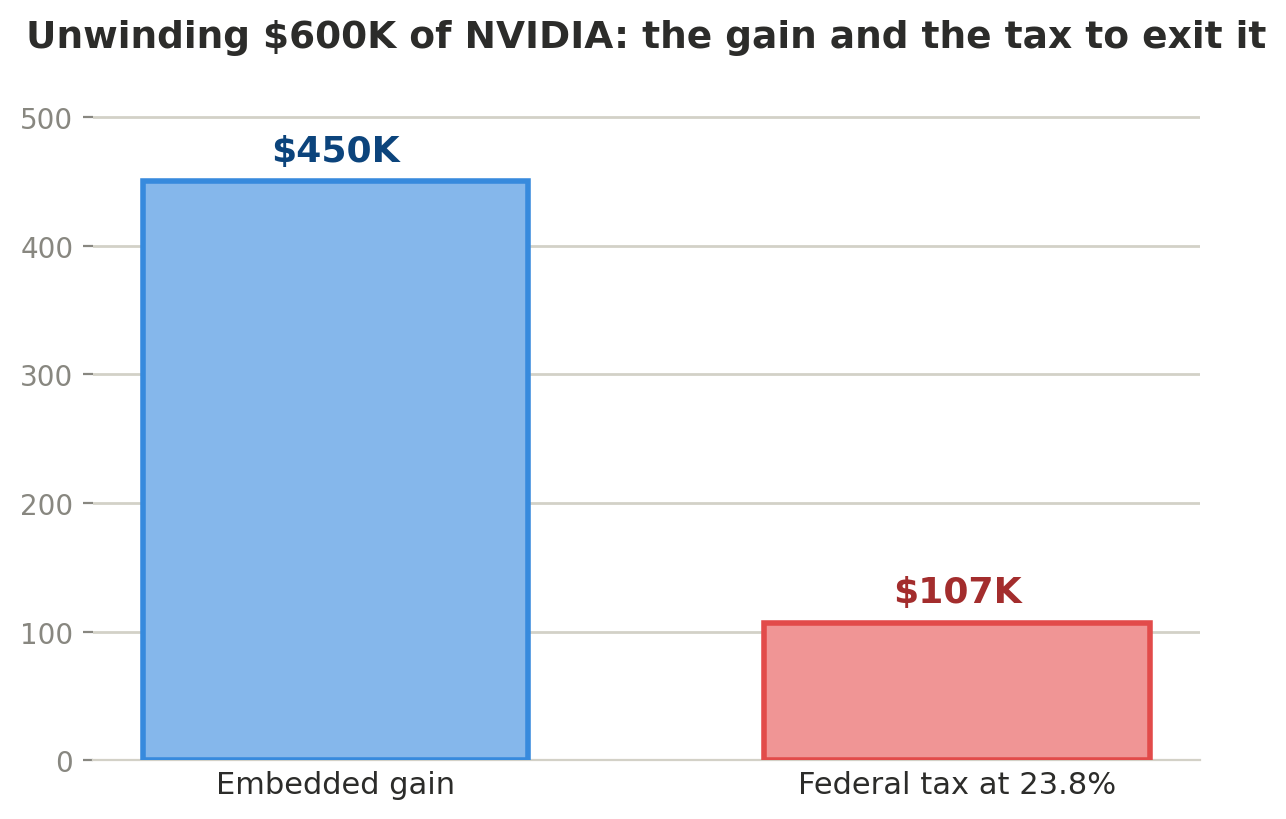
Say you're a senior engineer at NVIDIA. You've been there six years. $NVDA is up 56% over the last year alone, and a lot more over your tenure. You've got, let's say, $600,000 of vested NVIDIA stock, and roughly $450,000 of that is embedded long-term capital gain (meaning if you sold, you'd be taxed on $450K of profit).
You know you're too concentrated. One stock, one company, also your paycheck. Everybody around you knows the textbook answer is to diversify. But you haven't, and the reason is the tax bill.
If you sell that stock, the $450,000 gain gets taxed at the long-term capital gains rate. At your income level in 2026, that's the 20% federal bracket (long-term gains hit 20% above $613,700 of taxable income for married filing jointly), plus the 3.8% NIIT, which is the Net Investment Income Tax that kicks in on investment income above $250,000 of modified gross income for married filers. So 23.8% federal on the gain. On $450,000, that's roughly $107,000 in tax to unwind the position. Before state.
That number is why concentrated positions stay concentrated. The tax cost of fixing the problem feels worse than the risk of not fixing it.
This is exactly where harvested losses do their work. Every dollar of capital loss you harvest offsets a dollar of that capital gain, dollar for dollar. There's no cap on how much gain you can offset with losses. (The $3,000 limit people remember only applies to using losses against ordinary W-2 income. Against capital gains, losses offset without limit.)
So if your direct-indexed portfolio harvests, say, $40,000 of losses this year from individual names that are down, you can apply that $40,000 directly against your NVIDIA gain. At 23.8%, that's about $9,500 you don't pay this year. Do that consistently, year after year, while the index still climbs, and you build up a bank of losses that lets you sell down the concentrated position in chunks without the full tax hit each time.

The market being at all-time highs doesn't shut this off. It's the dispersion inside the market, the winners and losers coexisting, that creates the losses. And there's plenty of dispersion right now.
What You Can Actually Do About It
A few paths, with honest trade-offs:
- Do nothing and keep the concentration. Sometimes the right call if a sale is imminent for another reason. But "the tax bill is scary" is not a diversification strategy, and it's how people ride a single stock all the way down.
- Sell the concentrated stock outright and eat the tax. Clean, simple, and sometimes worth it if the concentration risk is severe enough. You pay the 23.8% (plus state) and move on. The downside is obvious: it's the most expensive version.
- Set up direct indexing alongside the unwind. Build the diversified core as a direct-indexed portfolio, let it harvest individual-stock losses throughout the year, and use those losses to offset the gains as you sell the concentrated position down over time. This is the version that turns a one-time tax event into a multi-year, managed drawdown. It's more moving parts, which is the trade-off, and it's why it usually wants a human keeping track of the wash-sale timing.
That last point matters, so one caution: the wash-sale rule. If you sell a stock at a loss and buy the same or a "substantially identical" security within 30 days before or after (a 61-day window total), the IRS disallows the loss. In a direct-indexed portfolio, the whole discipline is harvesting the loser and replacing it with a similar-but-not-identical stock to keep tracking the index without tripping this rule. That's mechanical, but it's easy to get wrong if nobody's watching the calendar.
The Bottom Line
An index at record highs is not an empty harvest. The index going up and individual stocks inside it going down happen at the same time, every year, and direct indexing is what lets you reach those individual losses. For anyone trying to diversify out of appreciated employer stock, those harvested losses are the difference between a $107,000 tax bill and a managed, multi-year unwind.
Everything being up is not a reason to stop harvesting. It's the exact condition under which harvesting quietly does the most good.
If you're sitting on a concentrated RSU position and putting off the diversification because of the tax hit, that's the situation we spend most of our time on. Happy to walk through what a harvest-and-unwind plan would look like for your specific numbers. Start here →
This content is for educational purposes and does not constitute personalized financial or tax advice. Tax rules and thresholds change; confirm current figures for your filing year and situation.

Plan with an expert
What to expect


.png)
.jpg)
.png)
.png)