Charitable Giving Has a Floor Now
A client emailed me in February with a one-line question: "Did something change with charitable deductions? My CPA mentioned a floor."
Something did change. Two things, actually, and both took effect on January 1, 2026. Neither got much coverage outside of tax press, because they are unglamorous and they mostly affect people who give a lot of money away. But if you are a high earner who writes charitable checks every year, your giving is quietly less tax-efficient than it was fourteen months ago, and the fix is a timing decision you have to make before December 31.
Here is what happened.
Change One: The 0.5% Floor
Starting in 2026, your charitable contributions are deductible only to the extent they exceed 0.5% of your adjusted gross income.
That is a floor, not a ceiling. It works the way the old medical expense deduction works. You add up what you gave, subtract half a percent of your AGI, and deduct what is left.
On a $600,000 AGI, the floor is $3,000. Give $30,000 to charity and you deduct $27,000. The first $3,000 does nothing for you.
On a $1.2 million AGI, the floor is $6,000. Same idea, twice the cost.
This is not enormous on its own. But it repeats every single year, and it is charged against the aggregate, which means splitting your giving across more organizations does not help and giving in smaller annual increments makes it worse.
Change Two: The 35% Cap
The second change is subtler and it only touches people in the top bracket.
Through 2025, a dollar of itemized deduction was worth 37 cents to a top-bracket taxpayer. Starting in 2026, the benefit of itemized deductions is capped at 35 cents per dollar for those same taxpayers.
So the deduction survives. It is just worth about 5% less than it used to be.
What the Two Changes Cost Together
Let us run it on a real shape of household. Married filing jointly, $600,000 AGI, top bracket, gives $30,000 a year to a mix of organizations they have supported for a decade.
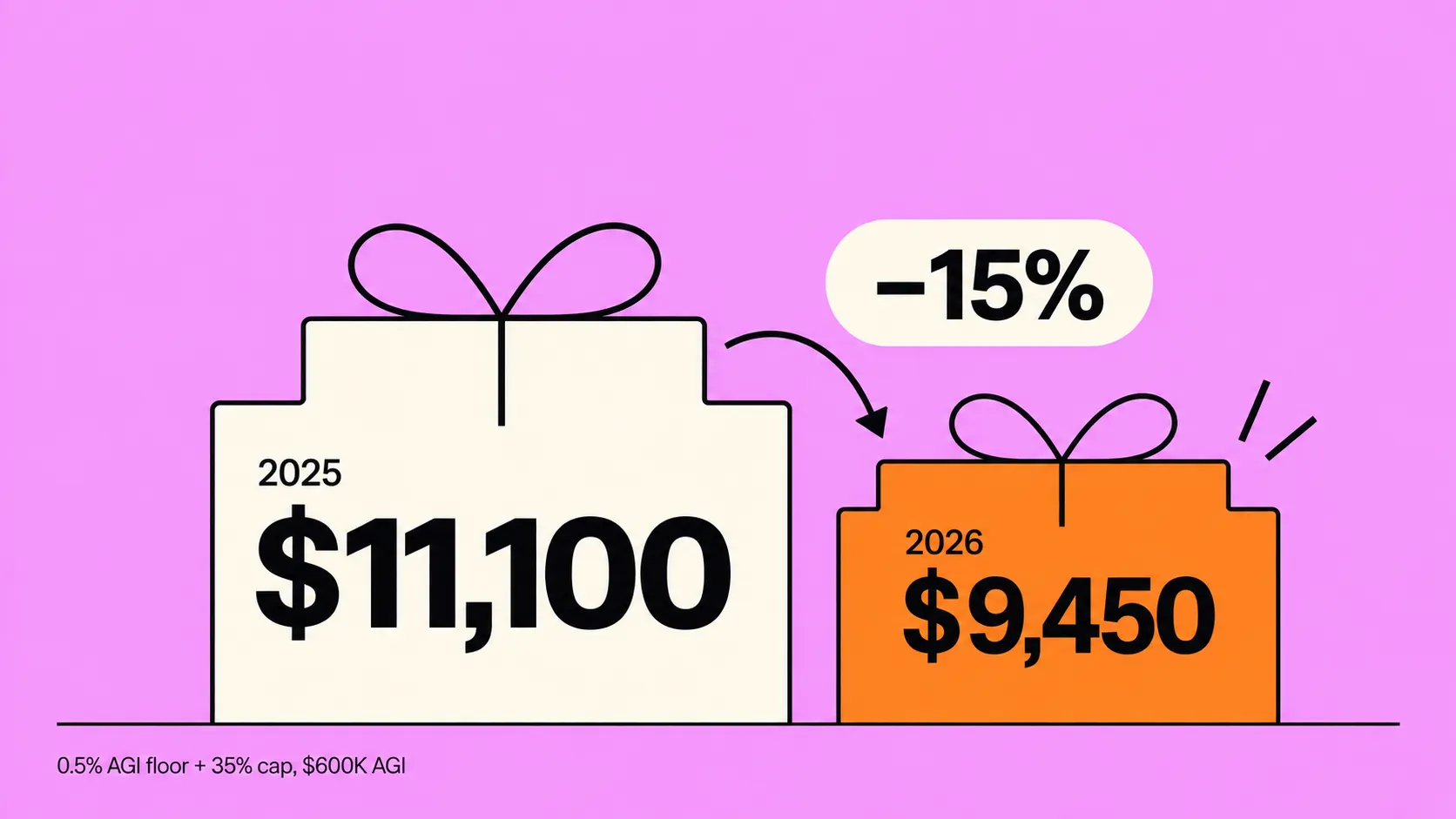
Under the 2025 rules: $30,000 deduction at 37% equals $11,100 of federal benefit.
Under the 2026 rules: the $3,000 floor reduces the deduction to $27,000. At 35 cents on the dollar, that is $9,450.
The gift is identical. The benefit dropped by $1,650, about 15%.
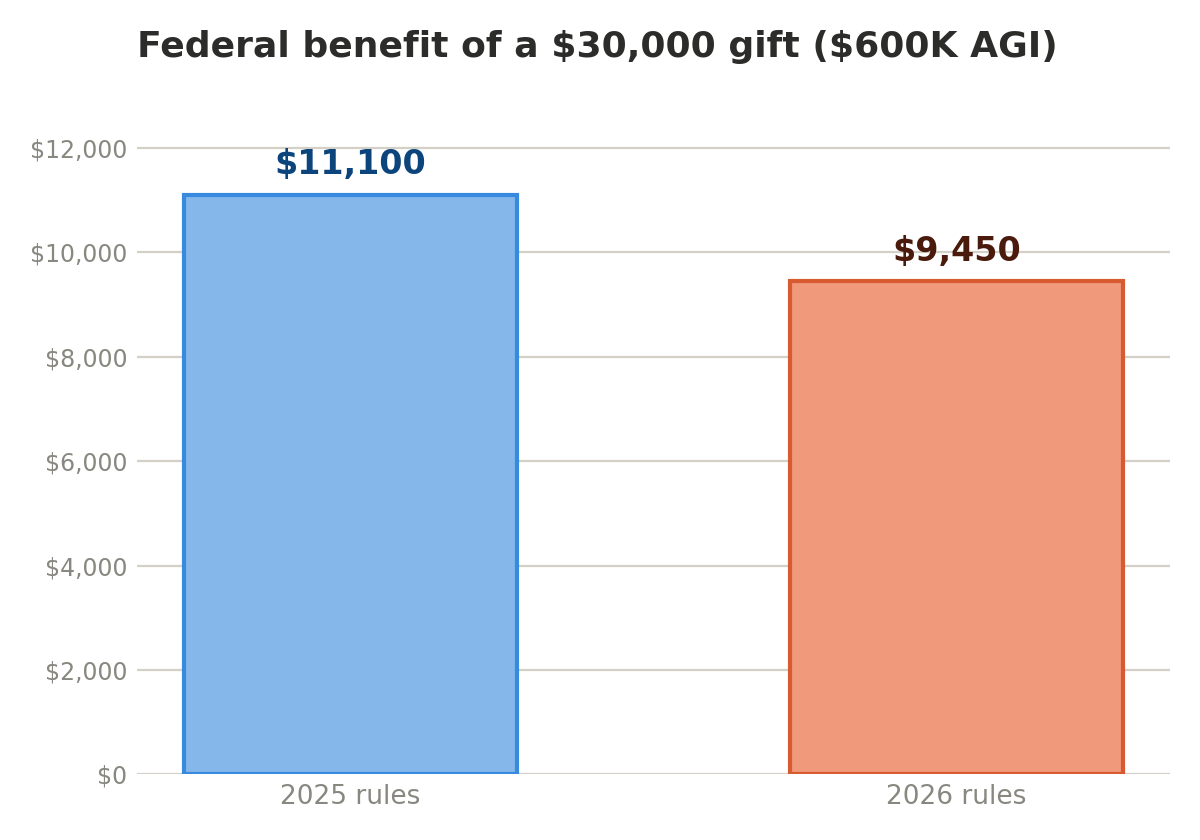
Do that for ten years and you have given up roughly $16,500 in deduction value without changing a single thing about your generosity.
The Part That Actually Matters
Here is where most of the commentary stopped, and where the useful part begins.
The floor is charged per year, against the aggregate of what you gave that year. It is not charged per gift and it is not charged per organization.
Which means the floor punishes people who give the same modest amount every year, and it barely touches people who give a large amount in one year and nothing in the next four.
This is the bunching argument, and it was already a good argument before 2026. The new rules made it a better one.
Same household, same $150,000 of total giving over five years.
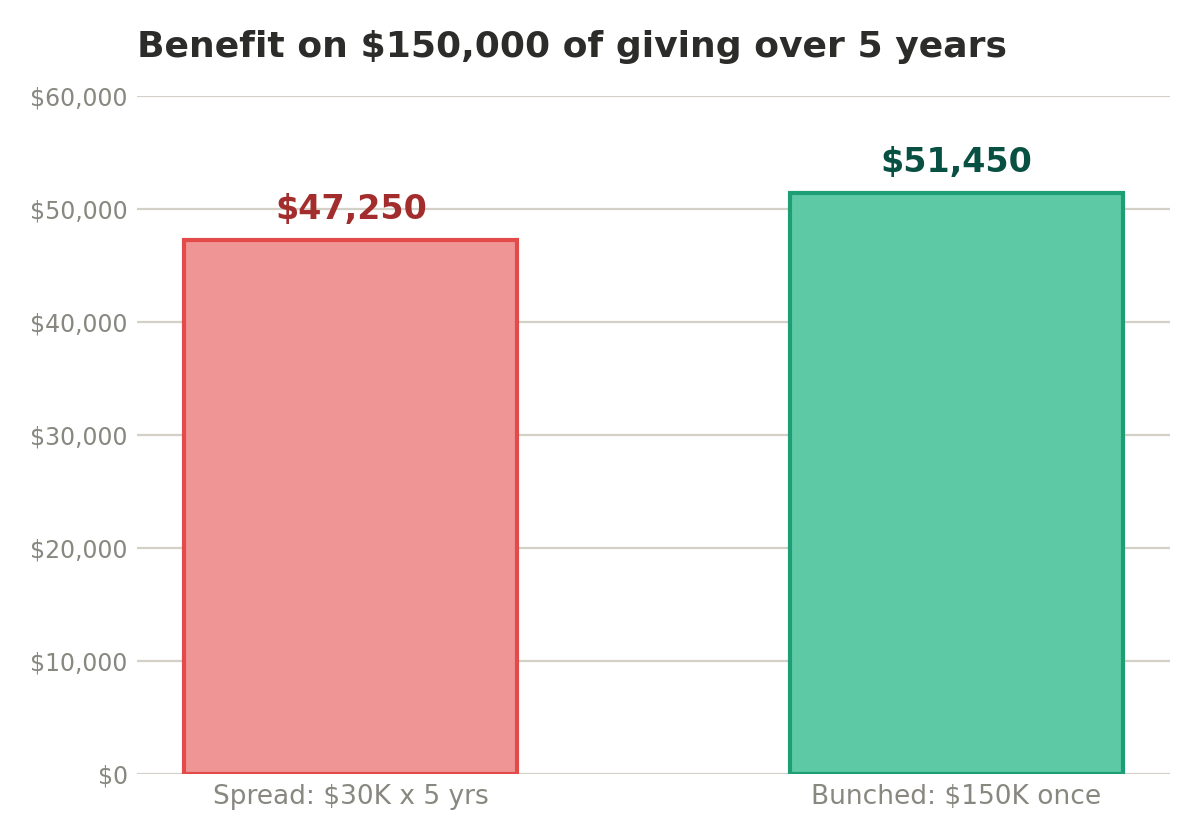
Spread evenly, $30,000 a year: the floor costs $3,000 a year, five times, so $15,000 of deduction disappears. You deduct $135,000. At 35 cents, that is $47,250 of benefit.
Bunched into one year: you give $150,000 in a single year and nothing for the next four. The floor applies once, costing $3,000. You deduct $147,000. At 35 cents, that is $51,450.
Same generosity, same charities, $4,200 more in your pocket.
And that ignores the bigger effect, which is the standard deduction. For 2026 it is $32,200 for joint filers. A household giving $30,000 a year may not clear that hurdle at all once you account for the SALT cap, meaning the charitable deduction does nothing in four out of five years. Bunch it, and the one big year clears the standard deduction by a mile while the other four years take the standard deduction anyway.
Run that version and the gap is not $4,200. It is closer to $40,000.
Where the Money Sits in Between
The obvious objection is that charities need funding every year, and most people do not want to hand an organization five years of budget and then disappear.
This is exactly what a donor-advised fund solves, and it is the whole reason the structure exists.
You contribute to the fund in one year and take the deduction that year. The money is irrevocably committed to charity at that moment. But the grants to the actual organizations go out on whatever schedule you want: $30,000 a year for five years, or more in a year an organization needs it, or a different mix entirely as your priorities change.
The deduction and the giving get separated. That separation is the product.
There is one thing to be aware of. The new above-the-line deduction for non-itemizers, $1,000 for single filers and $2,000 for joint, does not apply to contributions made to a donor-advised fund. If you are not itemizing, a DAF is not the vehicle for that particular deduction.
What I Would Actually Do
These are options with trade-offs, not a checklist.
1. Find out whether you are itemizing at all. A surprising number of people making $400,000 a year are taking the standard deduction and do not know it. If you are, your annual charitable giving is currently producing zero federal benefit and bunching is not a marginal improvement, it is the difference between zero and something. Trade-off: none. This is one line on last year's return.
2. If you are going to bunch, bunch into your highest-income year, not a random one. The deduction is worth the most in the year your marginal rate is highest. If you have a large equity event, a business sale, or a bonus year coming, that is the year to fund several years of giving. Trade-off: you are committing money to charity earlier than you otherwise would, and once it is in, it is not coming back.
3. Fund the DAF with appreciated stock rather than cash, if you have any. This is a separate and larger benefit that most people leave on the table, and it deserves its own conversation. Trade-off: the AGI ceiling for appreciated property is 30% rather than the 60% that applies to cash, so a very large gift may hit a different limit.
4. Check your carryforwards before you assume the floor applies to them. Contribution carryovers generated before January 1, 2026 are not subject to the 0.5% floor when you use them in later years. If you have carryforward from a big 2024 or 2025 gift, that is grandfathered, and using it in the right order matters.
The Bottom Line
The 2026 changes did not make charitable giving a bad idea. They made the way most people do it a worse idea.
Giving the same amount every year, in cash, without checking whether you itemize, is now the single least efficient way to be generous. It was already inefficient. The floor just put a number on it.
The fix is not to give less. It is to give the same amount on a different schedule, out of a different account, funded with a different asset.
If you give meaningfully every year and nobody has looked at whether the timing is working for you, we are happy to run your actual numbers and show you what the difference looks like.
This content is for educational purposes and does not constitute personalized financial or tax advice. Tax rules change and individual circumstances vary. All examples are hypothetical and illustrative. Alphanso LLC is a registered investment adviser.

Plan with an expert
What to expect


.png)
.jpg)
.png)
.png)