The 180-Day Gap: Why Pre-IPO Employees Can Owe $300K in Tax on Shares They Cannot Sell

There is a version of an IPO that nobody puts in the recruiting deck. Your shares settle, the income hits your W-2, and the tax is calculated on a price you had no say in. Then a lock-up keeps you from selling for the next three to six months, and by the time you can sell, the price may look nothing like the one you were taxed on.
That gap between when the tax is set and when you can actually raise the cash is the single most expensive thing most first-time liquidity-event employees have never heard of.
It is on my mind because the pipeline is real. Anthropic is reported to have confidentially filed with the SEC in June and to be targeting a Nasdaq listing this fall. None of that is confirmed by the company, and timing could move. But if you work anywhere near a filing, the planning window is open now, and most of it closes before the stock ever trades.
What Is Actually Happening
Most late-stage private companies grant double-trigger RSUs. Double-trigger means two things have to happen before you own anything: you have to hit your time-based vesting, and the company has to have a liquidity event, usually an IPO or acquisition. Hit both and the shares settle, and the full value becomes ordinary income on your W-2 that year.
Here is the part that catches people. The income is measured at the settlement price. Not the price when you sell. Not the price at the end of the lock-up. The IRS locks in a number on a day you did not choose.
Let us walk through it. Say you are a senior engineer at a late-stage AI lab with 40,000 double-trigger RSUs, and the stock settles at $50 per share. That is $2,000,000 of ordinary income landing in a single tax year, on top of your salary.
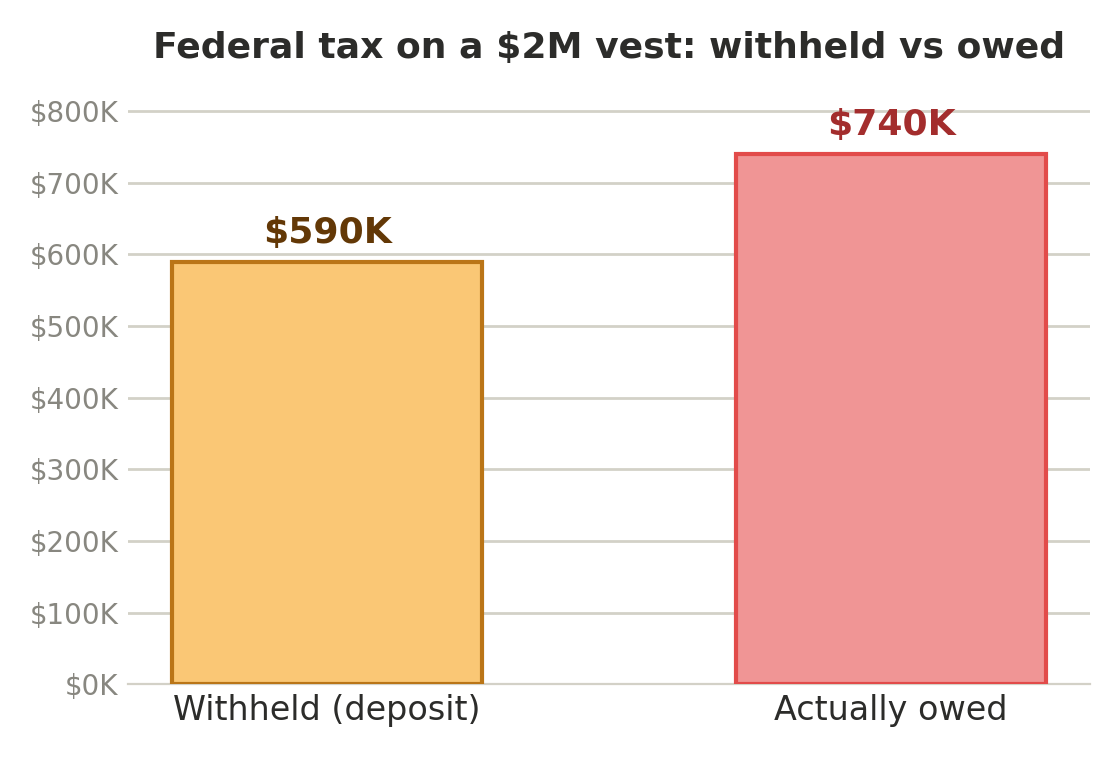
Your employer withholds at the federal supplemental wage rate. That rate is 22% on the first $1,000,000 of supplemental wages in a calendar year, and 37% on every dollar above it. So the withholding would be roughly $220,000 on the first million and $370,000 on the second, or about $590,000 total. That is an effective 29.5%.
Your actual federal liability on that income, at the top marginal rate of 37%, is closer to $740,000.
The shortfall is roughly $150,000, and that is before state tax. In California, at the top rate, you could be looking at another $200,000 or more that nobody withheld against at all.
Now add the lock-up. Those shares are restricted for what is typically 90 to 180 days after the listing. Suppose the price falls 40% over that window, which is not a pessimistic assumption for a newly public company. The stock you were taxed on at $2,000,000 is worth $1,200,000 by the time you can sell it.
You still owe tax on $2,000,000.
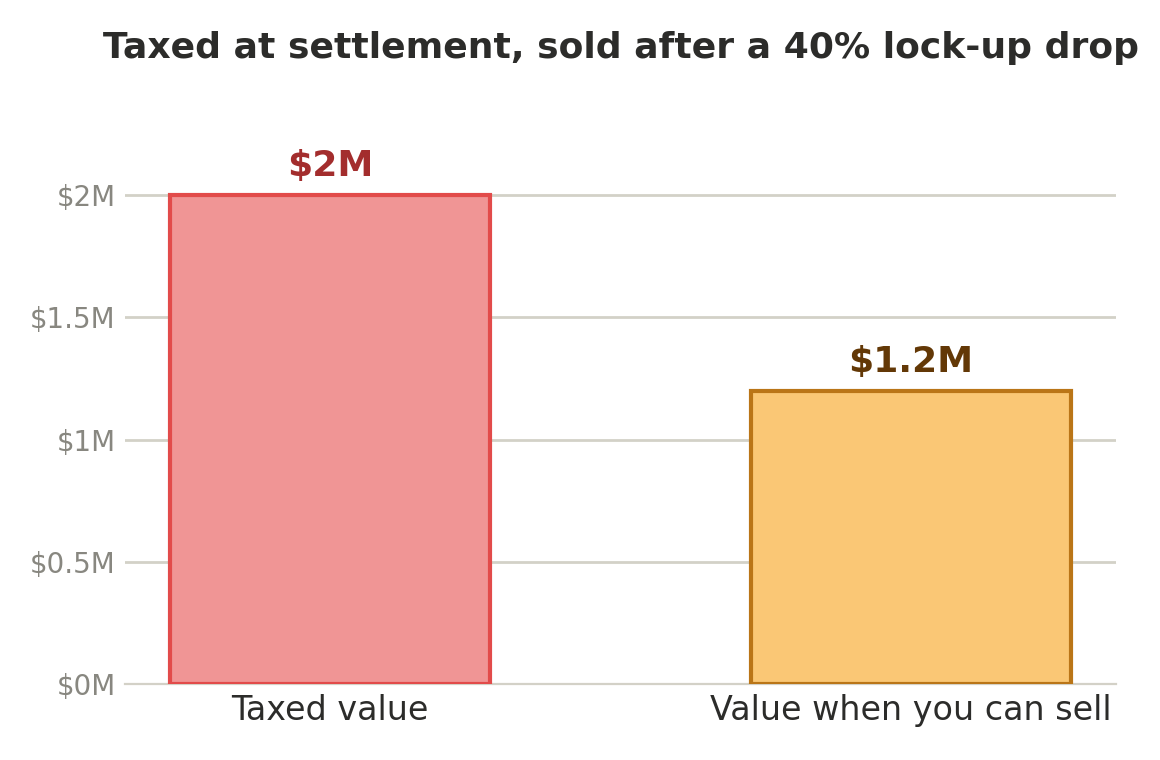
The $800,000 decline is a capital loss. It offsets capital gains, and beyond that it offsets only $3,000 of ordinary income per year. It does not undo the income event. Used against ordinary income alone, absorbing a loss that size would take over two centuries.
That is the trap. Not that the tax is high. That the tax is fixed on a value you may never actually receive.
Why This Catches Smart People
People miss this for three reasons, and none of them are about intelligence.
The first is that RSU education is written for public-company employees. Nearly everything you will read about RSUs assumes single-trigger grants that vest and settle on a schedule, in a stock you can sell the same afternoon. That advice is correct and completely inapplicable to a pre-IPO grant.
The second is that the withholding looks reassuring. Seeing $590,000 withheld feels like the tax got handled. It did not. Withholding is a deposit, not a settlement, and on a large equity event it is routinely six figures short.
The third is that the IPO reads as an ending. It is framed internally as the finish line. Financially, it is the start of the most consequential eighteen months of your tax life. The decisions that reduce this bill almost all have to be made before the stock trades, and a filing quiet period can make some harder to execute.
One more thing: if you hold incentive stock options rather than RSUs, you have a separate problem. Exercising ISOs creates no regular taxable income, but the bargain element, meaning the spread between your strike price and the fair market value on the day you exercise, counts as income for the alternative minimum tax. You can owe real cash on paper gains from stock you have not sold.
The AMT math tightened this year. For 2026 the exemption is $140,200 for married filing jointly and $90,100 for single filers, but the exemption now begins phasing out at $1,000,000 of AMT income for joint filers and $500,000 for single filers, and it phases out at 50 cents on the dollar rather than the 25 cents that applied through 2025. For a joint filer, the exemption is gone entirely at about $1,280,400 of AMT income. AMT rates are 26% and 28%. The practical effect is that a large ISO exercise pushes more people into AMT than it would have last year.
What You Can Do About It
These are options with trade-offs, not a checklist. Which ones matter depends on your grant type, your state, and how concentrated you are.
- Read your actual grant agreement and find the settlement trigger. Before anything else, establish which of your grants are double-trigger, and when settlement actually occurs under your plan. Some plans settle at the IPO. Some settle at lock-up expiry. Some stagger it. This single fact changes every number that follows, and it is written down in a document you already have. Trade-off: none. This is just work most people never do.
- Estimate the shortfall and decide where the cash comes from. Once you know the likely settlement value, you can size the gap between what gets withheld and what you will owe. You can close it by increasing withholding elsewhere, by making a quarterly estimated payment, or simply by reserving cash. Federal safe harbor rules matter here: pay in at least 110% of last year's total tax if your adjusted gross income was above $150,000, or 90% of this year's, and you avoid underpayment penalties even if you still owe a large balance in April. Trade-off: money set aside for taxes is money not invested, and on a six figure reserve that is a real cost.
- If you hold ISOs, model the AMT crossover before you exercise anything. There is usually an annual exercise amount that keeps you just under the point where AMT bites. Staging exercises across tax years instead of exercising all at once can materially reduce the total bill. We have modeled this for pre-IPO clients where staging projected around $42,000 in AMT savings versus a single-year exercise. Trade-off: staging means more time holding an illiquid position, and the price can move against you.
- Decide your post-lock-up selling schedule before the window opens, not during it. This is where a 10b5-1 plan comes in. It is a pre-committed trading plan that has to be adopted when you do not hold material nonpublic information, which for most employees means well before the lock-up expires. Deciding in advance to sell a fixed percentage on a fixed cadence is how you avoid making a seven figure decision in the middle of a price swing. Trade-off: a pre-set schedule gives up upside if the stock runs, and that is genuinely hard to sit with. The question is not which outcome you would prefer in hindsight. It is how much of your net worth you are willing to leave riding on one ticker.
For a lot of early employees, a single pre-IPO position is 70% or more of net worth. No advisor would build that portfolio on purpose. It happens by accident, through vesting, to people who are otherwise careful about money.
The Bottom Line
Your tax bill is set on the settlement price. Your ability to sell is set by the lock-up. Those are two different dates, and the distance between them is where the damage happens.
The IPO is not the finish line. It is the start of the hardest tax year of your career, and nearly every move that makes it cheaper has to be made before the stock starts trading.
If your company is anywhere near a filing and you want to know what your specific grants would actually cost you, we are happy to dig into your situation and model it with you.
This content is for educational purposes and does not constitute personalized financial or tax advice. Tax rules change and individual circumstances vary. All examples are hypothetical and illustrative. References to reported IPO plans are drawn from public news reporting and are not confirmed by the companies mentioned.

Plan with an expert
What to expect


.png)
.jpg)
.png)
.png)